

Is the 'racism' trap in Germany actually a cover for an authoritarian state? Green MP explains to 12punto
Cemal Bozoğlu, a Green Party member of the Bavarian State Parliament, argues that evaluating the rise of the far-right AfD in Germany solely through the lens of racism and anti-immigrant sentiment is insufficient. He points out that the capital and international connections behind the party carry the risk of pushing Germany toward a more authoritarian state model. In his statements to 12punto's Işın Ertürk, Bozoğlu detailed the AfD's relationships with new right-wing circles in Russia and the US, its funding sources, and the threats posed to the future of immigrants.



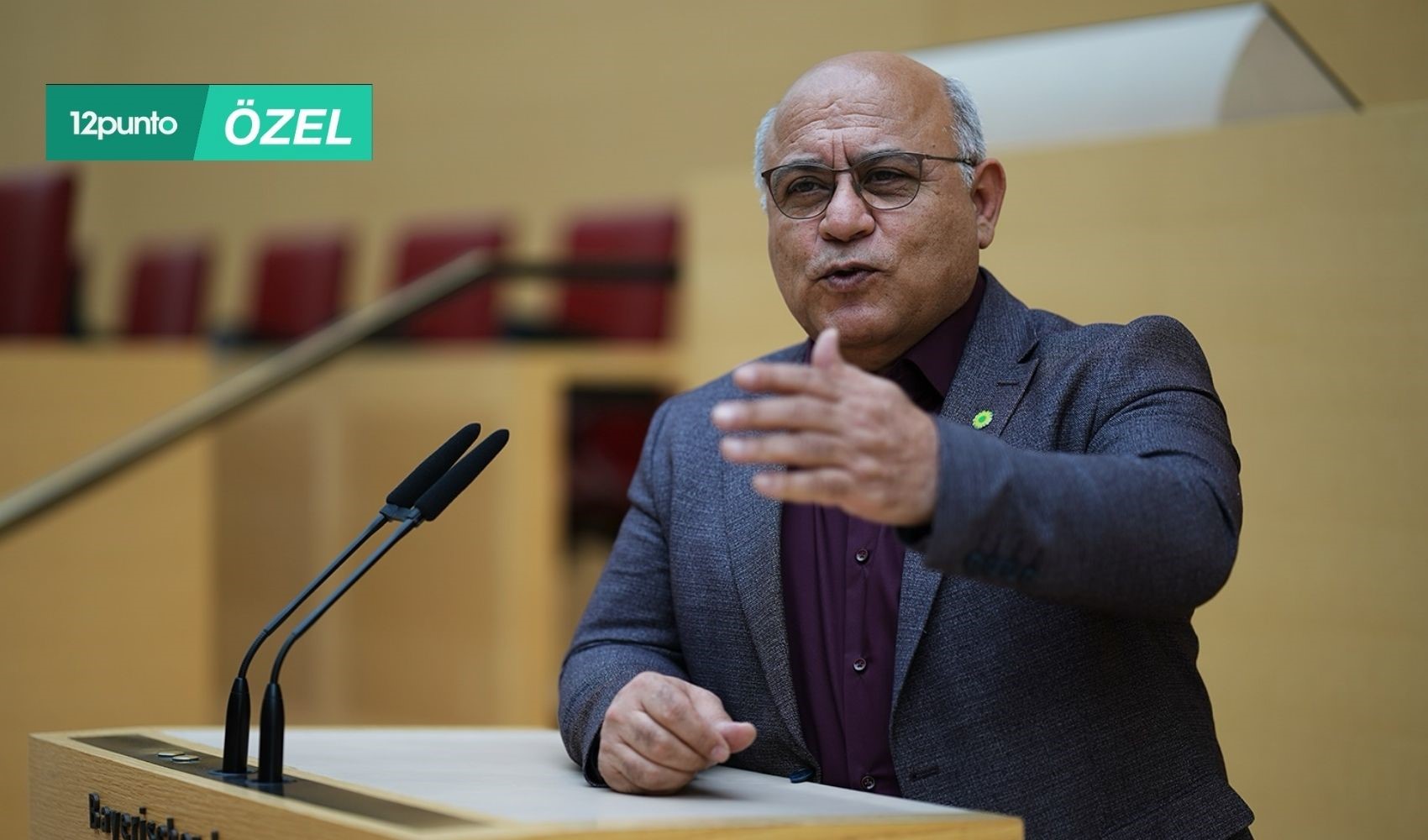
Cemal Bozoğlu, a member of the Alliance 90/The Greens in the Bavarian State Parliament who has spent years pursuing the file on the National Socialist Underground (NSU) cell—which murdered 10 people, including 8 Turks, in racist terrorist attacks—is now tracking the money and ideology networks surrounding the right-wing populist “Alternative for Germany” (AfD) party.
Bozoğlu, who brought the chain of relationships extending from the Ludwig von Mises Institute Germany and Degussa Goldhandel to the billionaire August von Finck circle and the AfD to the Bavarian State Parliament, is awaiting answers to 21 questions from the state government.
According to the Green politician, the issue at hand goes beyond debates on racism; it is much larger. The AfD's international connections and financial circles point to serious questions about whether Germany is being steered toward a more authoritarian state model.
On one side is Russia. On the other is the US. In between is the AfD.
Billionaires, gold trading, international capital, political donations, think tanks, and ideological circles that advocate for fundamentally changing the current structure of the state.
The trails Cemal Bozoğlu is following do not lead to the well-known addresses of the far-right. He also puts forward the view that framing the AfD debate in Germany solely around anti-immigrant sentiment and racism prevents us from seeing the real picture.
When one looks at who the AfD—now the leading party in Germany—is associating with, which international circles it receives support from, its funding sources, and the ideological structures surrounding it, a much larger question emerges: Is the AfD, whose rise to power is deeply feared, part of an international political transformation in the service of “foreign powers” that will move Germany toward an increasingly controlling and authoritarian state model?
THE POLITICIAN WHO RE-ESTABLISHED THE NSU RACIST TERROR CELL INVESTIGATION COMMITTEE
The politician raising this question did not start looking at the far-right file today. Cemal Bozoğlu was among the leading figures in the initiative to establish the NSU Investigation Committee in the Bavarian State Parliament for the second time. Subsequently, as a member of the committee, he scrutinized the NSU murders, the far-right networks around the organization, potential supporters, informants, and the role of security institutions in the investigations. The committee's mandate also included investigating potential links to contemporary far-right and far-right terrorist structures.
At the time, Bozoğlu made a very harsh assessment regarding the shortcomings in the investigations, stating that as the research deepened, new investigative weaknesses emerged. Now, he has another file in front of him with other names.
PRIVATIZATION OF THE ARMY AND POLICE, QUESTIONING THE RIGHT TO VOTE...
The ideas discussed in the Mises Institute circle are not just ordinary economic disagreements. Radical ideas such as moving beyond the current form of the state, questioning universal suffrage, and privatizing the army and police are being brought to the agenda. The contacts between the AfD and these circles are now also visible.
The money trails go back years.
Investigations conducted years ago by Süddeutsche Zeitung, WDR, and NDR reached the inner circle of billionaire August von Finck while researching the financial structure behind multi-million euro campaigns in favor of the AfD. It was not proven that Finck directly financed the AfD. However, the connections and unanswered questions were there.
AfD: A NEW PROJECT OF FOREIGN POWERS?
For this reason, Bozoğlu directed 21 questions to the Bavarian government:
Where does the money come from?
What was Finck's role?
How far do the relations with the AfD go?
What does the state know about these structures?
Why haven't security authorities taken action until now?
There is another development that increases the weight of the questions. The AfD's international relations are no longer discussed only within Germany. Contacts with Russia stand on one side, and relationships established with the new right in the US and political actors around Donald Trump stand on the other.
Bozoğlu's reading of the “racist” discourse—which is constantly served to us and thus turns our heads away from the real issue—is precisely where he differs. According to the Green politician, the critical point is actually beyond the right-left or German-foreigner opposition. The issue is in which direction the democratic state is being transformed.
THE US “ICE MODEL”: HE HAD WARNED GERMANY ABOUT ADAPTING IT TO THE COUNTRY
His warning in January regarding ICE (US Immigration and Customs Enforcement) also gains a different meaning today. Stating that the AfD's demand for a special deportation unit inspired by the US model should not be read as an ordinary hardening of migration policy, Bozoğlu evaluates the issue more as a sign of the expansion of the state's control over individuals.
Bozoğlu, who investigated the NSU for years, is now back on the trail of the same fundamental questions: Who is connected to whom? Where does the money come from? What ideology is being carried? What does the state know? And perhaps most importantly, what kind of state is Germany turning into before our eyes?
We spoke with Cemal Bozoğlu about the money networks behind and around the AfD, its Russia and US connections, the Mises Institute, Degussa, the ICE model, and the danger of an authoritarian state.
- It is known that there are individuals and groups within the Alternative for Germany (AfD) party who have contacts with ethnic nationalist (völkisch-nationalistisch), far-right, and even racist circles. However, is it sufficient to define the entire AfD solely as a “racist party” based on this to explain the political phenomenon we are facing today? The AfD is not a homogeneous party, nor is its electorate. In addition to fascistic, economically liberal, and center-right conservative segments, there are also groups within the party that advocate for a more statist line in social policy. We also see support for the AfD among voters of immigrant origin.
In your opinion, does explaining the AfD solely with the “racist” label turn into a form of laziness that avoids questioning why the party can receive votes from such different social segments? Especially when you look at it in terms of the welfare state, migration, and the “Germans first” discourse, could welfare chauvinism be a more inclusive concept to explain the AfD's success? How do you define the AfD?
CEMAL BOZOĞLU: When the AfD party was founded, its central political line aimed at neo-liberal economic policies to the right of the Christian Democrats, and its cornerstones were criticisms of the transition to the euro and the financial structure of the European Union. Anti-immigrant tendencies later gave the AfD a racist dynamic with the addition of anti-immigrant books led by Berlin Finance Senator Thilo Sarrazin, and the PEGIDA and “Monday demonstrations” that started in Dresden and spread to many cities in Germany. This dynamic caused the AfD to shift further to the right and become radicalized with every change of party chairman (Prof. Bernd Lucke, Frauke Petry, and Jörg Meuthen). It paved the way for radical right-wing tendencies to dominate the party program and management much more effectively.
Today, the traditional national-socialist tendency manages the party together by creating a ground for joint action with populist radical tendencies. Their goals are moving forward with big steps toward establishing a state system where a more militarist, authoritarian, single-ethnicity-based “neoliberal” economic system is dominant. Although their paths and methods are different, the goal is to establish an NSDAP 2.0 regime.
- While the rise of the AfD is being discussed, are the center-right and center-left facing their own responsibilities enough? People in Germany are struggling with rising prices and rents, feeling that their purchasing power is falling, and are worried about energy costs, their social security, and their future. By not sufficiently owning the people's concerns about livelihood, rent, energy, social security, and the future, didn't center politics leave this space to the AfD itself? From your party's perspective, what are the points where you say, “We made a mistake here too” in the rise of the AfD? What lessons should be learned from these results?
CEMAL BOZOĞLU: Thinking that the public chooses the AfD because of their concerns about social issues and war means both not knowing society and falling into the fallacy of thinking that society takes a political stance according to our own subjective thoughts. The AfD definitely does not want the expansion and protection of the public's social rights. In fact, it wants the exact opposite. What do I mean? For example, the AfD votes against raising the minimum wage. It is against the state investing in the housing market. What does the AfD want? It is entirely in favor of capitalist market dominance. It misdirects by using ethnic differences among the people. It says, “If immigrants are sent away, the housing problem will be solved, our financial difficulties will disappear, and unemployment will vanish.” Do these discourses really solve the problems? No, they don't. Because the reason for the emergence of the problems is not the presence of immigrants. The state's withdrawal from social housing construction and leaving this area to speculators for 30 years is the root cause of the problem. On the other hand, the increase in migration to cities while the population decreases in rural areas is the most important factor. While these problems need to be solved, immigrants are made the scapegoats. The goal here is not to eat grapes, but to beat the vineyard owner. In other words, they are trying to pull the majority to their side by targeting minority groups. If it were as you said in your question, these voters should have chosen the Left Party. But this is not the case, and AfD voters fall into this propaganda trap and turn to a political preference that is contrary to their own interests. We cannot call everyone who advocates for AfD party policies a fascist, but it is certain that they are racist.
Why do those who voted for parties like the CSU/CDU and SPD in the past vote for the AfD today? The world has entered a new phase with the end of the bipolar era. The uncertainties created by the slowly shaping multipolar world result in new conflicts and the re-sharing of the world. New sharing wars and the climate crisis lead to migration, and rising energy prices make living conditions difficult. This situation leads to future anxieties and new political searches in people. Authoritarian, security-oriented tendencies and racist tendencies are strengthening. This political space provides an opportunity for radical racist parties to become mass movements. Why do democratic parties have difficulty filling this void or why can't they manage it? These are the crucial questions that need to be answered, and democratic parties that cannot answer these questions lose elections. Finding answers to these important questions will allow us to take an important step in preventing the rise of the AfD.
- While defense spending is increasing rapidly in Germany, there are serious concerns in a part of society regarding war and armament policies. Especially in East Germany, it is seen that the objection to sending weapons to Ukraine is stronger. Parents are worried about the possibility of their children facing a war in the future, and young people are worried about their own futures.
The AfD positions itself as a “peace party” at exactly this point. Could the AfD have opened up a significant political space for itself because center politics did not take the concerns about war, armament, and the future in society seriously enough?
CEMAL BOZOĞLU: The AfD is definitely not a peace party; on the contrary, it is a party that targets a militarist, authoritarian, single-ethnicity-based state system. Its foreign policy follows a pro-Putin and pro-Trump line. This is not in the economic and political interests of either Europe or Germany. On the contrary, it pursues a policy of sabotaging everything that made Germany strong after the Second World War. It aims to transform Germany, which has been governed by democracy for 80 years, is in good relations with the peoples of the world, and forms the backbone of the European Union, into a different republic. The AfD coming to power aims to turn it into a country that has withdrawn within its own borders and is trapped within national borders determined by Trump or Putin. This means that a country that is the third-largest economic power in the world loses this power and its own people become impoverished.
- Doesn't a contradiction arise here in the AfD's own discourse? While the party opposes arms aid to Ukraine and increasing defense spending, Saxony-Anhalt AfD leader Ulrich Siegmund announced that they are not in principle against the Israeli defense company Elbit Systems producing in the state and argued that military production is necessary for Germany's security. Looking at this development, we also see that the AfD is not really a party against war and armament. How should you explain the AfD, which turns the anti-war reaction in society into political gain, to the public?
CEMAL BOZOĞLU: Yes, Saxony-Anhalt AfD prime ministerial candidate Ulrich Siegmund showed his true face with his statement. What did he say? “We need to continue arms production. Because we will need these weapons when we send immigrants home.” The AfD has never been a peace party and does not want to be. Currently, it is tactically opposing the policy of tension to get along well with Putin and Trump. However, a significant segment within the AfD expresses civil war fantasies. They are inclined to arm themselves against immigrants and their own political rivals. Showing a political party that is open to violence against its own people and citizens as a peace project is just political tactical propaganda. What the AfD opposes is an army structure that is committed to democratic institutions and the rule of law, focuses on national defense, upholds the constitution, and is not racist.
- On one hand, the AfD is at the center of serious debates in Germany due to its relations with Russia, and on the other, it receives open political support from US President Donald Trump and MAGA circles. Since the interests of Moscow and Washington are not the same, how do you evaluate this closeness to the AfD from both sides?
How true is it to say that the AfD, which appears before the voter with the claim of “Germany's interests” and sovereignty, follows an independent “Germany First” policy? How do you explain the warnings that Germany is turning into a political space where the interests of different foreign powers intersect?
And finally, in Germany, where millions of people of Turkish origin and approximately 5.5 million Muslims live, what does the AfD's strengthening to this extent mean for the country's internal balances, social cohesion, and the future of people of immigrant origin?
CEMAL BOZOĞLU: The AfD is supported financially and institutionally by certain neo-liberal capital circles within Germany. This also has international ties. The MAGA movement is one of these connections. I submitted a 21-question motion in Parliament regarding these relations. Russia, on the other hand, is trying to sabotage the European Union's strengthening in economic, political, and military terms. There is periodic cooperation here. If they succeed in these goals, the resulting structures or political centers will create the conditions to trigger new conflicts. New instances of the inhumane racist atrocities that we thought were buried in history will be inevitable. This results in humanity and our world facing extinction. Stopping this trend is a necessity. It is necessary to move to a system where international balances are protected, around principles that are re-agreed upon. It is essential that there is no place for racism in the new world.
In the last German general elections, many immigrants, including Turks, voted for the AfD. Immigrants who are deceived by the AfD's populist policies will pay the price for this wrong political choice dearly. Because the AfD aims to create a two-class society: those who are German and those who are not. They want this two-class lifestyle to be visible in every area of social life. The first article of the German Constitution says, “Human dignity is inviolable.” The AfD says that those who are not German have no dignity and everything about them should be violated. To prevent our dignity from being violated, we have no choice but to fight shoulder to shoulder with the democracy forces of Germany with all our might.
ABOUT CEMAL BOZOĞLU
Born in Istanbul in 1961, Cemal Bozoğlu came to Germany to join his family after completing his high school education in Sivas and settled in Augsburg. Bozoğlu, who received vocational training in the field of “Communication Electronics,” later completed his state-approved electrotechnical studies with a focus on data processing. He managed the IT company he founded in 1994 until 2018, when he entered the Bavarian State Parliament.
Bozoğlu, who started political and social work at a young age, took part in the Metal Workers' Union (IG Metall) while working at Siemens between 1980 and 1985. He was among the founders of the Augsburg Foreigners' Council and served on its board for many years. He joined the Alliance 90/The Greens party in 1982. After serving on the Augsburg City Council for ten years, he was elected to the Bavarian State Parliament from the Greens in 2018.
Bozoğlu, the spokesperson for the Green Parliamentary Group's Strategies for Combating the Far-Right, is also a member of the Federal and European Affairs Committee. He is also a leading figure who brought the Bavarian State Parliament's II. NSU Investigation Committee, established to clarify the NSU racist terror cell murders, to life and served within the committee. Bozoğlu, who is also a member of various organizations such as the Alevi Community, Augsburg, Tür an Tür, ADFC, and the Federation for the Environment and Nature Conservation (Bund für Umwelt und Naturschutz), is married and a father of two.
IŞIN ERTÜRK - MUNICH
News Source: 12punto
Most Read
Increased rates for mandatory traffic insurance have begun
Footage of the moment Kenan Evren was sentenced has emerged
Message from Fenerbahçe players to İsmail Kartal
Unexpected crisis in Yeni Parti before the convention
Erdoğan: 'There is no situation where a villa will be allocated'...
Mehmet Şimşek makes statement on tax audits and high income
Plan for Scotland, Wales, and Northern Ireland to break away from the United Kingdom
The hours-long journey between the two provinces will drop to 2.5 hours
The problem is not Balbay’s words, but his identity
The dust on the horse's nose and the religion that puts to sleep