



Last week, we talked about Paganism in Europe and covered the Baltics, the last Pagans of Europe. This week, let us touch upon Shamanism, the Pagans of the East.
Shamanism is one of the oldest belief and practice systems in human history. At its core lies the figure of the “shaman,” who acts as an intermediary between nature and the spirit world. Rather than a single religion, it is actually a collection of beliefs that share similar rituals and worldviews across different cultures. So, what would it be like to participate in a real Shamanic initiation in Central Asia?
September 2014. Travel is Art/Central Asian Explorations. Notes from Tuva.
“On the mist-covered peaks of the Altai, as the drums of Tuvan shamans echo, time dissolves once again, and spirit and wind intertwine. We gather around the circle of fire in the blue of the night; every beat of the drum awakens the ancient echoes within us. The red dawn rises like a flame trembling in the shaman’s copper eyes; prayers cast into the sky cling to the wings of eagles and travel far away. In these lands, the mountain is not alone, the stone is not silent. Everything has a spirit, every sound has a story. In the deep valleys of Tuva, on this journey one takes into their own inner universe, I realize that ecstasy is not a destination; it is that subtle, sacred vibration where nature and human remember one another.” Notes from my 2014 “Shamanic Tuva” travel journal…
Anthropologist and archaeologist Marjorie Mandelstam Balzer, famous for her work on Shamanism, summarizes it in her book “Shamanism: Soviet Studies of Traditional Religion in Siberia and Central Asia” as: “a religion or culture, what do you believe in yourself.”
So, what do you believe in yourself? Let us explore it together…
VALLEY OF SPIRITS: LANDS WHERE ONE SPEAKS WITH THE UNSEEN
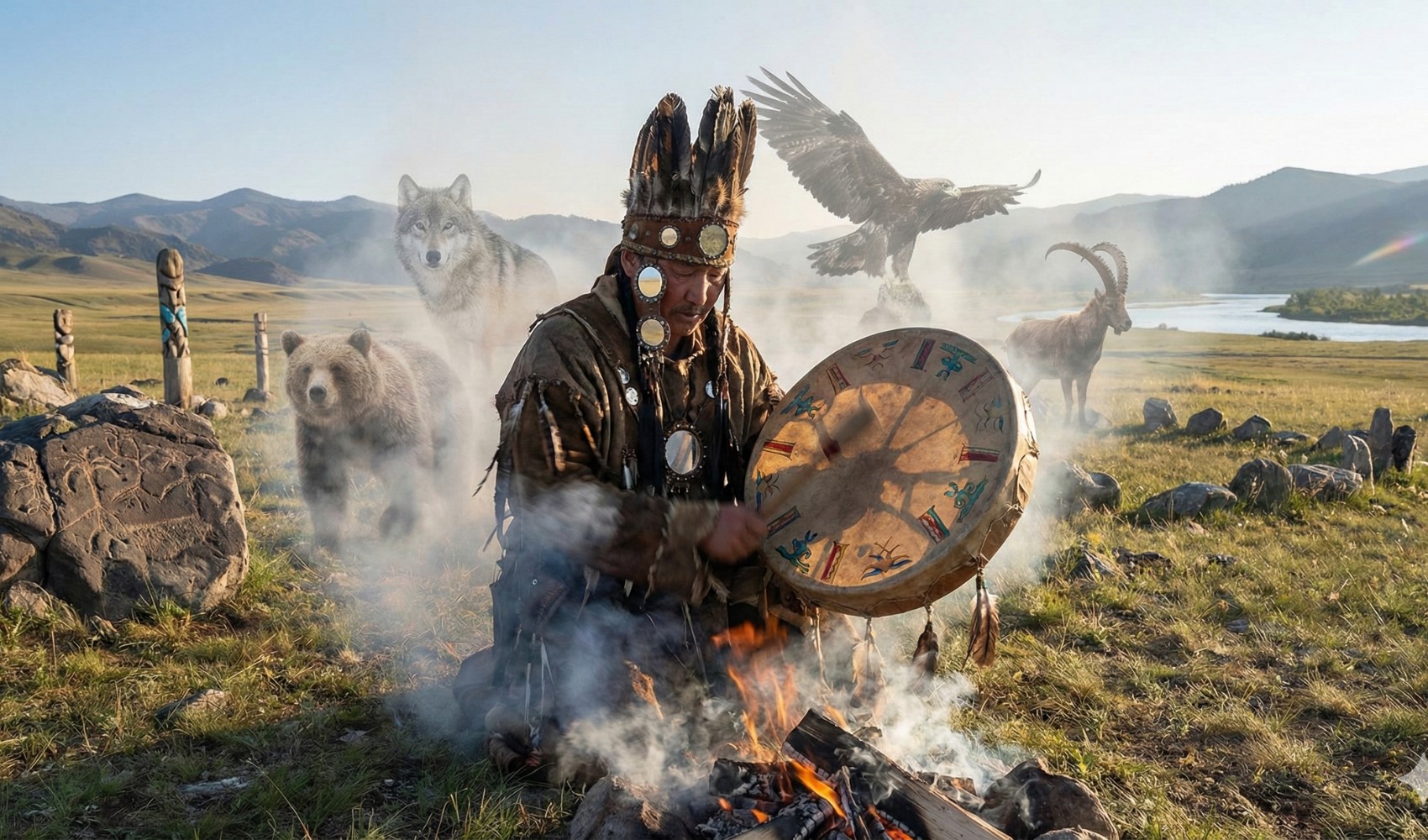
The sun is about to set in Tuva.. The tundra has turned a deep crimson. We are in Chindozyn, the desolate lands of Mount Khairykan, which Tuvan shamans visit once a year to enter a trance with the spirits. The preparations are complete. The fire is stoked with the dwarf shrubs of the tundra, and the shaman puts on his hat adorned with eagle feathers and ribbons. Everything begins with the first beat of the drum. Other rhythms that follow in harmony blend with the crow and cuckoo sounds made by the shaman. So much so that these magical birds guide his prayers. This is the first ritual in the depths of the Tuvan tundra. The first state of ecstasy between two worlds.. The first Shamanic journey…
A NIGHT AROUND THE KAM FIRE
Fire, smoke, and a state of trance… We are ready to witness the shamanic ritual. In the darkness of the night, the shaman plays his drum before the fire. Slowly.. He is conversing with the spirits. Every spark that flies from the fire seems to be an answer from the spirits to him.. Evil spirits are driven away. The shaman rises from his place to perform his final duty and scatters the milk, bread, and pieces of meat in his hand to the four directions.. The fire will continue to burn. Ancient secrets will be carried into the future by the flames. We are still around the fire in a state of trance. Flames carrying the wisdom that illuminates the night. And right beside this wisdom, we set up our tents.. To wake up to the next day with the shaman again and continue our journey in the world of Shamanic Tuva..
DOORS OPENED WITH KHOOMEI
You realize here that throat singing is not just music, but a tool for summoning spirits. Located in the heart of Siberia, at the intersection of Central Asia and the steppe culture, the Republic of Tuva welcomes you not only with its nature but also with its mystical sound that has echoed for centuries: Khoomei. This unique tradition of throat singing is an artistic expression of the ancient bond the Tuvan people have established with nature by imitating the wind, flowing rivers, and mountain spirits. In a world of belief where Shamanism and Central Asian Buddhism are intertwined, Khoomei is not just a genre of music; it is a tool for communication with spirits, meditation, and cosmic balance. While listening to this polyphonic technique, shaped by the rhythm of nomadic life on horseback, one feels outside of time, in the infinity of the steppe. A journey to Tuva, thanks to Khoomei, turns into discovering not just a geography, but an ancient civilizational memory where the human voice integrates with nature.
PROPHECY IN THE SHADOW OF SACRED MOUNTAINS
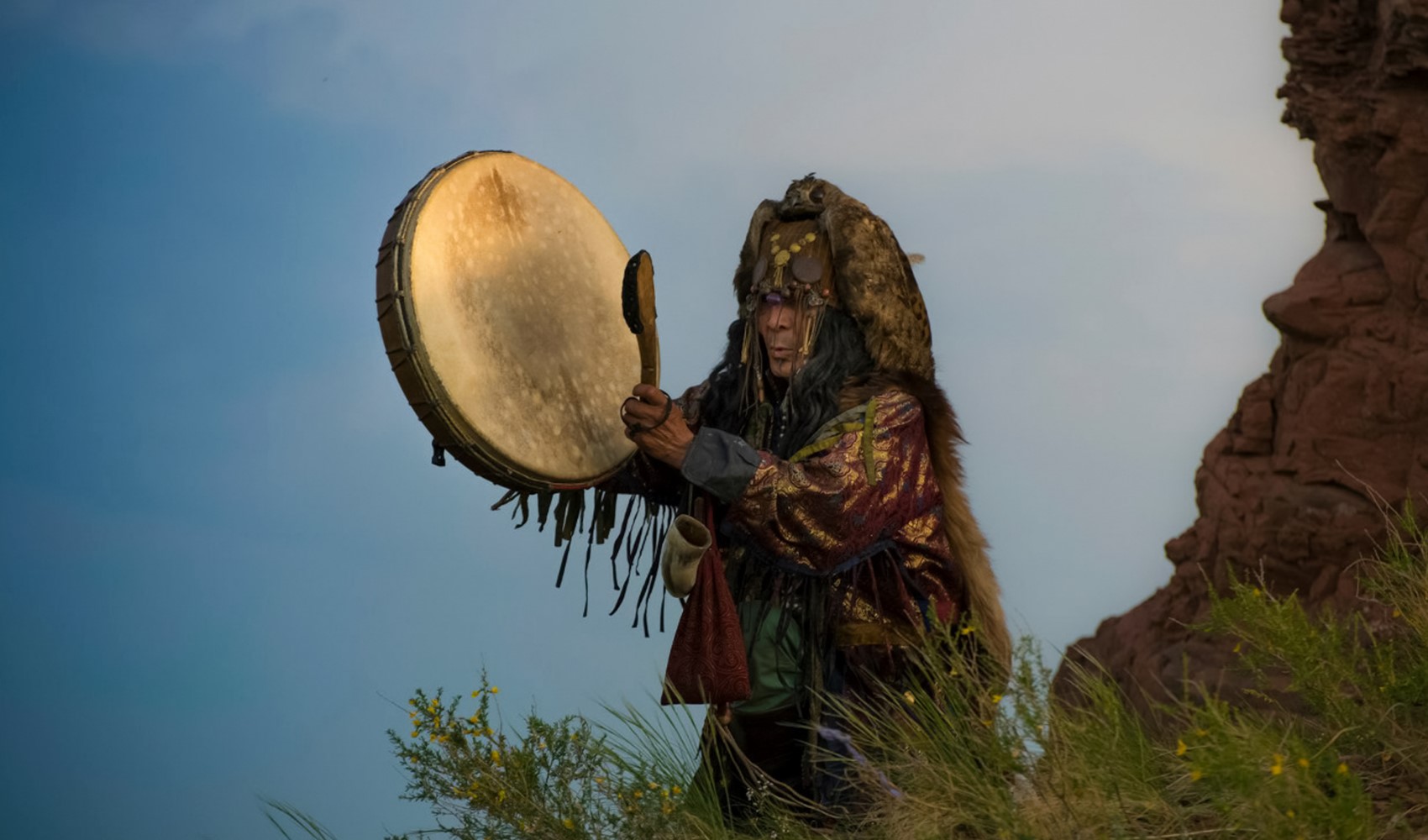
As we travel through the Tuvan steppes, we also listen to the ancient prophecies hidden in the silence of the stones, the memory of the bones, and the direction of the wind. For Tuvan shamans, nature is a book of prophecy. The arrangement of stones scattered on the plain points to the traveler’s destiny, the bones of game animals build a bridge between the past and the future, and the wind blowing through mountain passes whispers answers to questions. Today, watching these rituals as a traveler is not just an exotic experience; it is witnessing the deep relationship the nomadic culture has established with time. When the stories told by the fire are combined with the scent of the steppe and the sound of the wind, Tuva becomes a destination with a soul, discovered more through intuition than a map. A destination filled with ancient prophecies made by looking at stones, bones, and the wind…
ANIMAL SPIRITS HIDDEN IN THE SKIN OF THE DRUM
Behind every shaman drum lies a different totemic story. The shaman drum, echoing in the ancient lands of Siberia, especially in the Tuvan steppes, is not just an instrument; it is a carrier of animal spirits hidden in the stretched skin. These drums, made from deer, wolf, or eagle hide, are considered symbols of the spirits that guide the shaman on his journeys, and with every beat, the animal’s strength, intuition, and memory vibrate. For a traveler, witnessing this ritual is much more than an object seen in a museum: As the deep sound of the drum blends with the crackling of the fire, one feels that this ancient partnership established with nature is still alive. Listening to the shaman drum in Tuva is like embarking on a journey where you determine your route not by a map, but by rhythm and spirit…
WISDOM TAUGHT BY SILENCE
In the steppe, the moments where intuition speaks more than words will remain in the memory of this journey. At the end of a Shamanic journey, Tuva offers the traveler not just a distant geography, but a holistic culture where time, belief, and art are intertwined. Thousands of years of shamanic rituals, steppes bearing the traces of nomadic history, and the intuitive bond established with nature turn Tuva into a living cultural atlas. As ceremonies shaped by the rhythm of the drum and the meanings loaded onto stones and wind turn into art with the vibrating sound of throat singing, the visitor realizes that the past is still breathing. This journey is more like a silent but deep exploration of one’s origins than a classic travel experience; what remains when leaving Tuva is actually a state of mind that is felt rather than the landscapes that were seen.
Most Read

How the ISIS terrorist preparing for an attack in Istanbul was neutralized

Apple's foldable phone price tag to set a new record

YÖK launches investigation into 23 foundation higher education institutions

Two-day sale and collateral traffic in Gökçek family allegations

Another bankruptcy in the construction sector

Detention warrants for 31 lawyers, searches at 39 offices

Footage emerges of Berhan Şimşek allegedly assaulting his former partner

Journalist Oya Lale Arslan detained

Massive compensation claim against Acun Ilıcalı

New standard for fruit juices: Completely banned