What is a Republic?
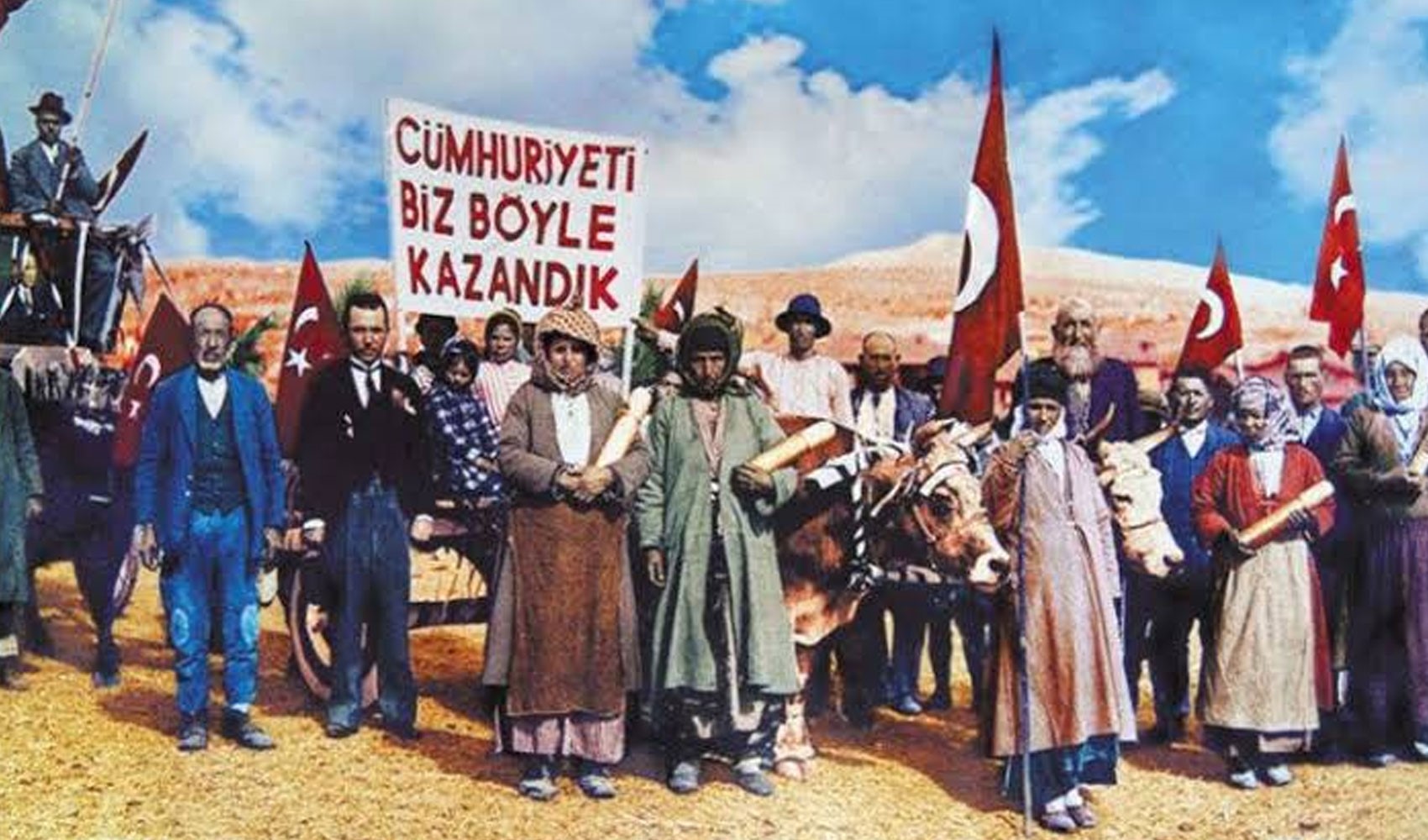
We mostly answer this question by saying, "It is the people governing themselves" or "It is a form of government where the people participate in administration." In Turkey, behind these answers lies a great history where the struggle for independence and the revolution of sovereignty are intertwined.
Our Republic was not established by simply changing the sign of the state following the collapse of an empire. It was established by taking sovereignty away from the dynasty and by abolishing the palace's privilege to rule.
The real reckoning was over who would govern the fate of the country and the nation: The palace or the nation?
The Turkish Revolution, led by Mustafa Kemal Atatürk, gave a definitive answer to this question: Sovereignty belongs unconditionally to the nation!
In this provision, there is no share left to a dynasty, no office reserved for a sultanate, and no will that can be held above the nation.
This is the revolutionary essence of the Republic.
While the palace in occupied Istanbul was looking for ways to maintain its existence, the nation's will for independence was being organized in Anatolia. The struggle led by Mustafa Kemal and his comrades paved the way for the nation to take its own destiny into its hands, along with the expulsion of the occupiers.
The Grand National Assembly, which opened in Ankara on April 23, 1920, became the center of this will. That Assembly, working in the midst of scarcity, made decisions on behalf of the nation in the middle of the war, formed a government, and led the National Struggle.
What rose in Ankara was not a will waiting for the command of the Istanbul Palace. It was a new sovereignty that derived its legitimacy from the nation.
The fact that national sovereignty, the will of the people, and the idea of democracy are so strongly united with the Republic in Turkey stems from this founding adventure. However, bearing the name of a republic does not automatically guarantee democracy. The reality of national sovereignty is measured by the freedom of the citizen, the powers of the Assembly, and the accountability of the administration.
The abolition of the sultanate on November 1, 1922, is the decisive step of this revolution of sovereignty. The right of a dynasty to rule the country was ended.
The fact that the Istanbul government was invited to the Lausanne Conference along with Ankara showed how vital the issue of representation was. It could not be allowed for the palace to be brought back as a joint authority against the nation that was waging the struggle for independence.
There could be no claim of right by a dynasty over a victory won with the blood of the nation!
The abolition of the sultanate closed this door, and on October 29, 1923, the form of government of the state, based on national sovereignty, was clearly declared: The Republic.
The thought expressed by Mustafa Kemal before the proclamation of the Republic explains this historical rupture with all its clarity:
"In the State of Turkey and among the Turkish people who founded the State of Turkey, there is no crown-wearer!"
In other words, there is no crowned monarch at the head of this nation. There is no person or family above the nation that possesses an innate right to rule.
The Republic cannot be reduced to replacing the sultan with another person. The source of the authority to rule has changed. State offices must cease to be places where sovereignty is established over the nation and must become duties that carry responsibility toward the nation.
The nation chooses representatives to exercise its own sovereignty; it does not choose new masters for itself!
For this reason, we cannot limit the founding of the Republic only to October 29. The abolition of the sultanate, the proclamation of the Republic, the abolition of the caliphate, the unification of education, and the steps toward secularization are all parts of the same great transformation.
The abolition of the caliphate and the Ministry of Sharia and Foundations on March 3, 1924, and the adoption of the Law on Unification of Education strengthened the Republic's direction toward modernization. The removal of the provision regarding the state religion from the Constitution in 1928 and the adoption of secularism as a constitutional principle in 1937 advanced this transformation.
Here, a historical distinction must also be made correctly: The original text of the 1921 Constitution did not have a provision determining the religion of the state; this provision was added with the 1923 amendment and was also included in the 1924 Constitution. What was done in 1928 was not a new constitution, but a constitutional amendment.
Ignoring this entire process and using the transitional provisions of the early years of the Republic as a justification for a return is an attempt to reverse the direction of the revolution.
Loyalty to the founding of the Republic cannot be shown by recalling the order it overcame!
This is what should be asked of those who open secularism to debate by saying "a return to factory settings": To which sovereignty do you want to return? To the sovereignty of the nation, or to the authority of offices that establish religious and political tutelage in the name of the nation?
Longings for the caliphate and the sultanate cannot be seen as an innocent curiosity about the past. These are preferences regarding the source of the right to rule. A mindset that seeks an office above the nation conflicts with the fundamental provision of the Republic.
There is also no common ground with a mentality that desires the victory of the occupier for the sake of the Republic's revolutions not having taken place. Defending the sultanate and the caliphate at the expense of losing independence is preferring the order of a dynasty over the salvation of the nation.
Secularism is at the center of this reckoning. Because a second authority that claims to rule in the name of religion cannot be accepted over the sovereignty of the nation.
Faith is in the conscience of the citizen; public power, on the other hand, bears equal responsibility toward all citizens. No one can cloak their own political decisions in a shield of sanctity and escape criticism and oversight.
History, in which the Middle East has paid heavy prices due to religious and sectarian conflicts, is warning enough for us. In the face of these divisions, which imperialist interventions also exploit, secularism is the guarantee of our common citizenship and our will to live together.
Defending the Republic requires defending this guarantee with determination.
One of the great historical achievements of the Republic is nation-building: It is the transition from subjects loyal to a dynasty to a nation consisting of citizens who are the owners of sovereignty. It is the union of people from different ethnic origins, religions, and sects on the basis of a common homeland, equal citizenship, and national sovereignty. For this reason, secularism, nation-building, and independence complement each other.
Tom Barrack's approach, which affirms the Ottoman "millet system," must also be questioned in terms of this achievement. I evaluate the presentation of this approach to Turkey as a political model again as an understanding of fragmentation that sets back the Republic's achievement of nation-building. Dividing the nation again into ethnic, religious, and sectarian political segments is to fragment common sovereignty and weaken the independent nation-state.
The point where political Islamism and ethnic separatism meet is the tendency to set back the Republic's nation-building achievement through Atatürk's revolutions. One aims to dissolve the bond of common citizenship through religion and the ummah, and the other through ethnic identity. The result is the erosion of the nation's common political will and making it open to external interventions.
Living identities freely and protecting one's mother tongue and culture is a right of citizenship. Defending these rights is different from turning identities into political boundaries that divide the nation. The defense of the Republic requires defending equal citizenship, Atatürk's revolutions, national unity, and the independent nation-state together.
The same determination applies to the Assembly. National sovereignty cannot be exalted by narrowing the oversight power of the Gazi Assembly, which led the War of Independence and founded the Republic. An Assembly whose power to have a say over the nation's budget, to hold the executive accountable, and to freely use its legislative authority has been weakened means moving away from the Republic's founding understanding.
The legacy of a liberation led by the Assembly in the middle of a war cannot be an unsupervised administration in peacetime!
Coming out of the ballot box does not give anyone unlimited authority. Being elected does not create the right to stand above the law. A person serving in the name of the nation cannot gather the nation's sovereignty in their own person and treat it as private property.
The journalist's question, the citizen's objection, the opposition's word, the independence of the judiciary, and the oversight of the Assembly are the life force of the Republic. An administrative understanding that views these as a burden reduces national sovereignty to merely a word that approves its own power.
My defense of the Republic, therefore, is not limited to ceremonial loyalty. It is the defense of full independence, secularism, the will of the people, and equal citizenship. It is to claim the right of the nation to determine its own future.
To commemorate Atatürk is also to carry the responsibility of standing against the re-rooting of the sultanate understanding that was liquidated under his leadership and against the fragmentation of the established national unity.
In the 103rd year of our Republic, our word must be clear:
This country is not the inheritance of a dynasty. The state is not the property of any person. The sovereignty of the nation cannot be left to the grace of any office; it cannot be fragmented by ethnic, religious, and sectarian divisions.
October 29 is the holiday of the nation taking ownership of its own destiny.
Sovereignty has been taken from the palace. It cannot be returned to the palace!
Long live the secular, democratic, and independent Republic of Turkey!
News Source: 12punto