


Journalists in a race to please their bosses


In fact, CHP Group Chairman Faik Öztrak's words about "Erişah Hanım's coat" had not really caught anyone's attention. The apocalypse broke out two days later, on October 21, with three sentences in an article by Hürriyet columnist Abdülkadir Selvi:
“Faik Öztrak made a post targeting Borsa İstanbul Board Chair Erişah Arıcan in his assessment regarding the fund crisis. ‘Dostoevsky said, ‘We all came out of Gogol’s Overcoat.’ In the bureaucracy, too, many institution managers came out of Erişah Hanım and her team’s coat.’”
Selvi did not explicitly mention that Öztrak was making a reference to Erişah Arıcan being the thesis advisor of Berat Albayrak and Şahap Kavcıoğlu. Despite this, a very harsh statement came from Berat Albayrak's lawyer on the same day. Sabah published this statement, which also characterized Selvi as a “subcontractor” like Ümit Özlale and Faik Öztrak, in a broad manner.
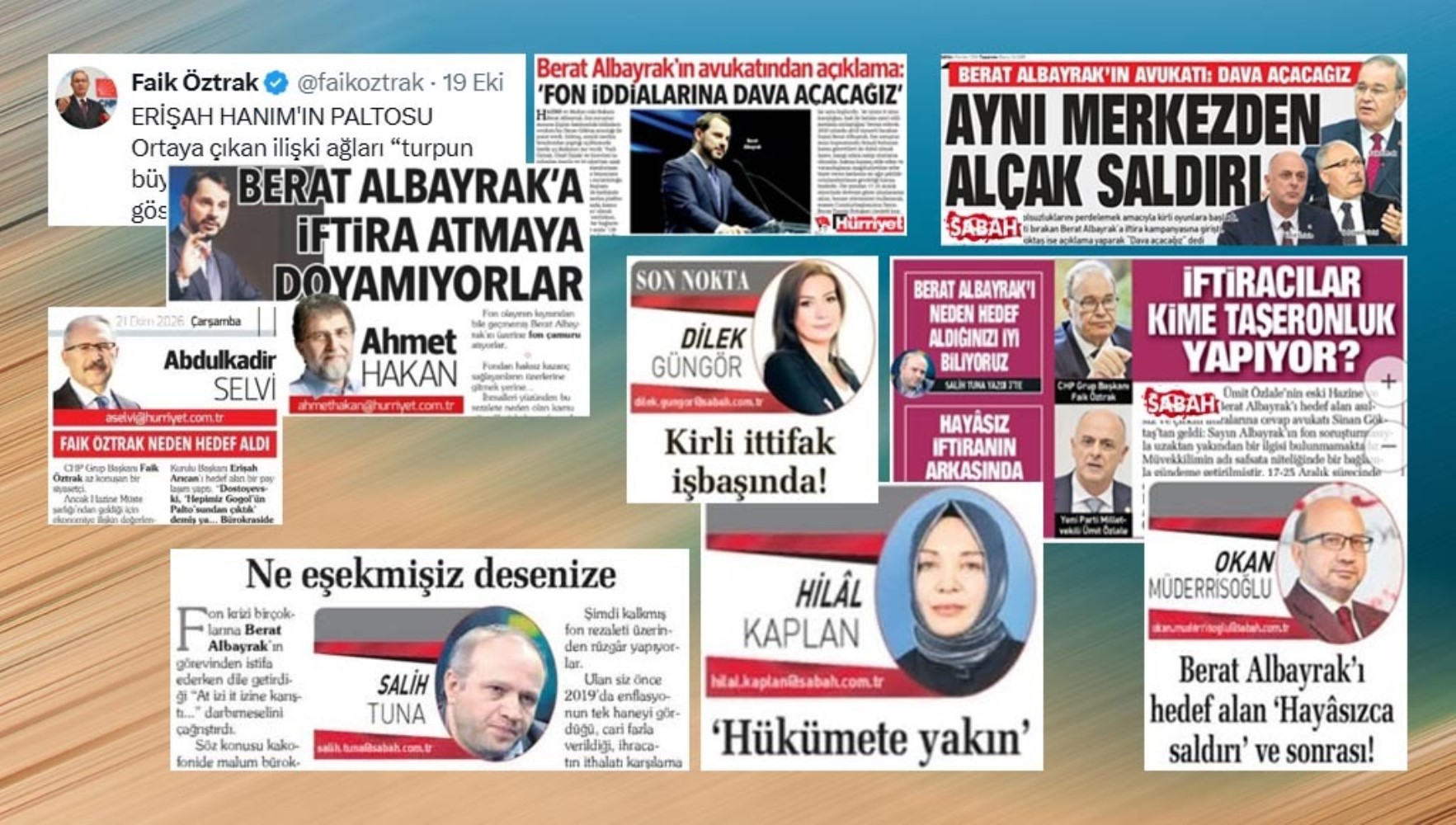
That day, Sabah columnists Okan Müderrisoğlu in his piece “The ‘shameless attack’ targeting Berat Albayrak and its aftermath,” and Salih Tuna (Davut Kayacı) in his piece “Say we are donkeys then,” defended Berat Albayrak tooth and nail.
On October 23, Sabah launched a collective attack on Selvi. Dilek Güngör with “Dirty alliance at work” and Hilal Kaplan with her “Pro-government” articles accused Abdülkadir Selvi and defended Berat Albayrak. A day later, Okan Müderrisoğlu gave his support once again by calling him a “trusted name.”
It is not possible to see these articles as objective assessments. Because Berat Albayrak is the brother of Turkuvaz Media CEO Serhat Albayrak, the group's newspapers and TV channels constantly publish praise for Berat Albayrak; whenever there is a criticism or accusation, they immediately go on the defensive. Their columnists are also ready at any moment to enter a race to please the boss. Of course, these efforts have nothing to do with journalism or the concern of informing the public.
Sabah's attitude is not new, so what is truly remarkable is Hürriyet's timid stance. First of all, it was significant that Selvi did not or could not respond to the heavy attack directed at him with even a single sentence. Moreover, Hürriyet not only published the full text of Berat Albayrak's lawyer's statement; the newspaper's editor-in-chief Ahmet Hakan also attacked Ümit Özlale and Faik Öztrak, saying, “They cannot get enough of slandering Berat Albayrak.” He acted as if his own newspaper's columnist was not a party to this debate; he did not defend Selvi against the accusations.
We do not know what happened in the background, why Abdülkadir Selvi and Ahmet Hakan could not respond to so many harsh words. If they had acted with journalistic reflex, they would have definitely responded. Other forces and concerns may have intervened. This is what happens when journalism becomes a guardian of the boss's interests and a party to political settling of scores...
Beyaz TV’s corporate reputation!
Cem Küçük and Tahir Sarıkaya have been in custody for about three months. Beyaz TV Program Coordinator İsmail Çanak, who surrendered, is free under judicial control conditions. Of course, we will be able to see the accusations more clearly once the indictment is prepared.
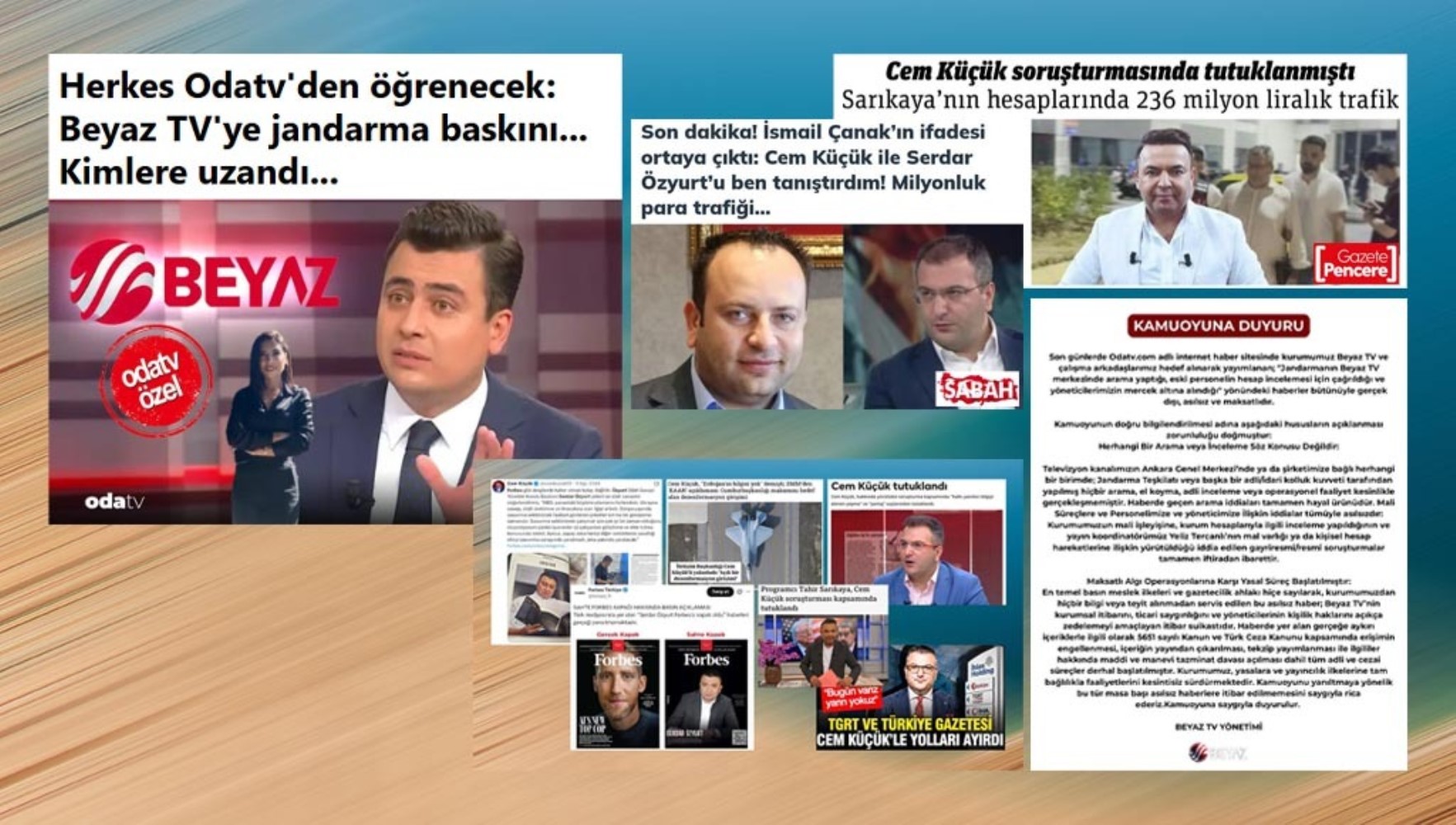
However, the prosecutor's interrogations and testimonies point to a constant “money traffic” between them. In his prosecutor's statement, Cem Küçük said regarding the money exchange of 537 thousand 800 TL between him and Tahir Sarıkaya, “It stems from a debt-receivable issue or organization fees.” He also categorically denied the accusation of blackmail and threatening broadcasting.
Tahir Sarıkaya also said in his statement, “I did not send money in exchange for tweeting or making news,” but said that “he might have also made payments for the openings and programs they attended together.” Sarıkaya admitted that “he made news and social media promotional posts about businessman Serdar Özyurt, and money was sent to his account in return.”
The most interesting was İsmail Çanak’s statement. Çanak said he made payments to “Cem Küçük in exchange for attending municipal organizations,” and to Tahir Sarıkaya for the events they attended. He also admitted to receiving money 64 times from Fatih Eke for 21, and from Serdar Özyurt for advertising, promotion, and social media posts.
Indeed, one of those who wrote praises about Serdar Özyurt as if he had been on the cover of the famous Forbes magazine was Cem Küçük, and the other was Ahmet Hakan. Neither of them even made a correction after it was understood that the cover they included in their visuals was fake.
Cem Küçük was most recently doing a program on TGRT; he was writing for Türkiye newspaper. Tahir Sarıkaya was presenting a morning program called “Uyan Türkiye” on Beyaz TV. İsmail Çanak was also the Chief of Staff of Özyurt Arms Industry. He was the reporter for the paid interviews with mayors broadcast on Sarıkaya's program. Then he became an entrepreneur who founded million-dollar companies!
Beyaz TV appears to be at the center of all these financial relationships. Tahir Sarıkaya and İsmail Çanak are also from the same channel. Were paid programs, paid social media promotions, and paid organizations being carried out with the knowledge of the Beyaz TV management, or without their knowledge? Beyaz TV executives did not make a sound during this process, as if another channel were being talked about.
It was announced that Beyaz TV “suspended its main news bulletin for a while due to renewal and technical changes.” Odatv, which announced this development, later wrote that the gendarmerie searched the channel building. But Beyaz TV and Osman Gökçek denied the search news.
However, Beyaz TV, which quickly denied the “search” news and spoke of “damage to corporate reputation,” has been silent for months about the accusations directed at Tahir Sarıkaya and İsmail Çanak.
It cannot be a response to talk about “corporate reputation” without the Beyaz TV management explaining whether broadcasting was done through monetary relationships, and if the accusations are true, why they did not intervene.
No support for the imprisoned journalist
The news that “The indictment of imprisoned journalist Fatih Ergin has been accepted” appeared on many news sites such as Cumhuriyet, Sözcü, Medyaradar, and T24. In the 4-5 sentence news, it was stated that Fatih Ergin had been in custody since September 28 on charges of “publicly disseminating misleading information,” that the indictment had been accepted, and that he would be brought before a judge for the first time on November 18.
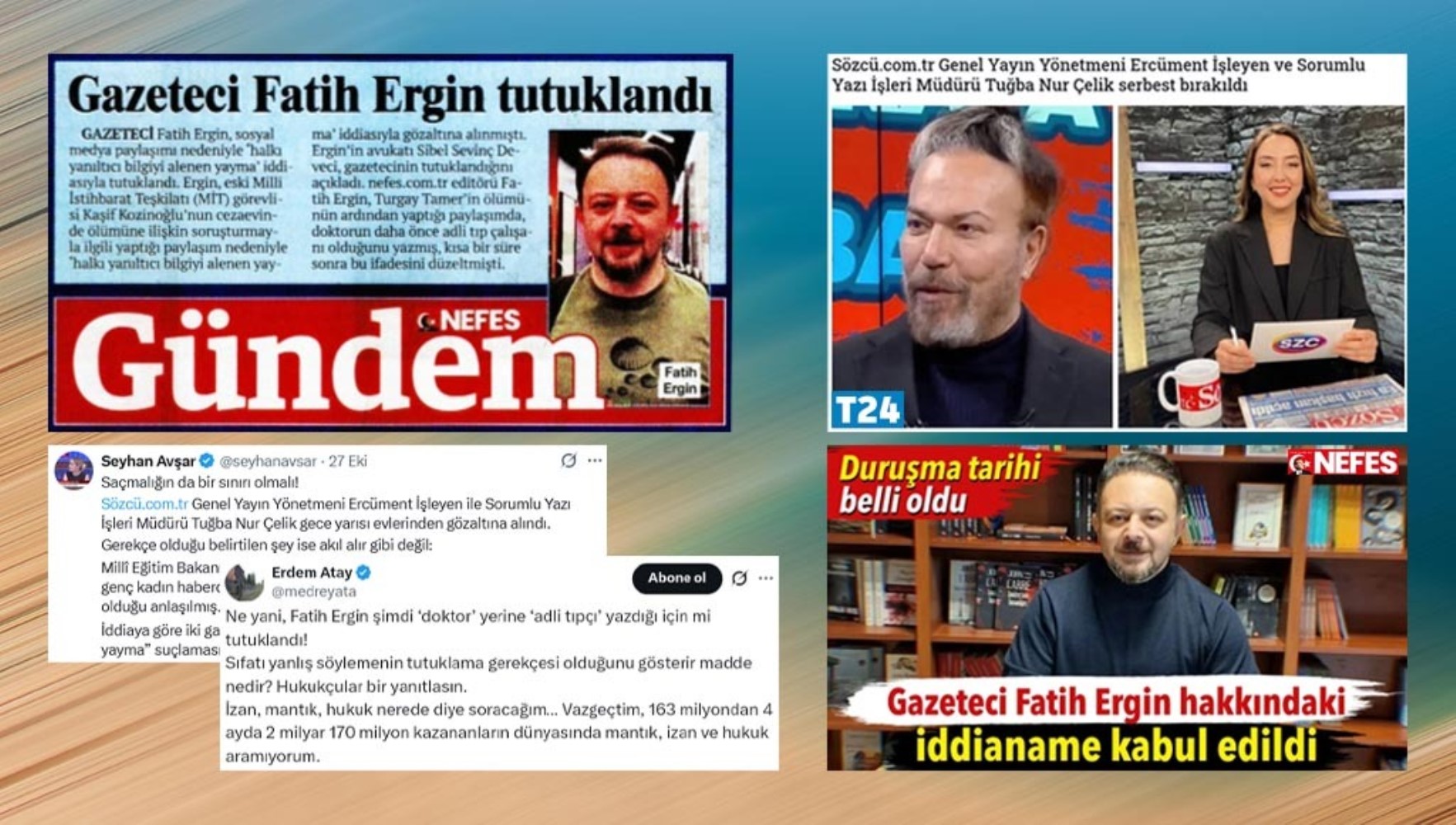
However, this news on October 26 did not contain the content of the accusation directed at Fatih Ergin. It was unclear what he did to be arrested and have an indictment prepared against him. Yes, the news that the indictment was prepared on October 19 had also been published on these sites, and this information was included there. But not everyone has to read every piece of news. News must contain the basic elements summarized as 5W1H.
Indeed, Yeniçağ and Nefes provided the information in the introduction of the news that he is a “journalist who has been in custody for 28 days on the grounds that he wrote ‘forensic medicine expert’ instead of ‘former prison campus doctor’ in the news tweet he shared on social media.” In the “What happened” section, it was also emphasized that Fatih Ergin was arrested despite correcting his mistake in his post about Turgay Tamer, who was detained and released in the investigation regarding the death of former MIT member Kaşif Kozinoğlu, and that he would be brought to the first hearing on November 18. 12Punto and Karar also included this information in their news. This is correct news writing.
However, Fatih Ergin is the news manager of Nefes.com.tr. Nefes, which squeezed the fact that he was an employee between the lines, had given the news so small on the day he was arrested, and had not even put it on the front page. Then it made two small news items, and then forgot about it until the indictment was prepared.
It is very painful for a newspaper not to defend its own employee against the injustice he suffers. A newspaper that cannot defend its own news manager can never be the voice of the voiceless or the power of the powerless.
Moreover, Fatih Ergin's arrest was the first example of journalists being arrested because of a word error. Most recently, Sözcü.com.tr Editor-in-Chief Ercüment İşleyen and Responsible Managing Editor Tuğba Nur Çelik were also held in custody for hours on the grounds that they wrote “high school student” instead of “university student” in the news about two young women who were arrested for hanging a protest poster against Minister of National Education Yusuf Tekin.
We must object to these operations, and as Seyhan Avşar emphasized, we must not consent to “the normalization of such a harsh method.” What should happen is a strong and continuous objection, like BirGün defending its reporter İsmail Arı, who was arrested and sued on trumped-up charges, by putting him on the front page every day.
There is no such thing as a child's bloody settling of scores
TV100 had put the headline “Bloody settling of scores” on the news as if criminal gangs had clashed. Yet a 15-year-old child had shot and killed another 14-year-old with a gun.
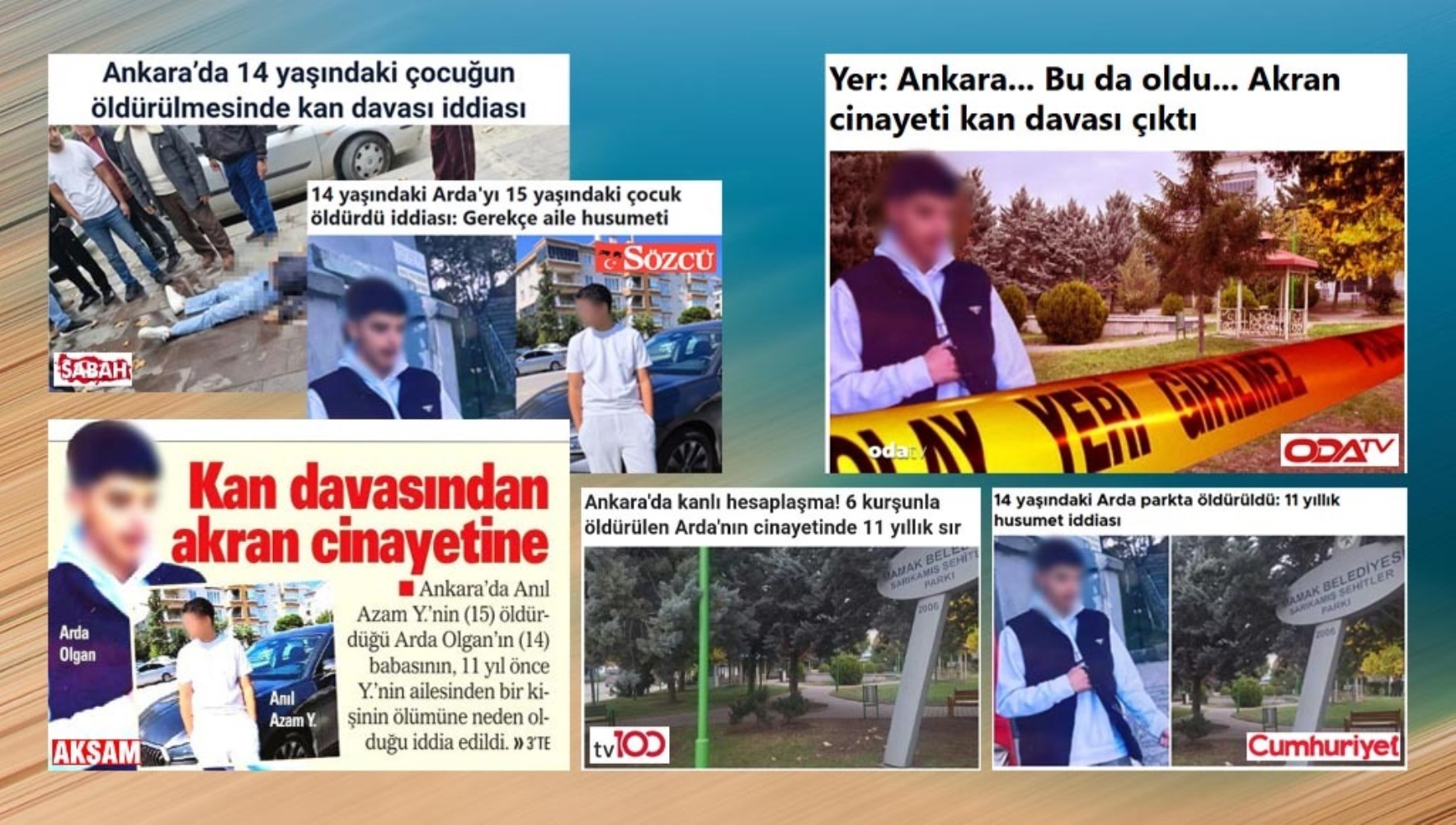
There was also confusion in the news about the reason for the murder. Both “a peer murder” was pointed to by saying “The argument that started on the phone between two children in Ankara ended in blood in the park.” And the possibility of a “blood feud” was dwelled upon with the sentence “The allegation of a feud that started due to a fatal incident between two families 11 years ago emerged behind the murder.”
Regarding the same murder, headlines such as “The feud of children who met in the park ended in murder” (İHA), “Allegation of blood feud in the killing of a 14-year-old child in Ankara” (Sabah, NTV), “11-year-old feud allegation” (Cumhuriyet), “Victim 14, killer 15 years old! Blood feud emerged from peer murder” (Habertürk), “Family feud emerged from peer murder” (Akşam) were used in other media outlets. “Feud” and “blood feud” were mentioned in all of them, but the sentences either started with “allegedly” or ended with words like “allegation” or “it was claimed.”
“Allegation” and “It was claimed” make me understand that it was not researched enough and the written information could not be fully verified. This is a serious journalistic error. News cannot be written with unverified information, and saying it is an allegation does not give the right to make news out of everything heard. Either you research well, verify it, and write it that way, or you don't write it at all.
Furthermore, a child cannot be “feuding” or have a “blood feud.” If it is truly a blood feud murder, the use of a 15-year-old child is in question. Unfortunately, this aspect of the murder was not dwelled upon at all in the news. How the child obtained that weapon was also not questioned. If it could have been researched well and moved beyond the allegation dimension, it would have ceased to be just an announcement of a murder in a way that arouses curiosity; it would have turned into useful, cautionary news for society.
It was also wrong to use a portrait photo of the 14-year-old child who died in this news, which contains all the diseases of police news. Especially Sabah using the bloody photo of the dead child lying on the ground was an even worse journalistic error.
In a single sentence:
• The Haberler.com site risked spreading terror to the reader for clickbait by using the headline “The phenomenon's severed head came out of this bag” and even publishing the photo of that bag.
• The accounts of 31 people, including journalists Birsen Altuntaş and Erk Acarer, on the social media platform X were blocked from access.
• The @kisadalgamedia account opened on X by the news site Kısa Dalga, whose @kisadalgamedya account was blocked from access, was also hacked; it could not be recovered despite having a blue tick.
• Barbaros Tapan, who writes in Hürriyet’s Kelebek supplement, praised two sugar and cologne brands in his article “Full marks from foreigners to Turkish brands” and made covert advertising for them.
• It was not mentioned in the news of Akşam, Milliyet, and Sabah regarding President Erdoğan’s words “There is no room for separation,” that Azerbaijani President Ilham Aliyev did not attend the summit in Ankara.
FOR YOUR CRITICISMS, COMPLAINTS, AND SUGGESTIONS: [email protected]
Would you like to get notifications about new developments and save news?
- NotificationsNew developments and breaking news
- SaveNews is stored in the app
Most Read
Multi-vehicle accident at the entrance of the 15 July Martyrs Bridge
Striking claim from Özdağ regarding Öcalan
New summary of proceedings being prepared against Özgür Özel following Emir Sarıgül's testimony
Price hike calculation for 2027 passport fees
Warning for Savcı Sayan from the AKP
Two figures on the table for retiree pay raises
The envelope and the contents in our foreign policy!..
Statement from Sözcü regarding Erman Toroğlu and layoffs
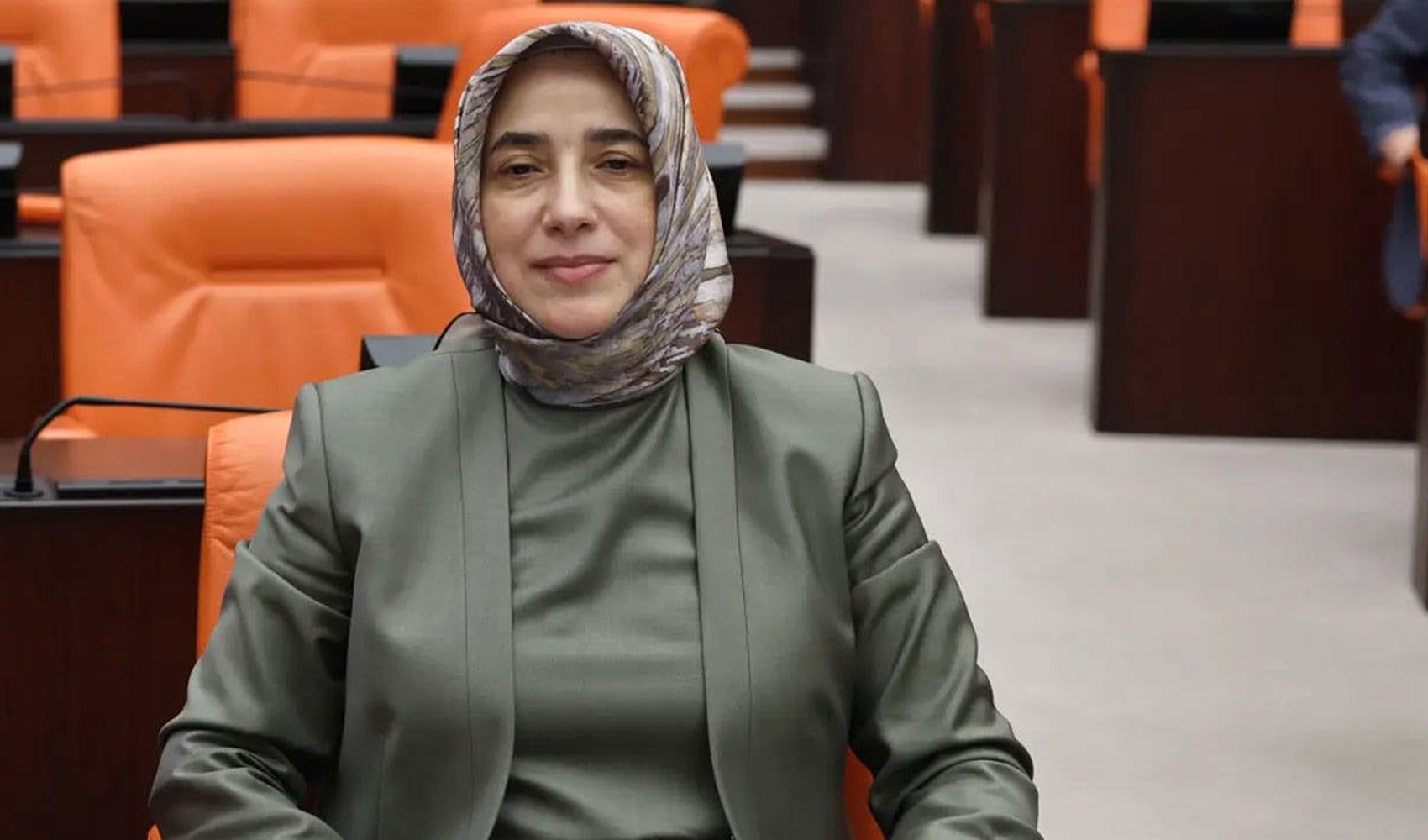
Özlem Zengin explained why she did not attend the conference
Journalists in a race to please their bosses