


Journalism under siege, journalists on the streets


When the "crime of publicly disseminating misleading information," used to arrest journalists, was no longer enough, absurd accusations were brought into play. Murat Ağırel and İsmail Arı were arrested on these absurd charges. They accused Murat Ağırel because of an incident he was carefully investigating to avoid spreading misinformation.
In the investigation into CHP MP Mustafa Sarıgül and his sons, Murat Ağırel was accused of "giving information and documents to Sarıgül instead of investigating them, and not sharing them with the prosecutor's office and the press." Ağırel responded to this accusation by saying, "I met with a person named Sinan Çampınar and requested documents regarding the boat sale and company establishment incident he alleged.
They made it a condition for me to do this story in order to report on Osman Gökçek. But he did not provide any documents, so I did not do the story, and I did not give information to anyone." Despite this, he was arrested with a one-sentence justification.
Furthermore, a journalist cannot have a mission to provide information in their possession to the prosecutor before publishing it. A journalist is not an auxiliary staff member of the prosecutor's office.
What could be more natural than a journalist not publishing an allegation they cannot verify? If they did not try to verify it and published it without verification, they would have done wrong. Asking the parties involved about the allegation and getting a "counter-view" is already a requirement of journalism. Unless proven otherwise, there is not only no crime in Ağırel's behavior, but not even an ethical violation. The article titled "To the Ankara Chief Public Prosecutor's Office," which he penned in prison and which contains unverified allegations about Osman Gökçek, was clearly written with resentment and anger.
The real ethical violation lies in Murat Kelkitlioğlu, who calls himself a "40-year journalist," saying on a program on TV100 that "there are discrepancies in Murat Ağırel's account transactions." The fact that he feels entitled to make such a serious slander by saying, "This is entirely an allegation. This is a prosecutor's allegation," shows how far he is from journalistic ethics. In fact, let alone the truth of what he said, it has not even been verified that the prosecutor's office has such an allegation.
The arrest of İsmail Arı is an entirely arbitrary punishment. He was called to testify after former RTÜK President and Halk Bank Board Member Ebubekir Şahin filed a complaint. The photo shared by İsmail Arı is real; moreover, he wanted to fulfill the requirements of journalism by calling Ebubekir Şahin to get his opinion, and there is no insult in his posts.
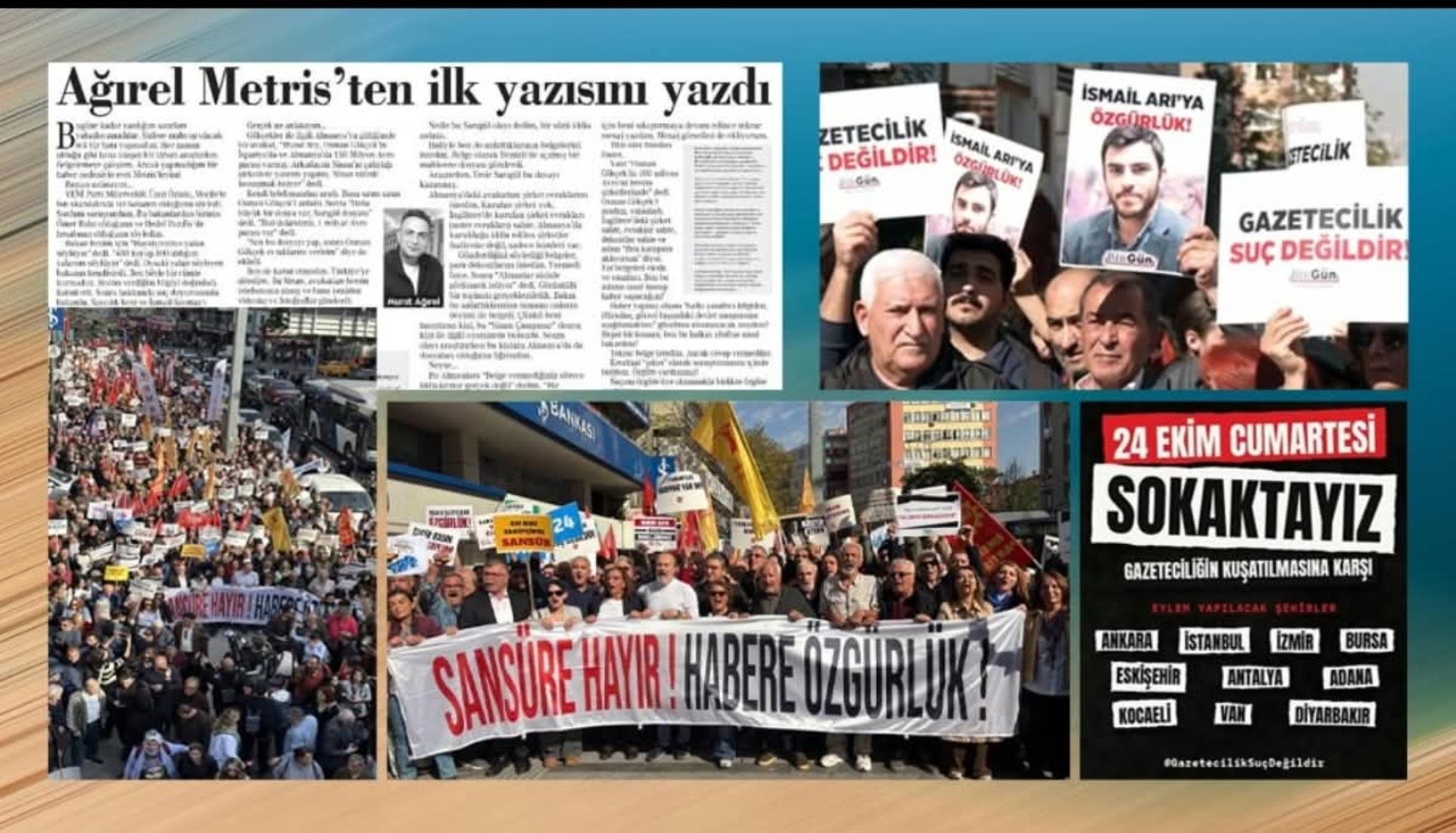
Despite this, the judge issued an arrest warrant without even seeing the need to listen to İsmail Arı. It is clear that the verdict had already been decided.
Undoubtedly, the method of arresting Murat Ağırel and İsmail Arı is a continuation of operations to besiege and stifle independent and critical journalism. The number of journalists arrested this year has exceeded 20. Following the seizure of Halk TV and the access ban imposed on the T24 website, the social media account of Yeni Yaşam was also blocked. Last week, 14 journalists appeared before a judge.
These pressures are the reason why journalists took to the streets in 10 different cities, primarily in Ankara and Istanbul (on October 24, the anniversary of the seizure of Tele1).
Journalism is in resistance; journalists are on the streets for freedom of news and the reporter...
Journalism lessons from the protests in Paris
There are lessons that the Turkish media should also learn from the mistakes made in reporting on the protests in France regarding the cost of living and educational conditions.
In French television, just as in Turkey, it was not the protesters and their demands that were at the forefront, but the images of aggressive groups destroying things and clashing with the police. However, those attacking were a minority; tens of thousands were expressing their problems peacefully. Despite this, giving weight to the attackers in the news made the peaceful reaction invisible and rendered the protests ineffective.
In particular, the long news report broadcast on the evening of October 18 on the public broadcaster France 2 under the title "At the Heart of Violence," in which images of chaos were presented in a chain and without commentary for 12 minutes, received great criticism.
Philippe Corbe, Head of the News Department at France Televisions, in his article published on the franceinfo.fr website, "We should have been clearer about editing, contextualization, and commentary" admitted their mistakes. The institution's ombudsman, Pascal Doucet-Bon, also agreed with the criticisms in his article, asking, "In an era where social media often publishes images without providing sufficient context, should television news bulletins do the same?"
This valuable discussion, which is useful and instructive for the future of protest reporting in France, should also be brought to Turkey. Because television channels in Turkey continued to broadcast images of violence from France for days even after the events, which lasted two nights in France, had subsided. It created a perception as if Paris had almost burned down and this had been going on for days. The same attitude was repeated during the major protests on October 24 and before.
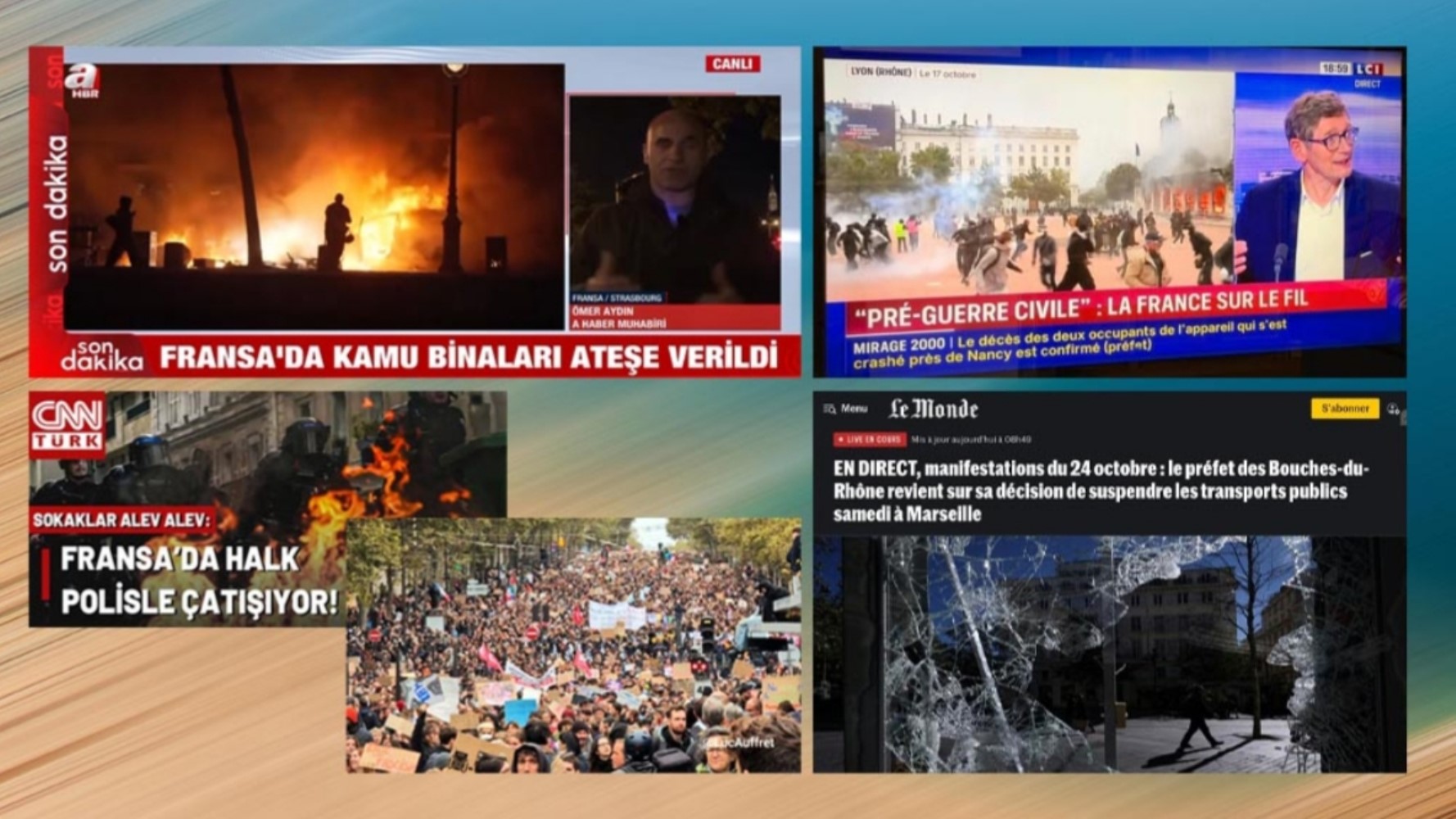
Moreover, the same images of destruction were broadcast over and over again. And because the place and time were not specified, old and new images were mixed up. Even in evening discussion programs, because the place and time were not specified, a perception was created as if those events and attacks were happening at that very moment. However, French TV stations were very sensitive about this. The location and date, and even the time if necessary, were displayed on the event footage. Looking at it this way, the image selection and broadcasting of some of our news channels are both problematic and deceptive, as well as amateurish.
In addition, the desire to analyze through conspiracy theories without data also manifested itself in news and discussion programs regarding the protests in France. Rumors were produced that Israel had an influence on the protests in France; this was talked about, written about, and commented on. President Macron's words, "There is no foreign interference, but there is foreign-sourced information manipulation," were not given as much space as the conspiracy claims.
The newspaper Türkiye, on the other hand, published a news story titled "Confession from Israel: We burned Europe." However, the news contradicted its headline. In the news, Israeli Diaspora Minister Chikli did not make a confession, but rather expressed his wish for France to "win a victory against the barbarians."
Giving space to such exaggerated news and conspiracy theories instead of the truth is bad journalism. Unfortunately, those who make these broadcasts are unaware that they are attributing more power than it has to a murderous state like Israel and acting in Israel's favor by portraying it as if it is capable of everything.
Still, I hope that television journalists, in particular, will learn a lesson, even if only a little, from the journalism debate in France; and that they will stop focusing on momentary images of violence or police intervention rather than people's demands and the problems they express in protest news.
As Pascal Doucet-Bon said, "television news must be different from social media, which publishes images without providing any context..."
Another journalist acting in an advertisement
Murat Güloğlu presents the news program "Burası Haftasonu" (This is the Weekend) on Habertürk on weekends. He must consider himself a journalist, as his social media profile also says "TV | Gazeteci | Journalist | News Anchor #HaberturkTV."
But recently, he posted a video on his Instagram account where he clearly acted in an advertisement. He picks up a box of a food supplement brand and starts praising it:
"Are you also looking for a way to take good care of your heart? I use... Starting good habits always seemed daunting to me. Upon recommendation, I researched... and started using it. It has science behind it and quality inside. It's exactly the omega-3 I was looking for. I turned taking care of my heart into a daily habit. I'm good with..."
Güloğlu also added the #reklam (advertisement) and #işbirligi (collaboration) tags under this post because it is a legal requirement. Thus, he declares that he is advertising in accordance with legal conditions. In fact, this company has had many celebrities, including athletes and actors, shoot similar promotional videos along with Güloğlu. This campaign is also part of a "growth move" that started with public offerings.
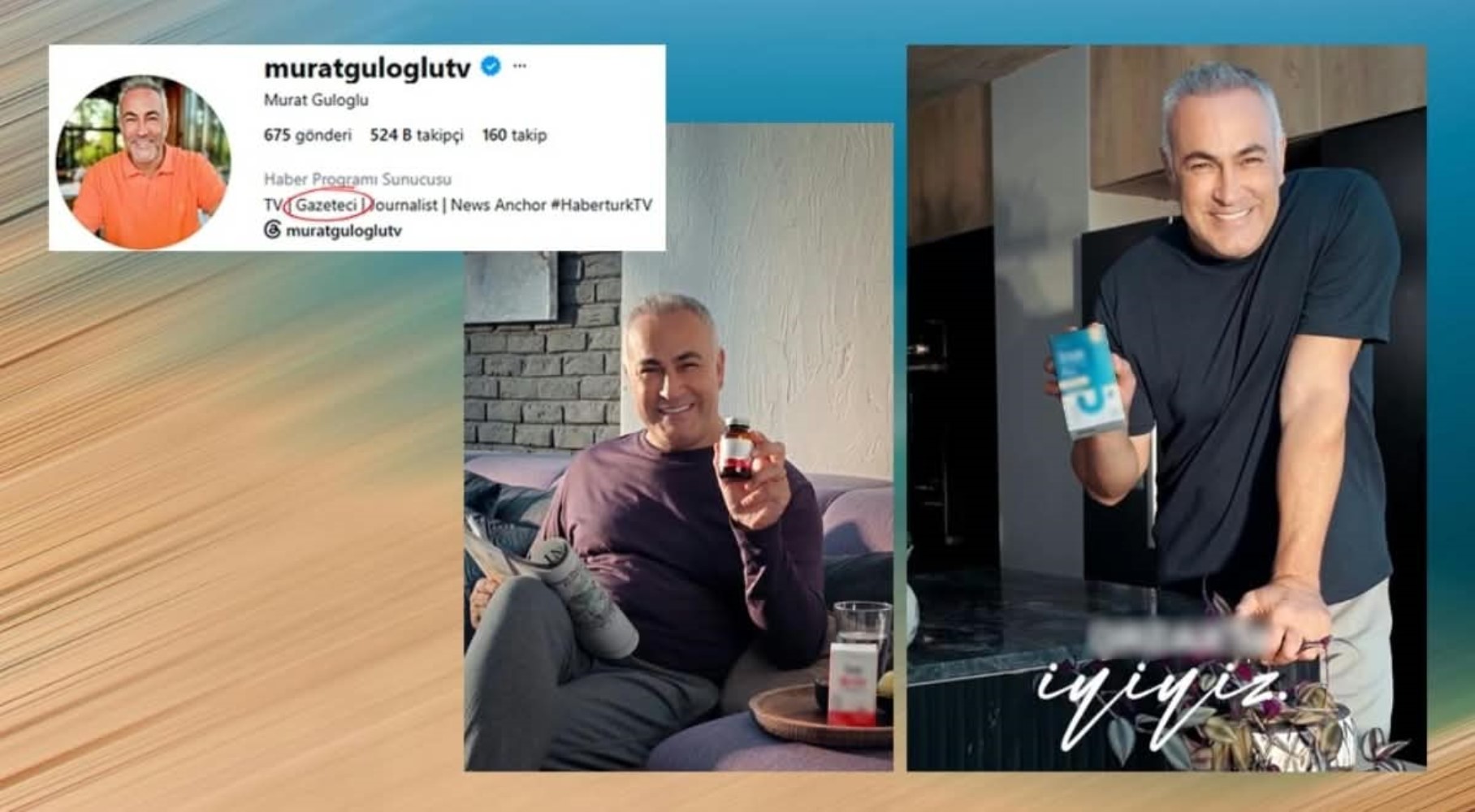
What Güloğlu did may be legal, but it is not ethical. A journalist can take advertisements or sponsorships for their YouTube broadcast. But if they become an advertising actor, they use the credibility of journalism for the sale of a commercial product. They are reduced to the position of a person who can say whatever the paying commercial organization wants.
Journalism is the business of reporting the truth. The suspicion arises that other news presented by a journalist who acts in an advertisement may also be for profit. What a journalist who acts in an advertisement sells is journalism.
Artificial images in İmamoğlu news
Journalists could not get footage of Ekrem İmamoğlu's defense in the IMM case, nor could they take photos. Those who took the İmamoğlu footage that spread on social media and for which the prosecutor's office opened an investigation were not journalists either.
However, dozens of media outlets, from Cumhuriyet to BirGün, Karar, and Sözcü, and from Medyascope to Agos and T24, had images of the moment İmamoğlu was making his defense. All of them were not photos, but images produced by artificial intelligence programs.
It is a shortcoming that it is not written that these unreal images are AI products. Because at first glance, they give the impression of a photo, and most readers may think those images are real photos.
A journalist does not deform the truth. These images are a distorted version of the truth and cannot be presented as if they were real. Therefore, it is not right to use such images produced by artificial intelligence as news photos.
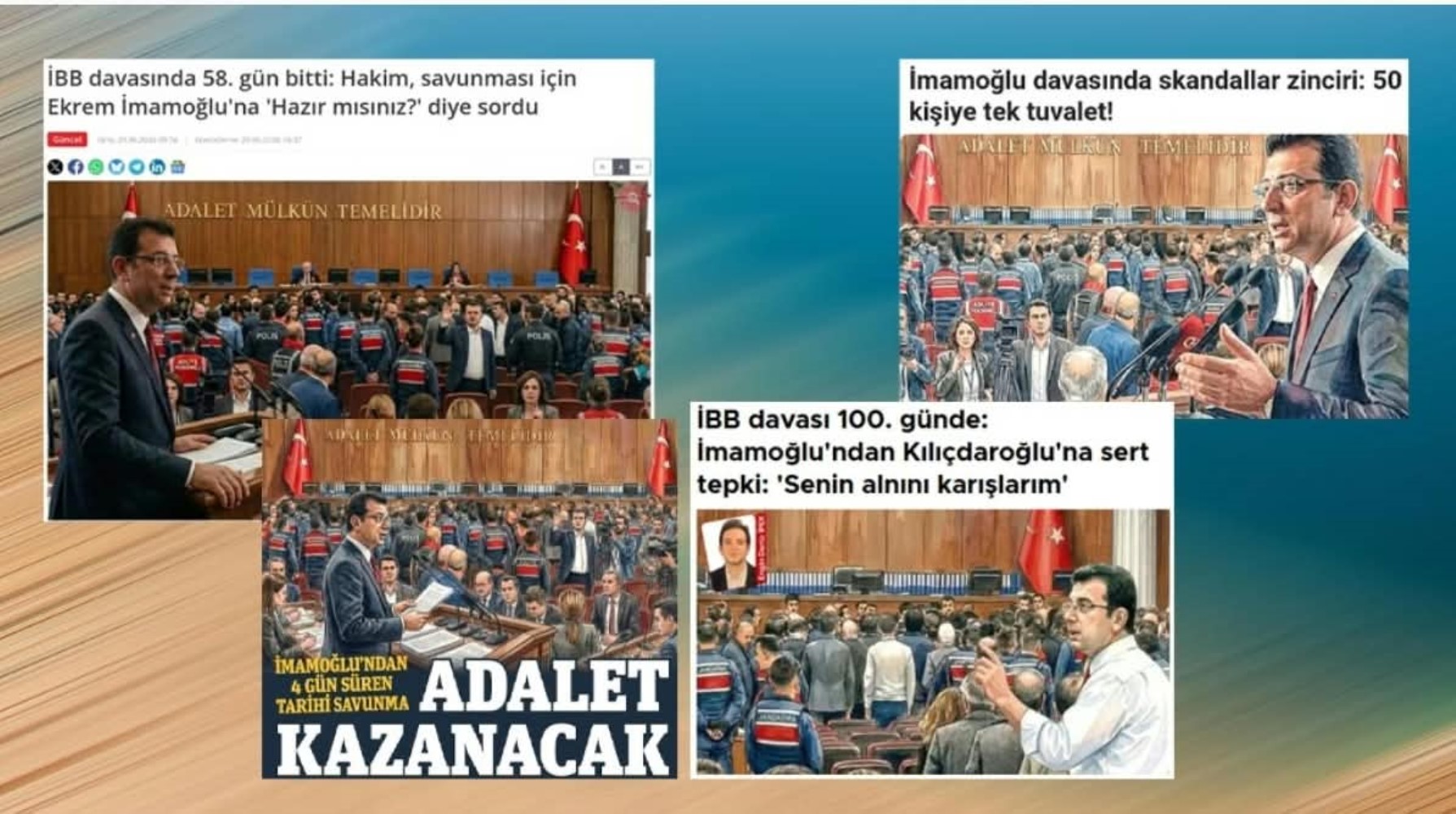
If they are used, it is necessary to state that they are AI products so as not to be misleading. Of course, this applies not only to İmamoğlu images but to all artificial intelligence images. For example, the image used by Yeni Şafak showing the leaders of Germany, France, and Italy shivering in the snow under the title "New fuel crisis at the door in Europe" was also the work of artificial intelligence, and the reader was misled by not stating its source.
Sabah deceived its readers
On Hürriyet's economy page, there was a news story about a chain market titled "... agricultural platform opened to all local producers." When searched carefully, a faint "This is an advertisement" warning could be seen vertically in the bottom left corner.
On the same day, there was a news story on the economy page of Sabah newspaper titled "Opened agricultural platform to local producers." This news was also decorated with the orange color of the chain market, just like in Hürriyet, and was the same as the one in Hürriyet, except for very small changes.
However, in Sabah, there was no warning that this text was an advertisement prepared by the company, and there was also a byline "Feride Cem / Sabah." The advertisement was presented as if it were an exclusive news story by Sabah. However, it should have been stated in a way that the reader could easily see that the text was an advertisement or a commercial.
Hürriyet gets away with it with a tiny warning, but what Sabah did is to use journalism as a tool for advertising and, most importantly, to deceive the reader.
In one sentence:
. Yeni Şafak wrote in its news "İzmir Metropolitan Municipality funded Halk TV" that "Murat Koçak benefited from effective remorse and admitted to taking bribes," but did not publish the denial of Koçak's lawyer, Eren Toprak, and did not allow the right of reply.
. Sabah and Hürriyet did not write that Osman Çelik, who was removed from the position of Deputy Minister of Treasury and Finance, was the father-in-law of İskender Balcı, who was arrested in the "fund fraud" investigation.
. Sözcü, in its news "Forbidden love came out from under the suicide," coded the surname of the prosecutor with whom it claimed the deceased deputy governor had a relationship, but "exposed" and stigmatized the woman by publishing her name and position with her photo.
. In Now TV's news "No one heard her screams," broadcasting the footage of the moment a woman named Gözde Akbaba was murdered along with her screams for help was violence porn.
FOR YOUR CRITICISMS, COMPLAINTS, AND SUGGESTIONS: [email protected]
Would you like to get notifications about new developments and save news?
- NotificationsNew developments and breaking news
- SaveNews is stored in the app
Most Read
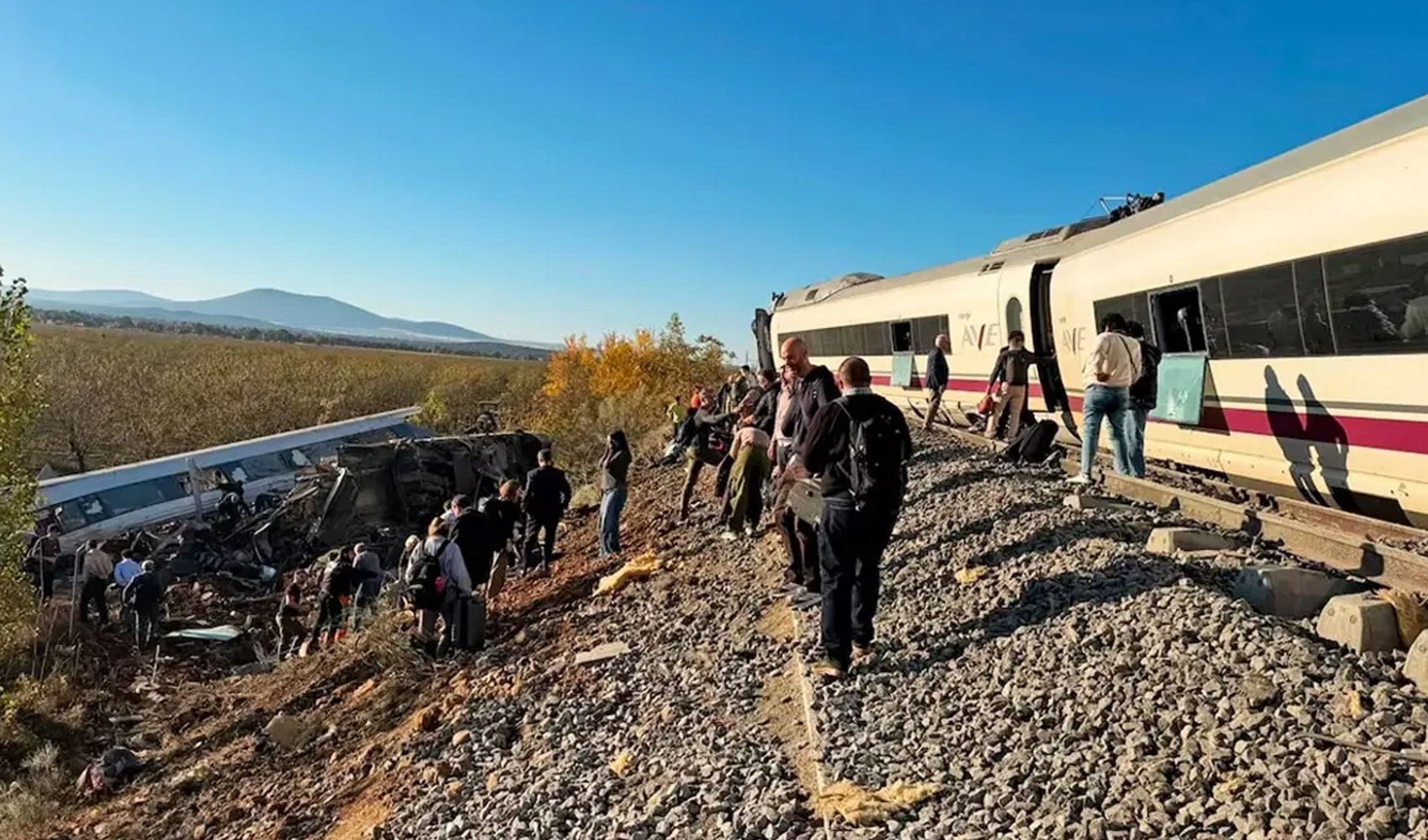
Two high-speed trains collide in Spain!
New formula for indefinite alimony regulation
Can Yayınları Editor-in-Chief Cem Akaş has passed away
Surprise results emerge from the ballot box in Israel

Allegations involving Turkey in the case of 748 kilos of cocaine seized in Ecuador
With the Republic, sovereignty was taken from the palace; it cannot be returned to the palace!

The digital era for IDs begins
NEW Party decision from Mustafa Sarıgül!
Striking claim regarding the Erdoğan-Aliyev meeting!
Social media move from Oktay Saral following his resignation