


The Çanakkale Robbery-3- Troy's Helios Metope: What is that?


_____________________________________________________
You can find the previous articles about Troy at these addresses.
https://12punto.com.tr/yazarlar/sefa-taskin/canakkale-soygunu-2-troya-hazinesi-nerede-157618
______________________________________________
A STONE IS HEAVY IN ITS PLACE – 177. LET US NOT FORGET, LET US NOT LET BE FORGOTTEN
Researchers, diplomats, history buffs, and robbers disguised as archaeologists were plundering Anatolia at the end of the 19th century,
in Bergama, in Gaziantep, in Çanakkale...
Çanakkale and Troy are among the first places in our country where historical artifacts were stripped bare.
Çanakkale, which would later be called "impassable," was being crossed by German smugglers and their local collaborators, with the backing of Europe's wealthy, right before the eyes of helpless patriots, as they took away its unique treasures.
One of these was the British amateur archaeologist Frank Calvert, who settled in Çanakkale under the guise of a diplomat.
This history enthusiast argued that the famous Troy, where the poet Homer from İzmir—one of the greatest poets of all time—told his epic, should be sought at Çanakkale's Hisarlık Hill.
Although it was forbidden, he was one of the first to conduct excavations there.
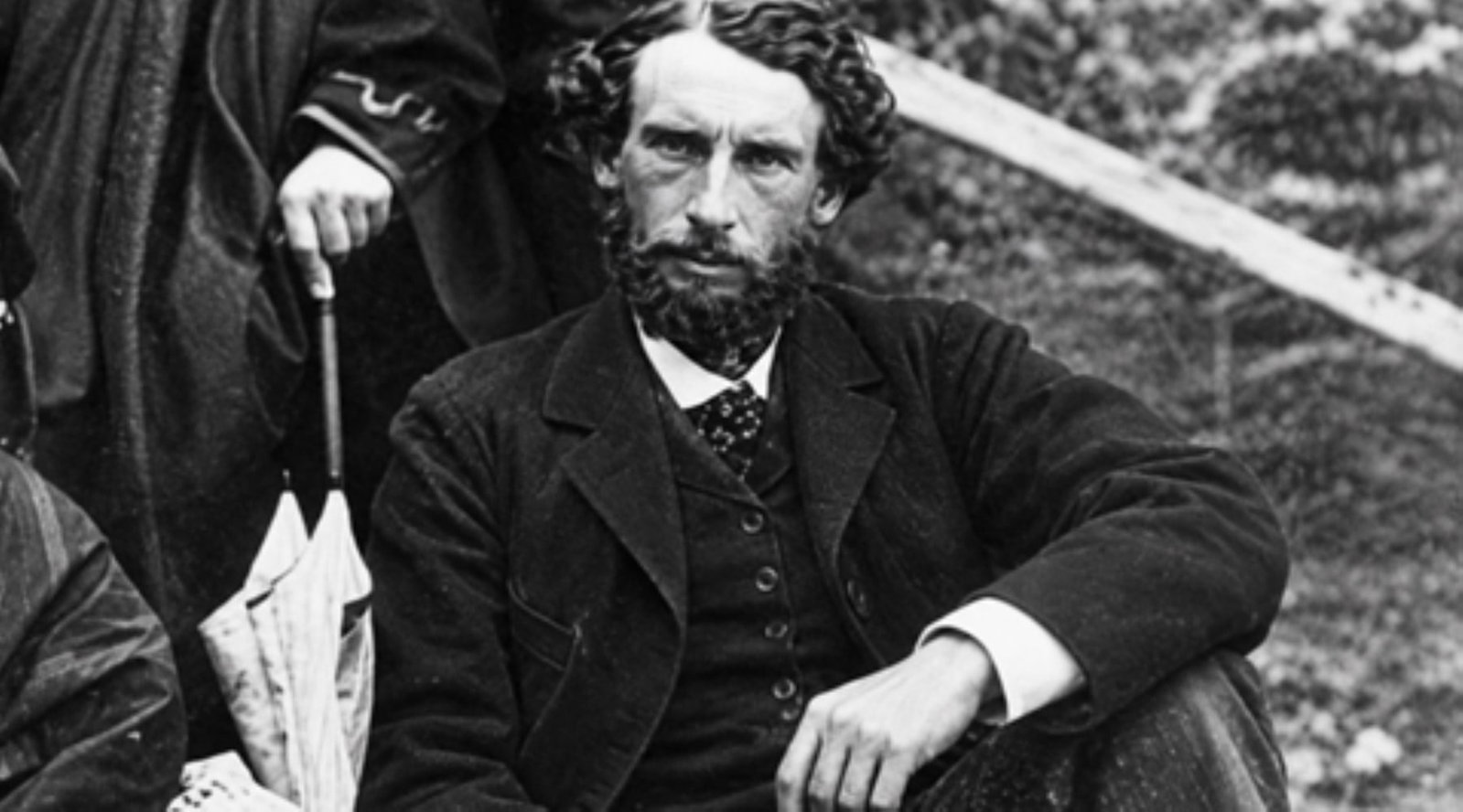
(Frank Calvert)
***
In 1868, the German merchant and researcher Heinrich Schliemann (1822–1890) appeared on the scene.
He, too, was obsessed with finding Troy.
The developing European bourgeoisie, while searching for roots for its barbaric past, had set its sights on the ancient culture and magnificent works of the Aegean geography.
Homer's magnificent verses and the dramatic stories he told dazzled the eyes of a culturally deprived Europe.
The Englishman Frank Calvert had convinced the obsessively Troy-bound German Heinrich Schliemann that Troy was at Hisarlık Hill in Çanakkale.
"Come on, let's find this land of fairy tales!"
They had to excavate!
According to the 1st Regulation on Antiquities (Asar-ı Atika Nizamnamesi) issued by the Ottoman Empire in 1869, excavations could be carried out in archaeological sites under strict conditions with permission, but findings could not be taken abroad.
It was strictly forbidden!
Schliemann was rich enough to spend a lot of money on excavations and was bold. Or perhaps he had influential powers behind him to protect him in these illegal activities.
He began illegal excavations in 1870, but he could only obtain permission the following year.
He was determined to find the Troy described in Homer's Iliad epic.
Calvert was his guide.
Schliemann revealed that there were cities built on top of each other from different periods under Hisarlık Hill.
With these rapid and reckless excavations, he also damaged some important archaeological layers.
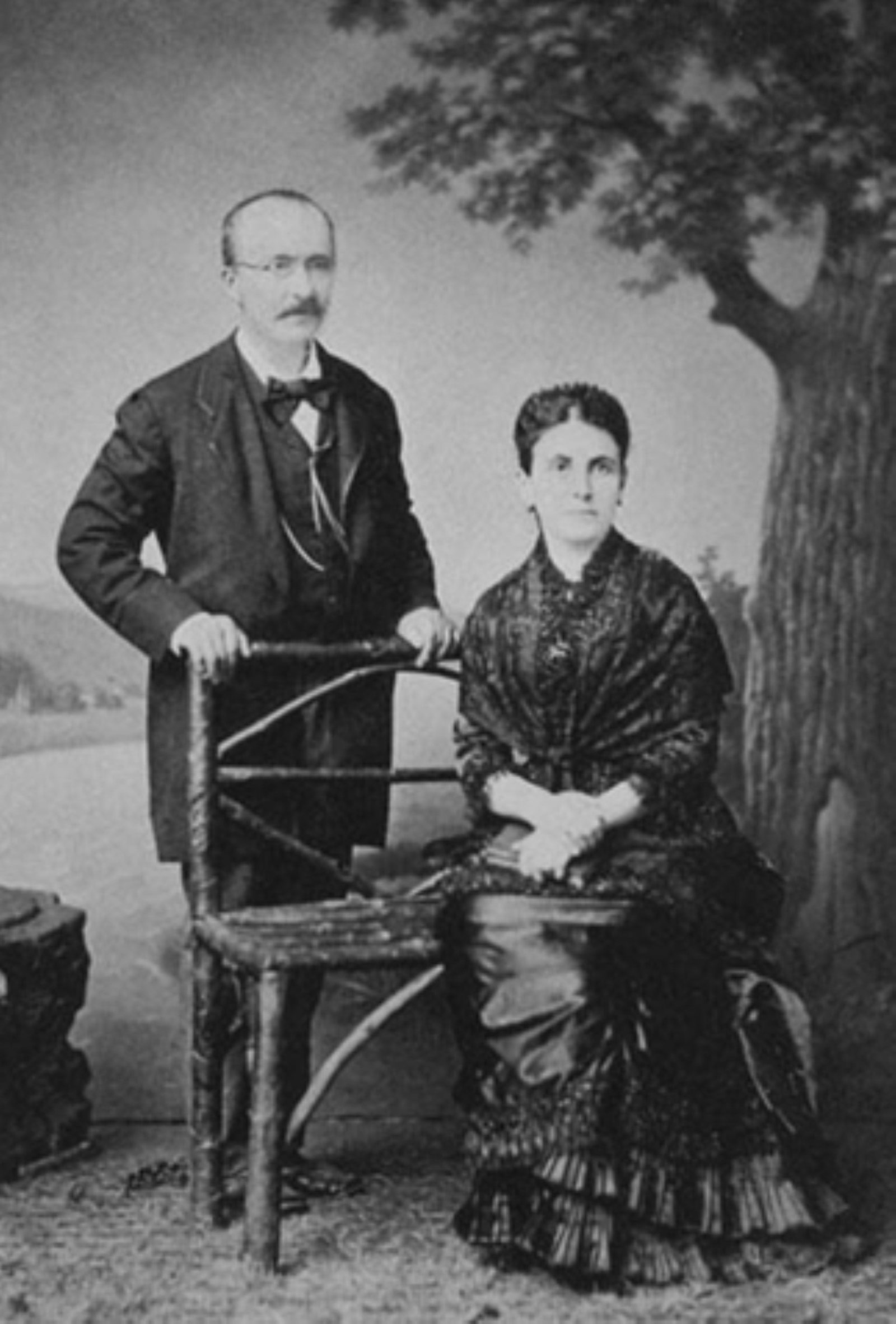
(Heinrich and his wife Sophia Schliemann)
***
In 1873, he found a large treasure consisting of gold, silver, and bronze items and declared it "Priam's Treasure."
However, it was later understood that the treasure belonged to Troy II (approximately 2500–2300 BC), more than a thousand years before Priam's supposed period.
This finding also showed the existence of an advanced civilization in Troy in the 3rd millennium BC.
It would later be understood that these findings were very special historical evidence regarding the history of Western Anatolia and the level of its civilization.
Schliemann had not found Priam's treasure; but Hisarlık Hill was now known worldwide as ancient Troy.
Schliemann had received excavation permission from the Ottoman State to excavate, but he did not have permission to take the "Priam's Treasure" he found abroad.
We explained in our previous article how the treasure was smuggled from Anatolia to Athens in 1873, the Ottoman Empire's pursuit of the artifacts, the lawsuits, the intimidation of the Ottoman Empire, how the findings were taken to Germany, what happened to them during and after World War II, and their current situation.(https://12punto.com.tr/yazarlar/sefa-taskin/canakkale-soygunu-2-troya-hazinesi-nerede-157618)
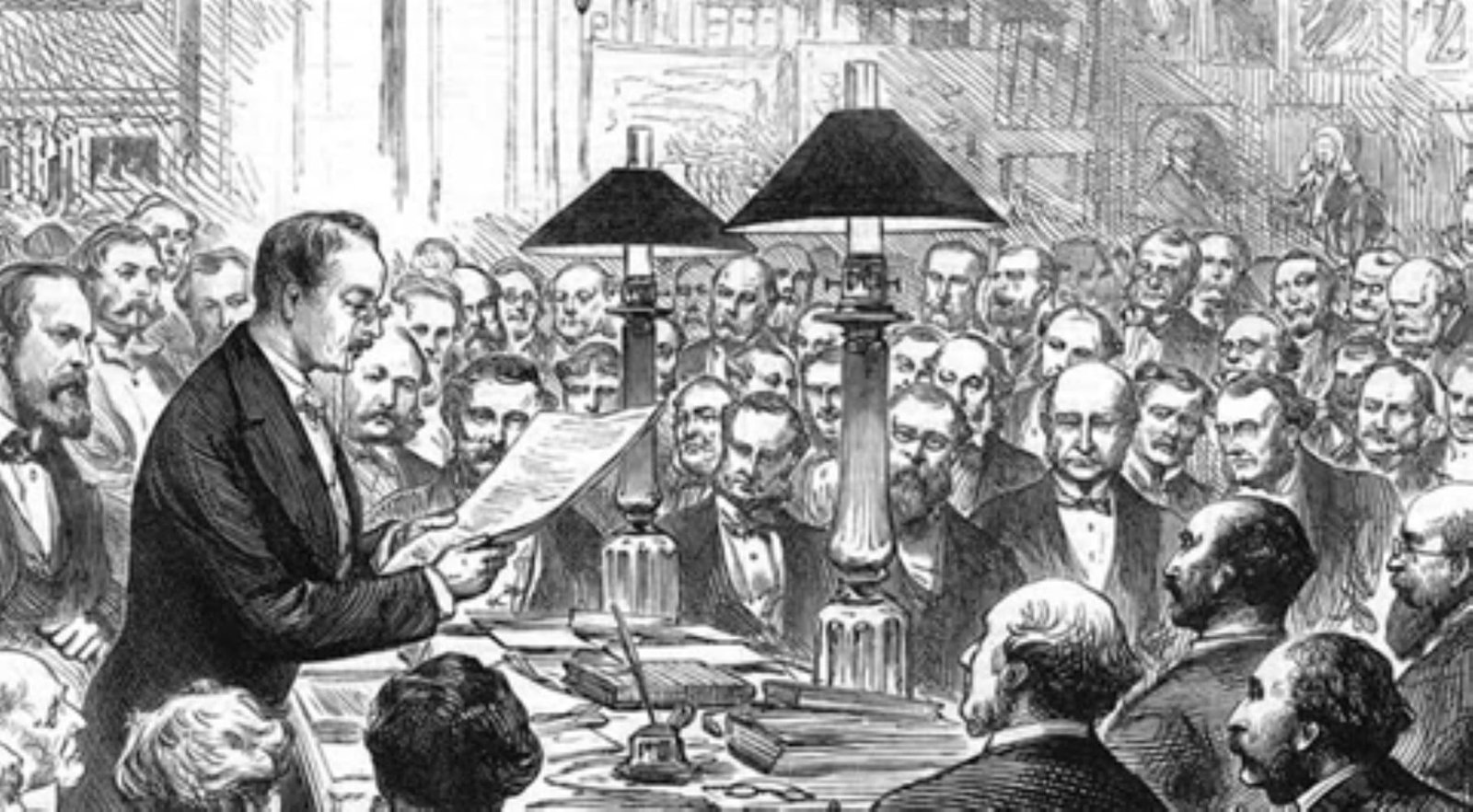
(Schliemann announcing in Europe that he found "Priam's Treasure." https://www.grunge.com/632736/the-truth-about-the-man-who-discovered-troy/)
***
In addition to the Priam's Treasure that he found and smuggled during his illegal and permitted excavations, Schliemann reached and smuggled many other historical artifacts.
On the northeast side of Hisarlık Hill, he found the Temple of Athena, whose existence was reported by ancient writers such as Herodotus and Arrian. During the excavation, he unearthed many pieces belonging to this temple.
Of course, these excavations were haphazard, based on no scientific method. Perhaps he was breaking the artifacts sleeping under the ground in his quest to find them.
In June 1872, in the trench Schliemann had opened on the north side of Hisarlık, he found the artifact we now call the "Helios metope."
What was this "Helios Metope"?
What was its feature?
Where is it now?
What happened to it?
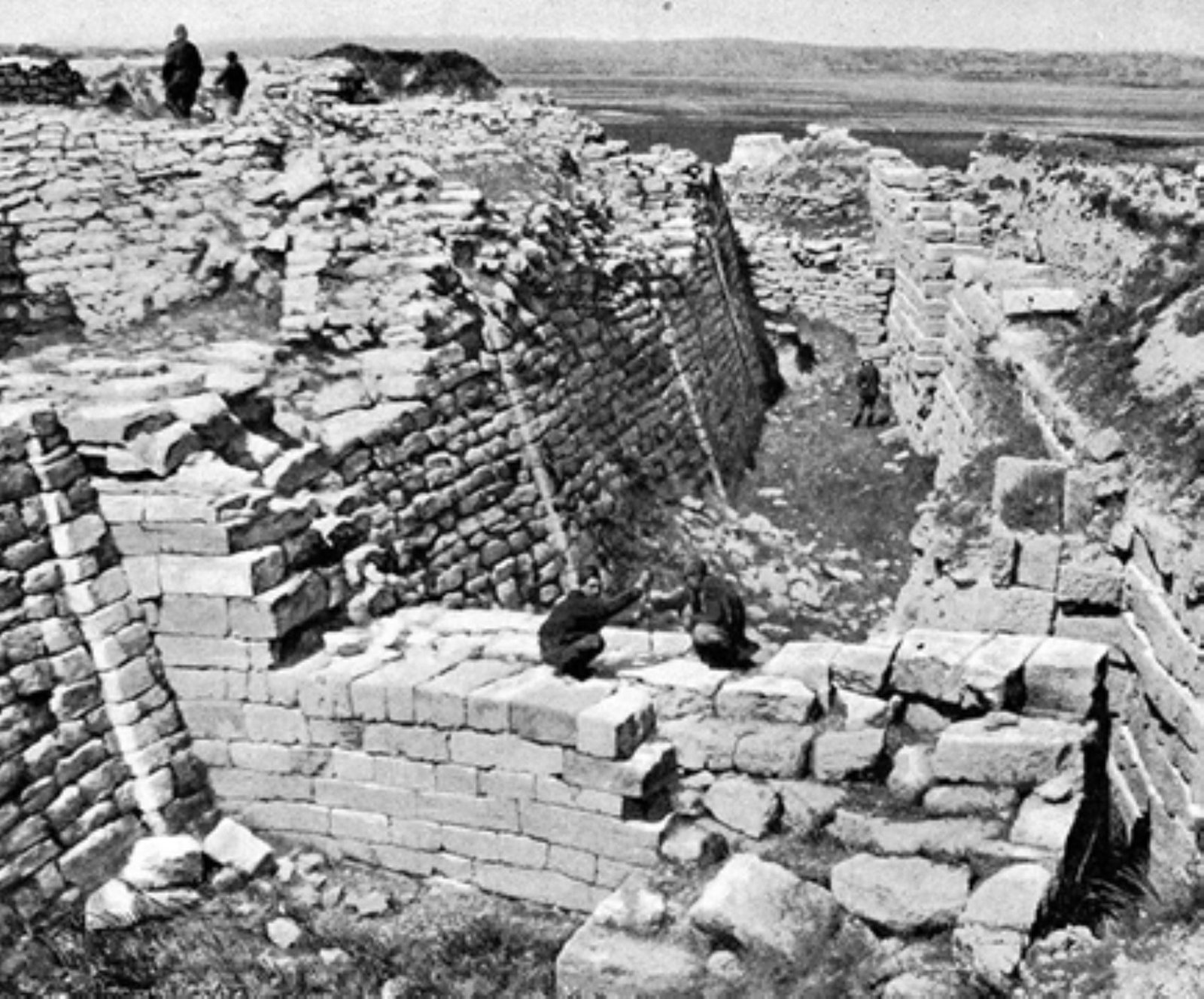
(The brutal excavation Schliemann conducted at Çanakkale-Hisarlık Hill)
***
Apart from the magnificent gold and ceramic findings that Schliemann called "Priam's treasure," one of the most spectacular artifacts found in Troy that has survived to the present day is the marble metope showing the Sun God Helios and the four horses pulling his chariot.
This is called the "Helios Metope."
What is this "metope"?
First, one needs to look at the eaves of the temple, that is, the frieze. In the frieze of temples in the Doric style, or more accurately, the Doric order, there are rectangular stone blocks with three vertical grooves on them.
These are called "triglyphs." The name means "three grooves" in Greek.
The rectangular marble slabs remaining between the triglyphs, which are either decorated with figures or left plain, are called "metope" .
The frieze on the exterior facade of the Temple of Athena, built in Troy during the Hellenistic and Roman eras, was also decorated with these metopes.
These are generally used in temples of the Doric order to provide architectural order and add aesthetic visuality to the temples.
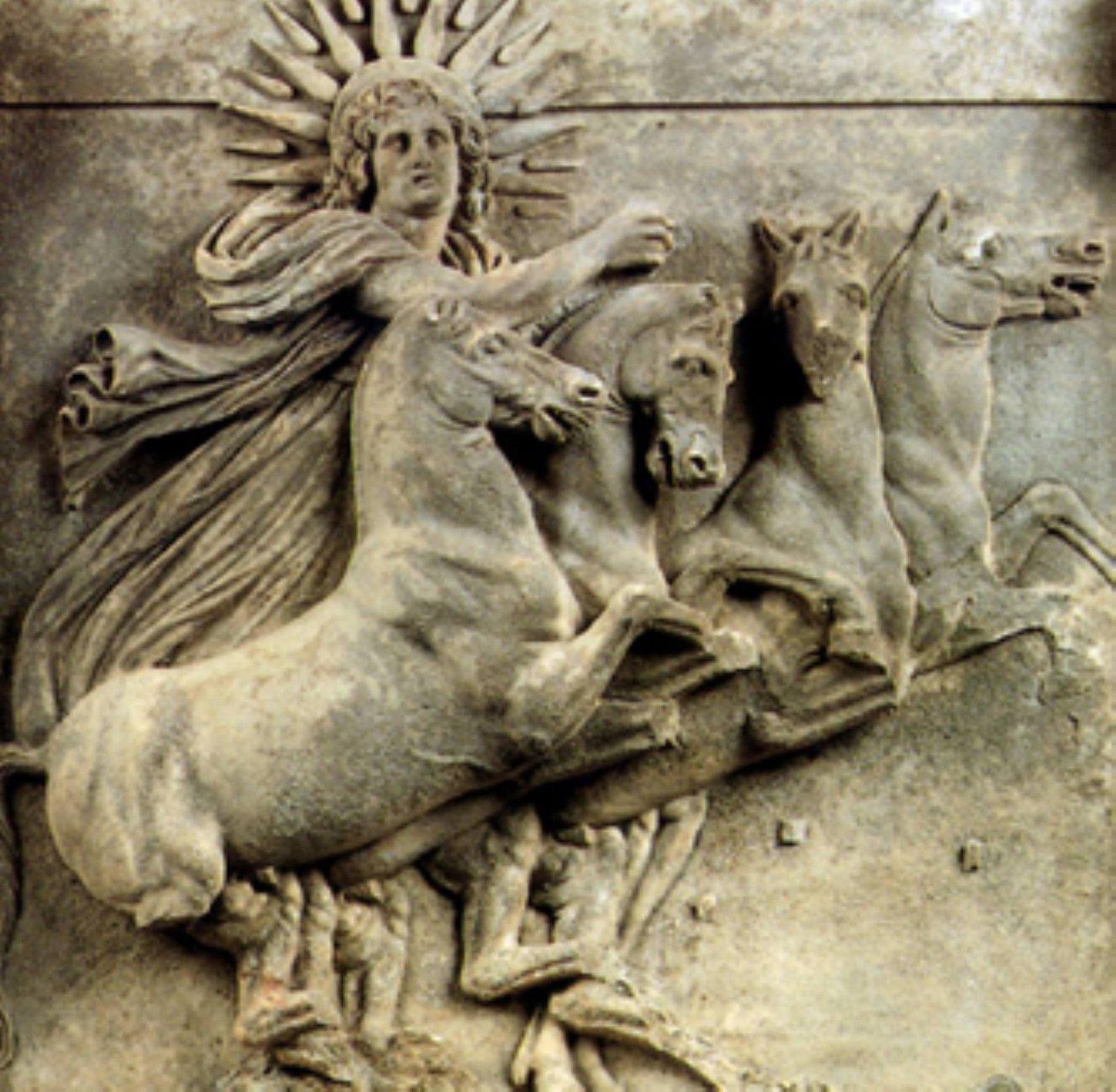
(Helios Metope)
***
Such temples are the simplest, heaviest, and most powerful-looking temples of ancient Greek architecture.
They take their name from the Dorians, one of the ancient Hellenic tribes.
The columns have no base. The column shaft sits directly on the stepped floor.
The columns are thick and strong; they taper slightly towards the top.
There are vertical grooves on their shafts.
In the Doric order, column capitals are simple. They are like a plain stone cushion that takes the load of the beam and transfers it to the column. The spiral ornaments (volutes) in the Ionic order or the acanthus leaves in the Corinthian order are not here.
In the frieze located above the columns (the ornate horizontal band surrounding the temple), triglyphs and metopes are arranged alternately. This is one of the most distinct signs of recognizing the Doric order.
Metopes can be decorated with reliefs.
The "metope" with the Helios relief that we know from the Troy Temple of Athena is also a part of this architectural system.
Their general appearance is simpler, more dignified, and monumental compared to the Ionic and especially the Corinthian order.
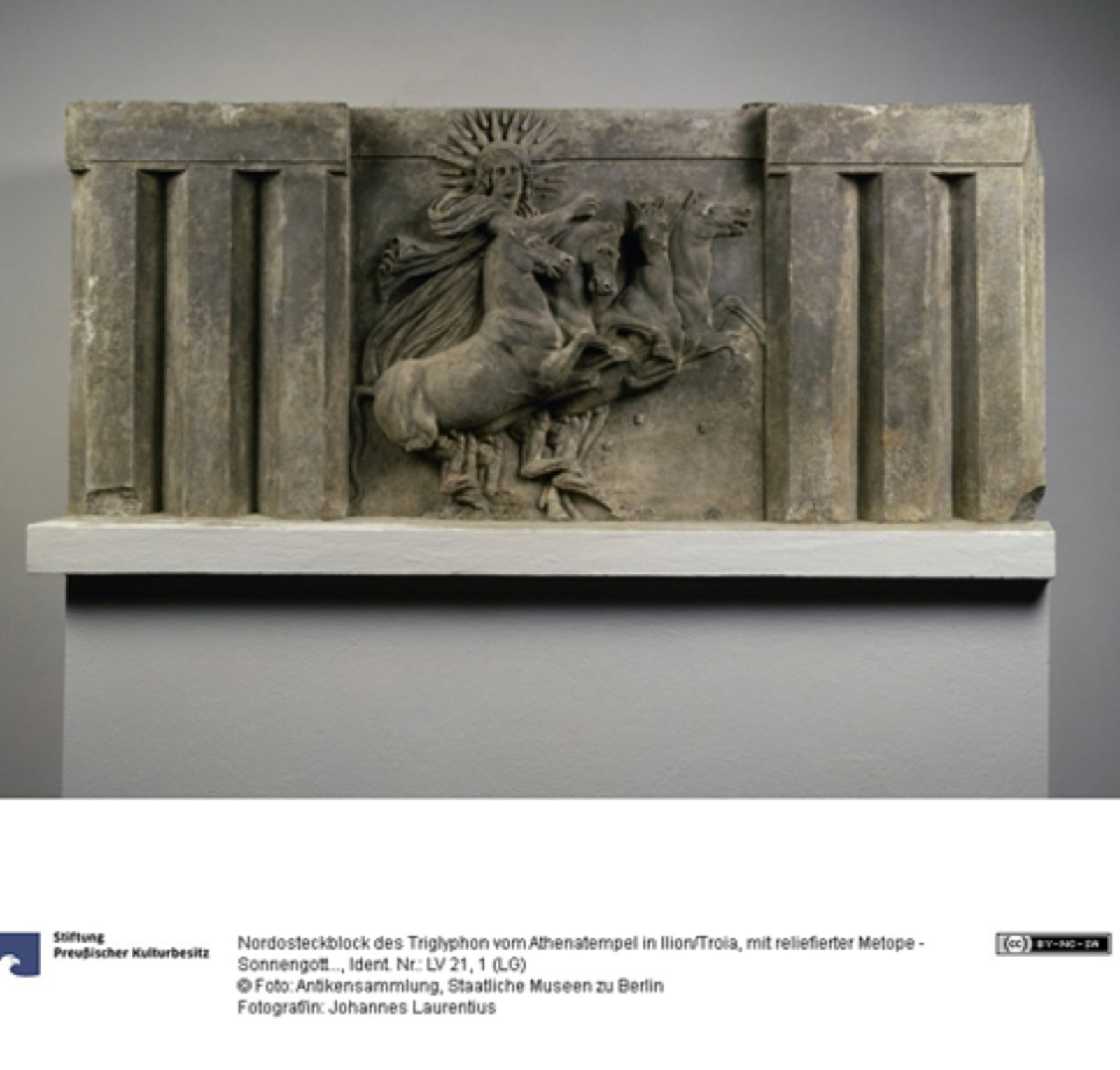
(Troy's Helios Metope, which was smuggled to Berlin and is currently kept in Berlin Museums/Prisons)
***
The exact construction date of the great Temple of Athena on the Troy Acropolis is still debated. There is no consensus among archaeologists on this matter.
The Berlin State Museums date the Helios Metope belonging to the temple to 300–280 BC. This date coincides with the view that the temple was built during the period of Lysimachus, one of Alexander the Great's commanders.
However, according to the assessments of US archaeologist C. Brian Rose, the findings obtained in the excavations show that the construction of the temple did not begin before 240 BC. There was an older Athena sanctuary/temple on the site of the temple built in the Hellenistic period.(C. Brian Rose, The Archaeology of Greek and Roman Troy, Cambridge University Press, 2014.)
Homer also mentions a temple of Athena on the Troy acropolis in the Iliad, during the period he lived and created the epic (8th-7th century BC).(Homer, Iliad, VI. 86-98 and 269-311. Turkish translation: Azra Erhat - A. Kadir.)
However, the existence of such a temple in the 12th-century BC Troy, where the events in the epic are assumed to have taken place and where Troy is assumed to have fallen, has not been archaeologically proven.
The clear archaeological traces remaining to the present day regarding the Athena sanctuary in Troy belong to later periods. Homer may have carried the religious world of his own era to the Troy of the past.
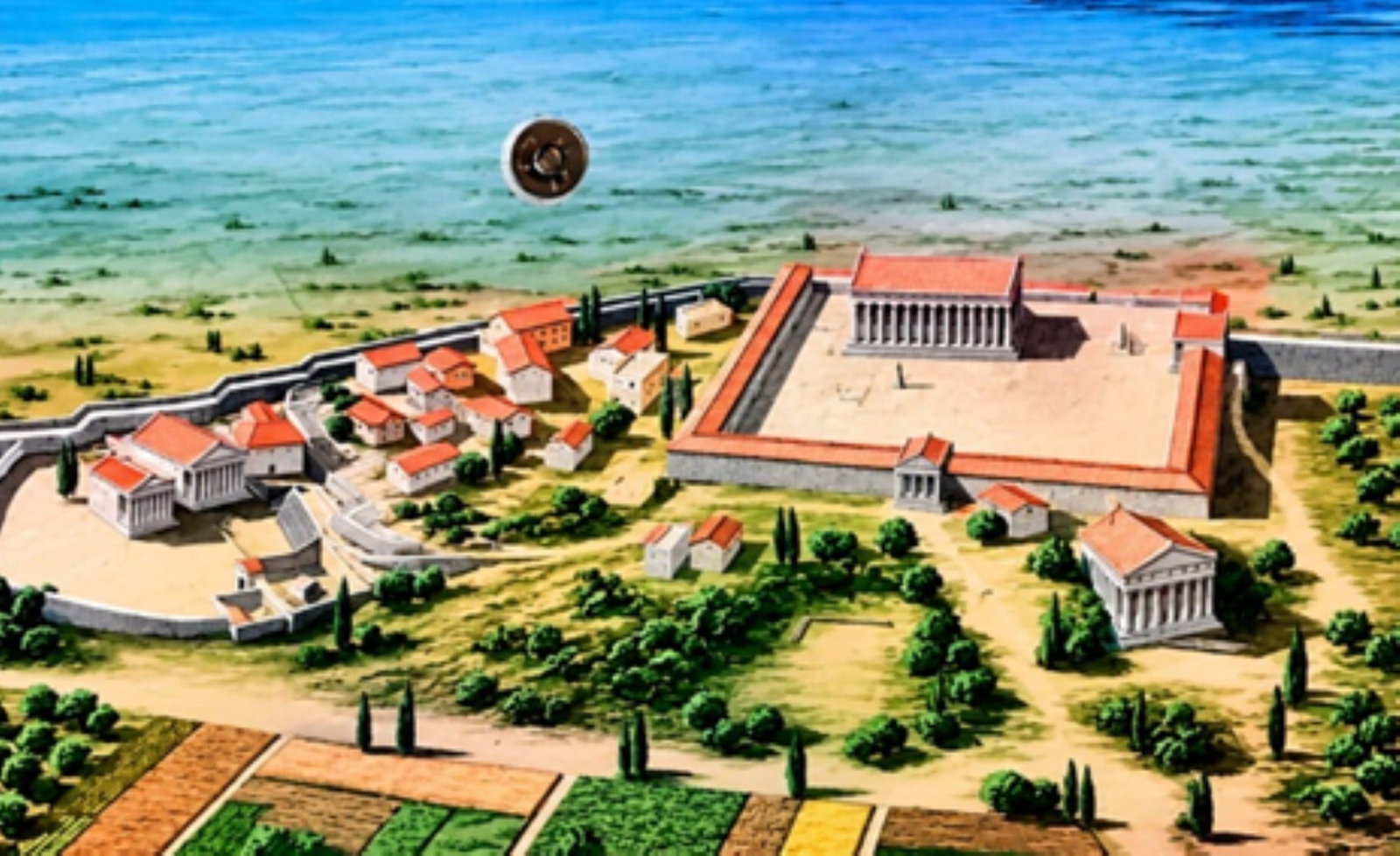
(Troy and Athena temple-Reconstruction)
***
The temple, whose ruins Schliemann found, was built in the Hellenistic period and measured approximately 36x16 m, and was renovated during the Roman period in the time of Emperor Augustus (31 BC–14 AD).
The Helios relief series located on the north facade of the temple symbolizes a cosmic and mythological order:
The beginning of the narrative in the friezes is in the east. The Sun God Helios, rising from the sea, rises from the sea with his four-horse chariot.
It is thought that scenes showing the Trojan War and the struggles of the heroes might have followed.
It is thought that the series might have been completed at the opposite end with the Moon Goddess Selene..
The composition starts with the morning and ends with the night!
The Temple of Athena, which was also used in the Roman period, lost its importance in Late Antiquity.
With the earthquakes that affected Troy in the late 5th and early 6th centuries AD and the gradual abandonment of the city, the temple also disappeared.
In the following centuries, the stones of the structure were dismantled and used in other buildings, and only traces consisting of foundations and architectural fragments remained from the magnificent temple.
And Troy fell asleep for long centuries!
It was even forgotten!
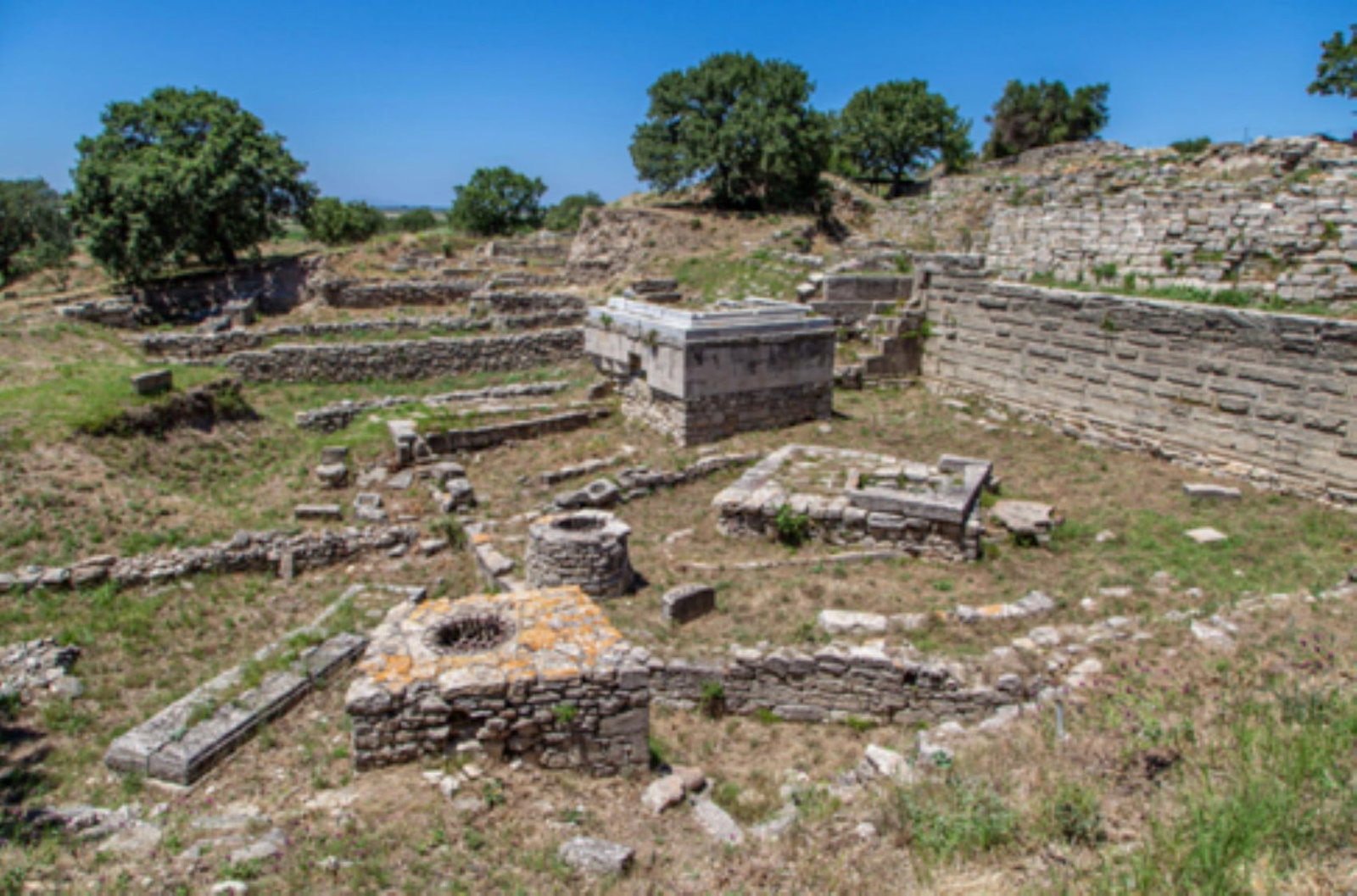
(Ruins of the Athena temple in Troy-Today)
***
The "Helios Metope" was a part of the frieze of Troy's famous Temple of Athena and was found on the land owned by Frank Calvert on the Çanakkale-Hisarlık hill.
A property dispute had arisen between an Englishman and a German over a valuable Anatolian artifact.
They were two elements of Europe's pre-imperialist colonial period.
Sometimes they competed, sometimes they even fought, and sometimes they compromised.
Whose would Troy's "metope" be? For this reason, Schliemann and Calvert would both claim rights over the metope.
Calvert thought the "metope" was quite valuable.
According to the Scottish researcher David Traill (1942-2025), based on the correspondence between Schliemann and Calvert, Calvert estimated the value of the artifact at approximately 500 pounds (3.7 kg of pure gold), and calculated that his share would be approximately 240 pounds (1.7 kg of pure gold) after shipping costs were deducted.(David A. Traill, “Schliemann's Acquisition of the Helios Metope and his Psychopathic Tendencies”, Myth, Scandal, and History (1986), pp. 8–80)
Despite this, he asked for only 125 pounds (0.92 kg of pure gold) from Schliemann for his share (acting generously in his own mind).
Schliemann did not accept this.
He told Calvert that no one would give him that amount and offered 40 pounds (0.29 kg of pure gold). In the end, he bought Calvert's share in the metope at this much lower price.
This is how they bought and sold Anatolian artifacts, bargained with each other, and smuggled them away.
Was imperialist culture something like this?
What else can you call this but robbery?
Or "the goods of a sinking ship."
The Ottoman Empire was sinking. And the artifacts on its lands were being snatched by whoever could grab them.
Of course, the fault was first with the thieves. But there were also those who left the door open.
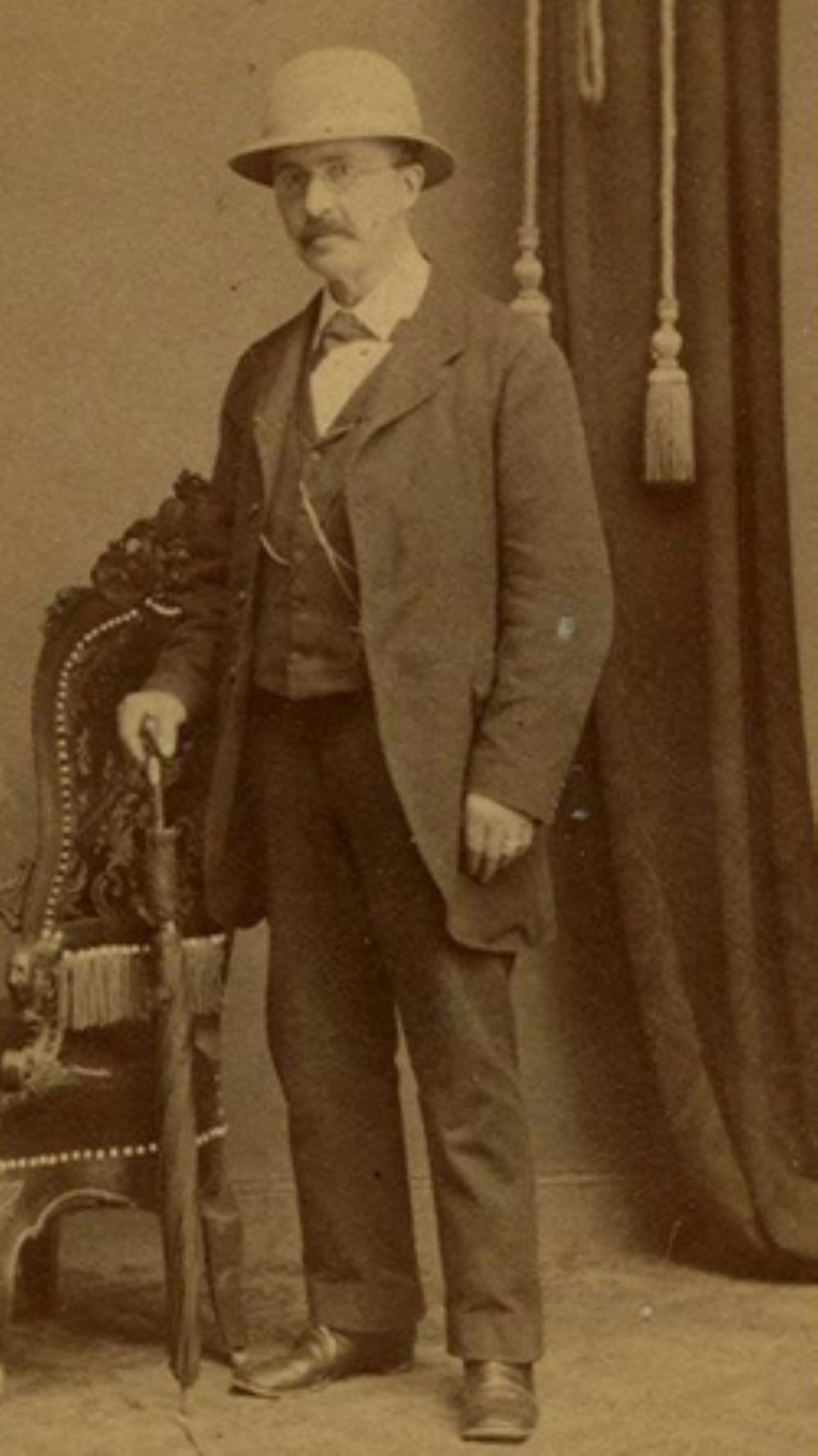
(Heinrich Schliemann)
***
Schliemann secretly smuggled the metope and took it to Athens.
Probably along with other artifacts.
There, he began to show the value of the artifact as much higher.
According to D. Traill, he spoke of a market value of 25,000–30,000 francs (7.3 kg - 8.7 kg of pure gold); in 1873, he valued the metope at 100,000 francs (29 kg of pure gold).(David A. Traill, “Schliemann’s Acquisition of the Helios Metope and his Psychopathic Tendencies”, W. M. Calder III - D. A. Traill (ed.), Myth, Scandal, and History: The Heinrich Schliemann Controversy, Detroit 1986, pp. 48-80.)
Of course, Calvert was also saying that this was many times the amount paid to him.
More importantly, taking the "metope" to Athens was also not legal.
According to the 1869 Regulation in force, it was clearly smuggling...
Research indicates that the metope reached Athens at the beginning of August 1872.
Researchers examining Ottoman sources also clearly evaluate the removal of the Helios metope from Troy in 1872 as smuggling .(Ali Sönmez, “Anadolu’dan Kaçırılan Miras: Troya Hazineleri”, Avrasya Uluslararası Araştırmalar Dergisi, Volume 8, Issue 21, March 2020.)
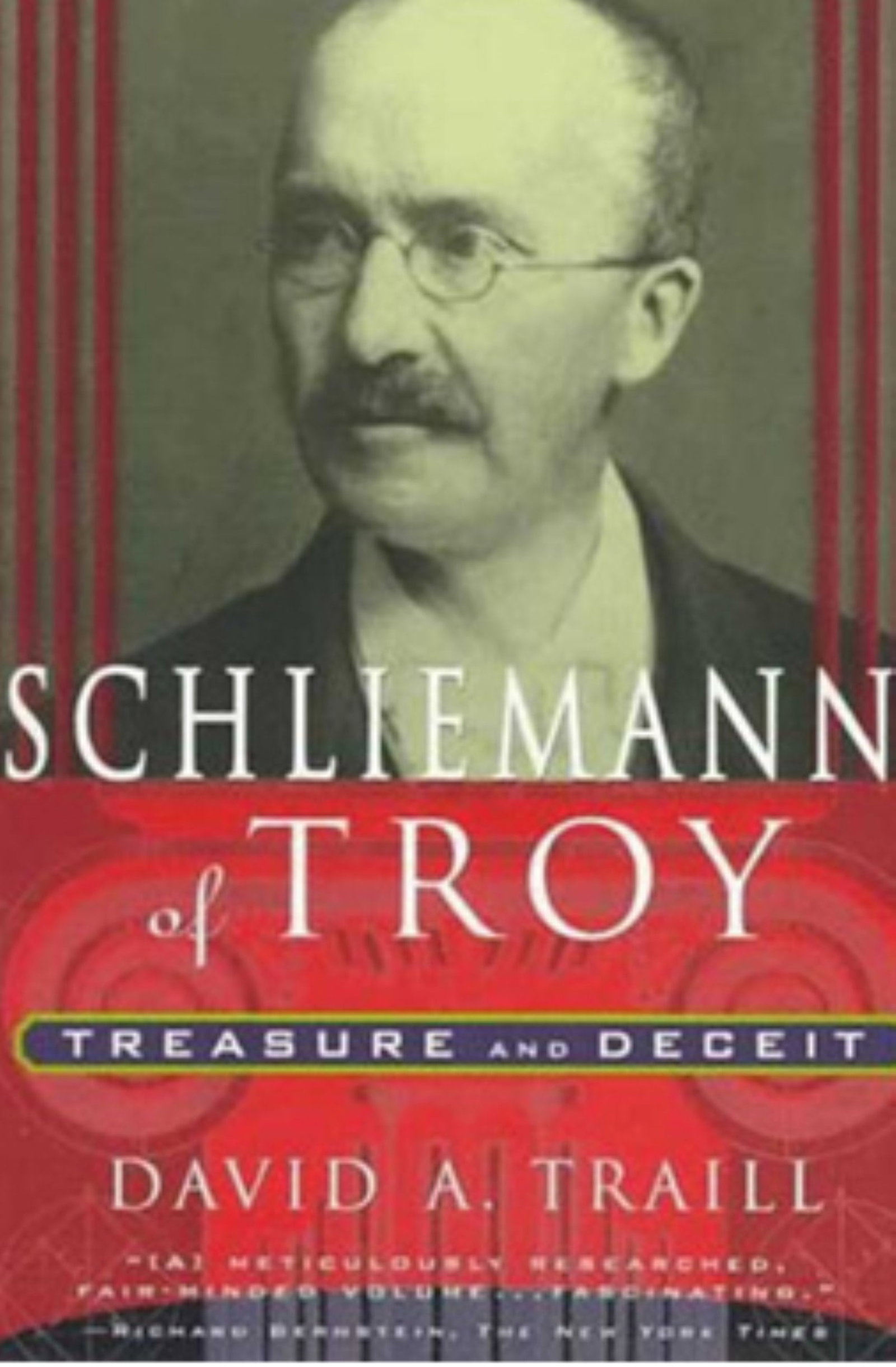
(David A. Traill’s book)
***
And in the same years, a little further south of Troy, in Bergama, there was another German:
Carl Humann.
Humann had come to Bergama in 1864-1865. He had become interested in the ancient ruins on the acropolis, and before larger excavations began, in 1871, he had sent/smuggled many relief fragments to Berlin.
It is not just us saying this. Even the Prussian Cultural Heritage Foundation, to which the Berlin museums are affiliated, admits that the frieze fragments sent to Berlin before the excavations were "subsequently legalized."(Eduard Schulte, “Humann, Carl”, Neue Deutsche Biographie 10, 1974; Stiftung Preußischer Kulturbesitz, “The History of the Finds: Nefertiti and the Pergamon Altar”, January 13, 2023.)
However, the First Regulation on Antiquities, which came into force in 1869, prohibited the removal of historical artifacts found on Ottoman lands abroad.
The sending of these artifacts also brought the issue of removing historical artifacts from Ottoman lands to the agenda.
Humann's excavations in Bergama before the 1878 excavation permit (https://www.deutsche-biographie.de/sfz35955.html?language=de&utm) were unauthorized; he was sending a significant portion of the artifacts he found to Berlin without obtaining permission from Ottoman authorities. (https://www.zeit.de/2022/02/archaeologie-osmanisches-reich-tuerkei-deutschland/seite-2?)
In other words, just like what Schliemann did in Troy, the name of Humann's secret removal of historical artifacts from Bergama abroad was also smuggling. (https://www.cumhuriyet.com.tr/turkiye/tas-yerinde-agirdir-1820820?utm)
In a harsher word:
"Theft."
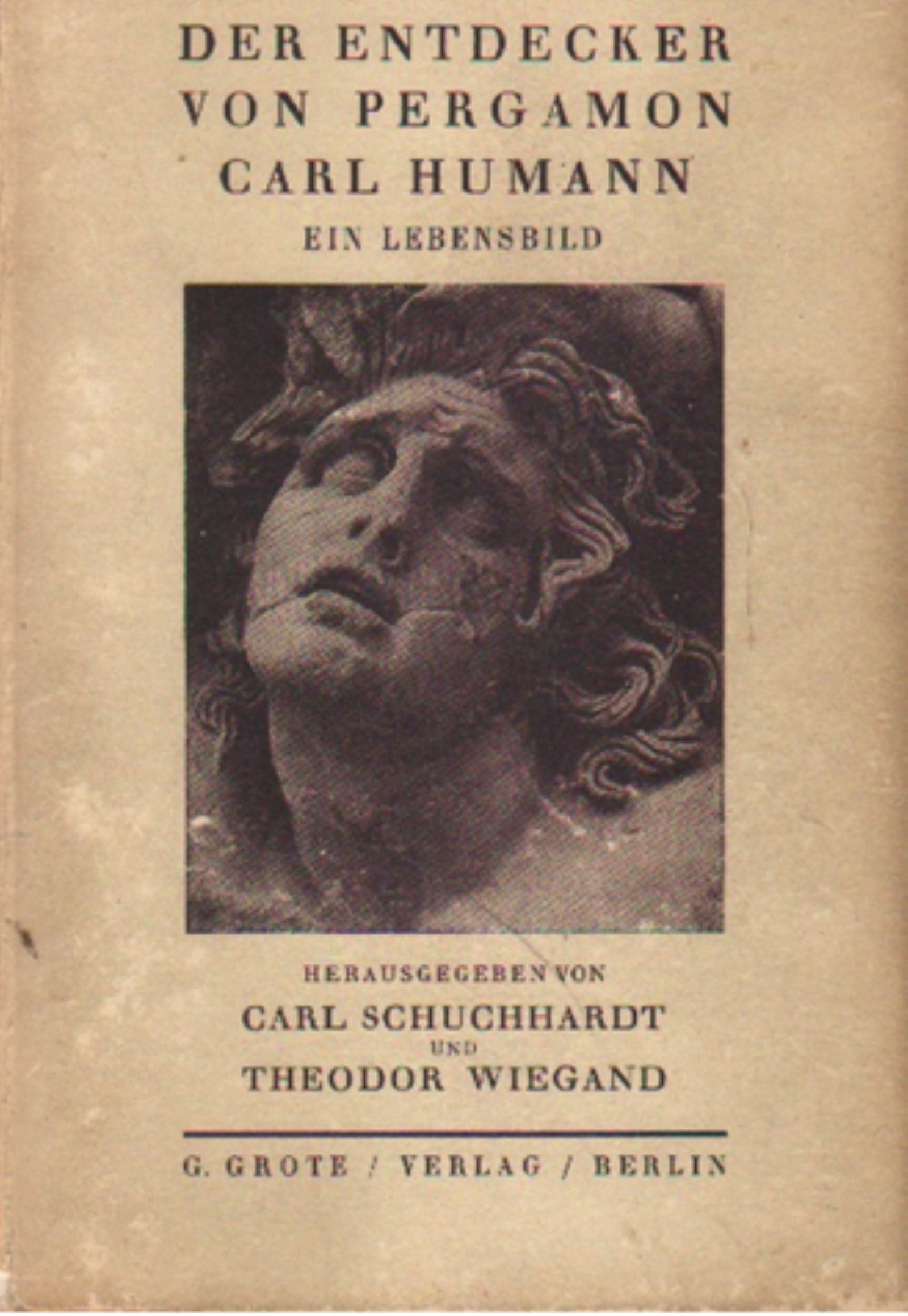
(The excavation diary where Carl Humann describes what he did/the crime he committed in Bergama)
***
Just as these events were taking place, an important change had also occurred in Istanbul, the capital of the Ottoman Empire.
The German archaeologist Philipp Anton Dethier was appointed as the Director of the Müze-i Hümâyun (Imperial Museum) in 1872 and was tasked with pursuing the Troy Treasure case in Athens on behalf of the state.
Dethier made significant but fruitless efforts on behalf of the Ottoman Empire to recover the treasure in Athens.
During this process, a new Regulation on Antiquities was being prepared. The person preparing it was again Dethier.
At first glance, it seemed like a coincidence: Dethier, who was trying to recover the Ottoman Empire's smuggled artifacts in Athens, was also the preparer of the regulation that reorganized the law on historical artifacts in Istanbul.
Was this really a coincidence?
The law on historical artifacts in the Ottoman Empire was changing. And in whose favor?
Following the great controversy created by Schliemann's smuggling of Priam's Treasure in 1873 and during the reckless smuggling process carried out by Carl Humann, the Second Regulation on Antiquities came into force on April 8, 1874. (Sinan Genim, “İmparatorluk ve Cumhuriyet Döneminde Korunması Gerekli Kültür Varlıkları Mevzuatı”; Nurettin Can, 1948.)
Four days earlier, on April 4, 1874, Saffet Pasha had been appointed as the head of the Ottoman Ministry of Education. As soon as the new minister took office, the regulation was approved.(Source: TDV İslâm Ansiklopedisi, “Saffet Mehmed Esad Paşa” and “Ârifî Ahmed Paşa” entries.)
This new regulation prepared by Dethier left one-third of the artifacts found in excavations to the state, one-third to the landowner, and one-third to the excavator.
More importantly, the excavator could take the artifacts that fell to their share abroad.
The understanding of the 1869 Regulation, which tried to strictly prevent the removal of artifacts abroad, had thus changed significantly.
Another legal path had now been opened for foreign excavators to acquire historical artifacts from Anatolia.
It would be seen in the coming years that this regulation would facilitate the work of foreign excavators, especially teams working on behalf of large European museums.
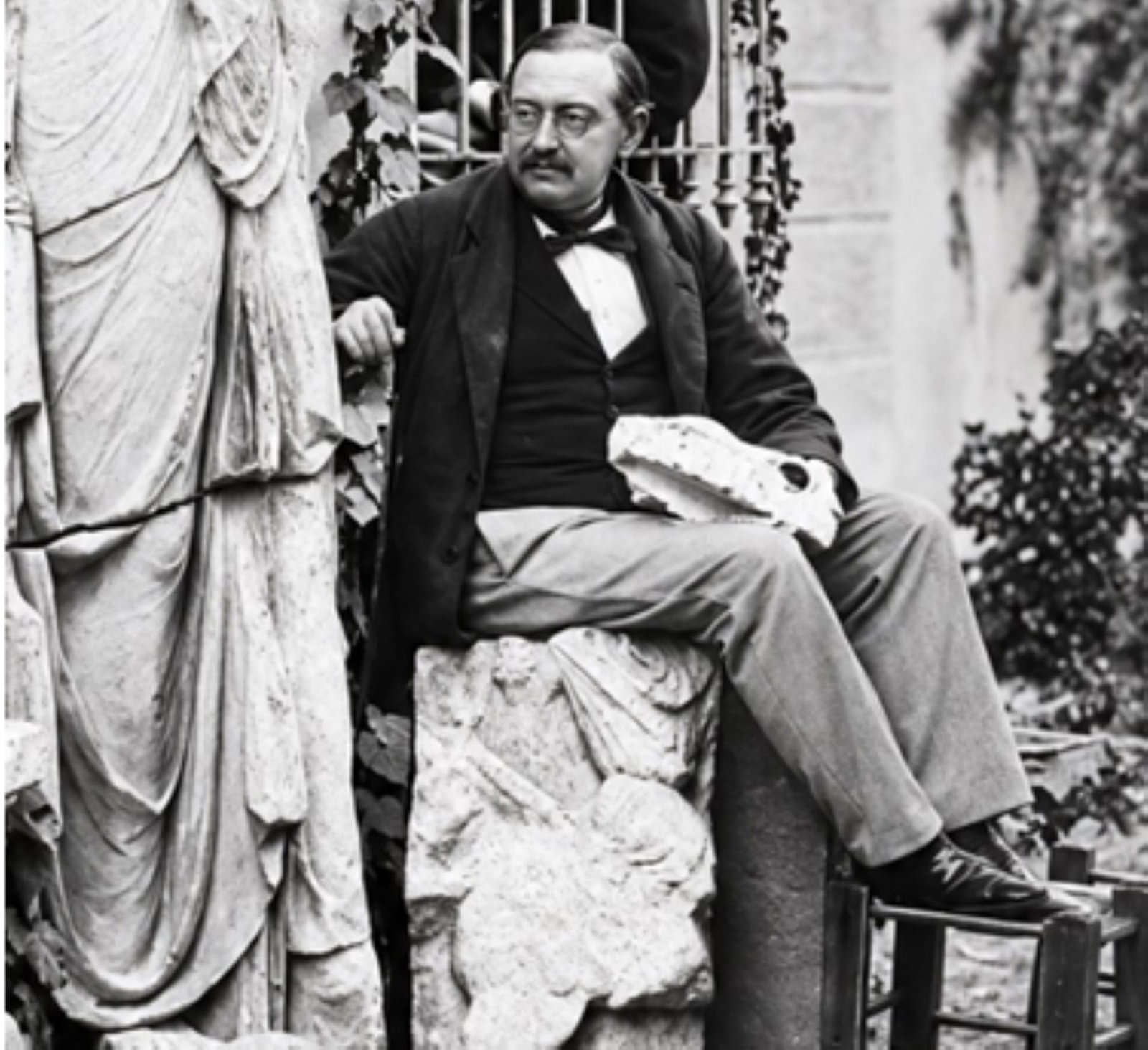
(P.A. Dethier. 19th-century photograph registered in the Alamy archive under the title “Philipp Anton Dethier and his collection.” Public domain.)
***
The 1874 Regulation gave foreigners excavation permission and allowed for the removal of a certain amount of findings abroad, but
patriotic Ottoman officials prevented the implementation of this law until 1878 and did not grant exit permits.(https://12punto.com.tr/yazarlar/sefa-taskin/bu-memleket-bizim-86291)
In 1875, the Ottoman Empire gave up on the Troy Treasures case, forced by the dragging out of the case in Athens and probably by the pressure of foreign states.
In the same year, the Council of Education (the board responsible for the Ottoman Empire's education and culture affairs) decided "not to grant Schliemann any more excavation and research permits in Troy."
But it didn't take long, and who knows under whose pressure and influence, Schliemann received permission to excavate in Troy again in 1876. Then, these permissions continued three more times in 1878, 1882, and 1890. Ostensibly, it was still forbidden for him to take the artifacts abroad.
The names at the head of the Ministry of Education were changing frequently: Saffet Pasha in 1874, Ârifî Pasha in 1875, and Saffet Pasha again at the end of the year. An administration that was pursuing the treasure in the courts on one hand, and reopening the door to the smuggler on the other. The ministers were changing, but the door always remained ajar. (Source: TDV İslâm Ansiklopedisi, “Saffet Mehmed Esad Paşa” and “Ârifî Ahmed Paşa” entries.)
While Schliemann was continuing his work quietly, the Germans in Bergama were struggling because they could not take the Zeus Altar pieces even though they had passed the necessary law, and they were even trying to get permission from the Ottoman Empire by involving Crown Prince Friedrich Wilhelm, who would later briefly become the German Emperor under the name Frederick III.
They would get their wish before long.
In 1878, the Ottoman government granted the necessary permission for excavations in Bergama.
Following the political turmoil experienced after the assassination of Sultan Abdülaziz, the heavy defeat suffered in the Ottoman-Russian War, and as a result of the pressure of the German State, the law was implemented in exchange for a small donation during the reign of Abdülhamid II, permission was granted; Carl Humann continued his excavations and continued to transport the artifacts to Germany.
Thus, the large and official German excavations in Bergama began in 1878.
The permission was based on the triple-sharing principle in the 1874 Regulation: one-third of the findings would be left to the state, one-third to the excavator, and one-third to the landowner.
The German team led by Humann began digging on the Bergama Acropolis without delay.
In addition to the artifacts he had previously found and smuggled, he dismantled many statues and the remaining sections of the Zeus Altar's giant Gigantomachy friezes from the fortification walls; he excavated the small mound where the Altar foundations were located, unearthed the remaining sections of the structure, and seized them.(Philipp Vandenberg (1984): “Das Versunkene Hellas, Die Wieder entdeckung Des Antiken Griechenland”, pp. 168, 210)
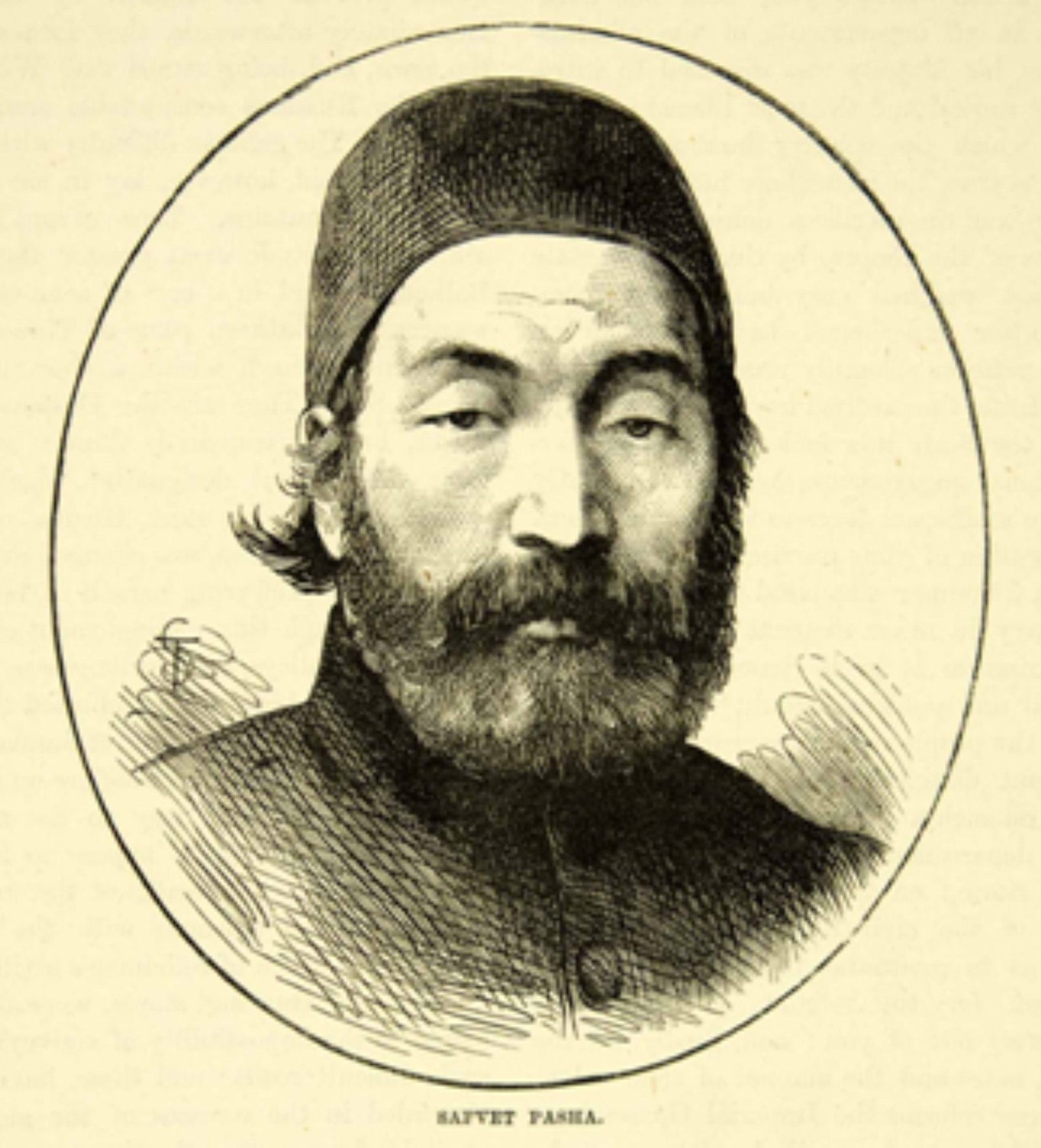
(Mehmet Esat Saffet Pasha)
***
All these practices in Bergama were carried out in accordance with the 1874 Regulation on Antiquities.
According to the law in force, the artifacts coming out of the excavations were to be divided into three between the excavator, the state, and the landowner. This division would be made by the German manager from Göttingen of the Ottoman Bank in İzmir.
However, the primary goal of the Germans was not to leave any piece of the Zeus Altar behind.
As a result of intense pressure, they achieved their goals.
German colonialism/imperialism succeeded in obtaining the large friezes of the Zeus Altar and other important pieces.
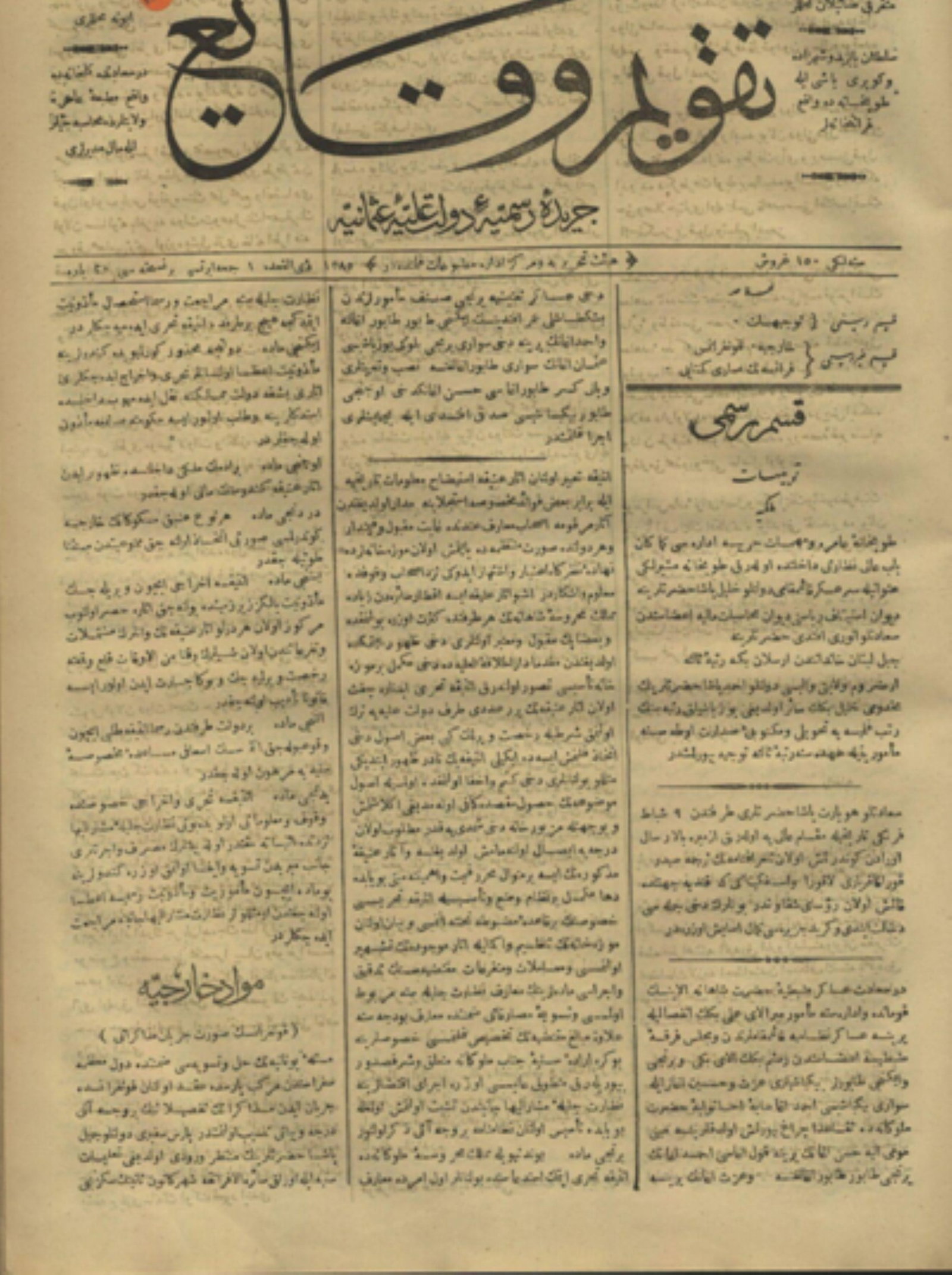
(Ali Sönmez: Yitik Miras: Zeus Sunağı. 14: 1874 dated Asar-ı Atika. As a source for that, Rûznâme-i Cerîde-i Havâdis, 1874, issue 2446)
***
For this reason, the departure of the Troy Treasure, which was smuggled by being put into crates and pockets secretly as Schliemann did in Troy, and the Zeus Altar in Bergama to Berlin, mostly happened with a similar method, smuggling.
And some with dubious permissions and agreements.
But in the end, the most important artifacts of Anatolia's two great ancient cities were setting off towards Europe in the same years.
Helios from Troy...
The artifacts called Priam's Treasure from Troy...
Zeus Altar from Bergama...
And most of the roads led to Berlin.
To the center of the German state...
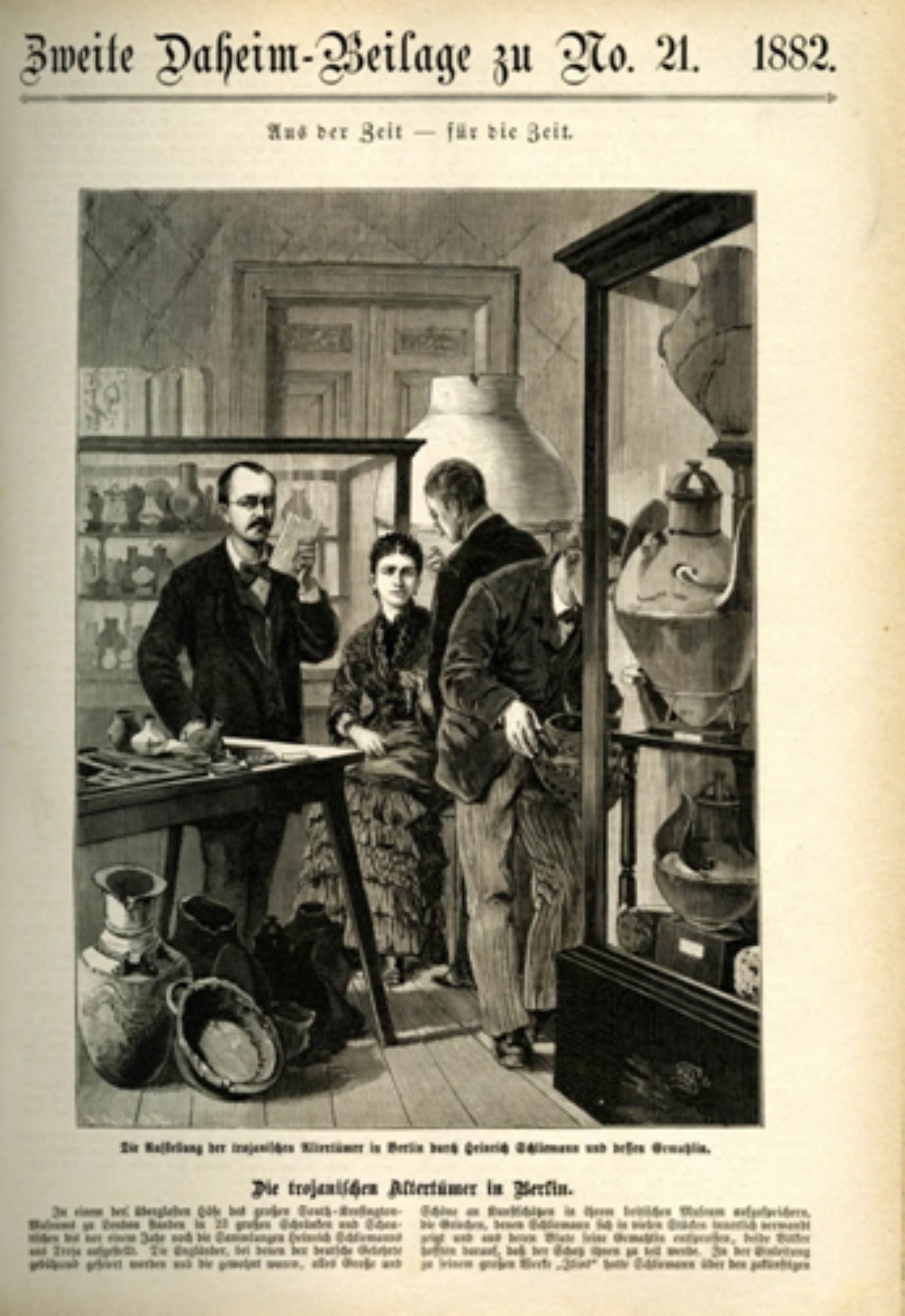
(Schliemann explaining in Europe that he found Troy.)
***
In 1881, Philipp Anton Dethier, the Ottoman Museum Director and an observer and perhaps the preparer of this process, died.
Osman Hamdi Bey, a son of a Pasha, was appointed as the Director of the Müze-i Hümâyun.
Osman Hamdi Bey, who was actually a painter, could see what kind of picture was in front of him.
Foreign excavations were being carried out all over Anatolia, and a significant portion of the artifacts found were going to European museums.
Three years later, on February 21, 1884, the new Regulation on Antiquities came into force.
With this third regulation, the fundamental understanding changed.
Historical artifacts found in excavations would be considered state property and could not be taken abroad.
This regulation brought by Osman Hamdi Bey placed a legally much stronger obstacle in appearance in front of the removal of historical artifacts from Anatolia.
However, the regulation did not bring an absolute and exceptionless ban. Article 32 allowed for some artifacts to be taken abroad under certain conditions.
This situation gave Museum Director Osman Hamdi Bey great initiative regarding which artifacts could be taken abroad. This led to great controversies and suspicions. (Yaşar Yılmaz. Osman Hamdi Beyin Öteki Yüzü. Korpus Kitap. 2023)
Especially, the fact that one of Osman Hamdi's paintings, who also painted pictures similar to orientalists, was purchased by German Museums, his close friendship with the smuggler Carl Humann, and his relations with Schliemann created question marks.(Franscis Bacon. Assos days. An archaeological expedition to Asia Minor American Schools of Classical Studies. Athens. 47. Quoted by: Rüstem Aslan. p. 24)
Both Humann's and Schliemann's excavations continued during Osman Hamdi Bey's term of office.
One of the documents that best explains these relationships is a photograph.
March 1890. Hisarlık.
Schliemann's claim that he found Troy was still being debated. German captain Ernst Bötticher argued that Hisarlık was not a city but a cemetery where the dead were burned, and accused Schliemann of distorting the findings. Schliemann also called scientists from Europe to the hill.
Who wasn't on the hill?
Heinrich Schliemann, who robbed Troy, and his wife Sophie.
Carl Humann, who transported the Zeus Altar from Bergama to Berlin.
Frank Calvert, who was deceived by Schliemann regarding the Helios metope.
And in the middle, Osman Hamdi Bey, the Director of the Müze-i Hümâyun, tasked with protecting the Ottoman Empire's historical artifacts.
What was being debated was where Troy was. What was not being debated was where Troy's artifacts were.
Did Osman Hamdi Bey ask this question that day? We don't know. Looking at his comfort in the photograph, we don't think so.
Unfortunately, the situation was like this. The documents say these.
Very important artifacts of both Troy and Bergama had long since left Anatolia and fallen into foreign hands!
The historical artifact robberies of Troy, Bergama, and Gaziantep were the work of the same actors of the same period, outside of political will.
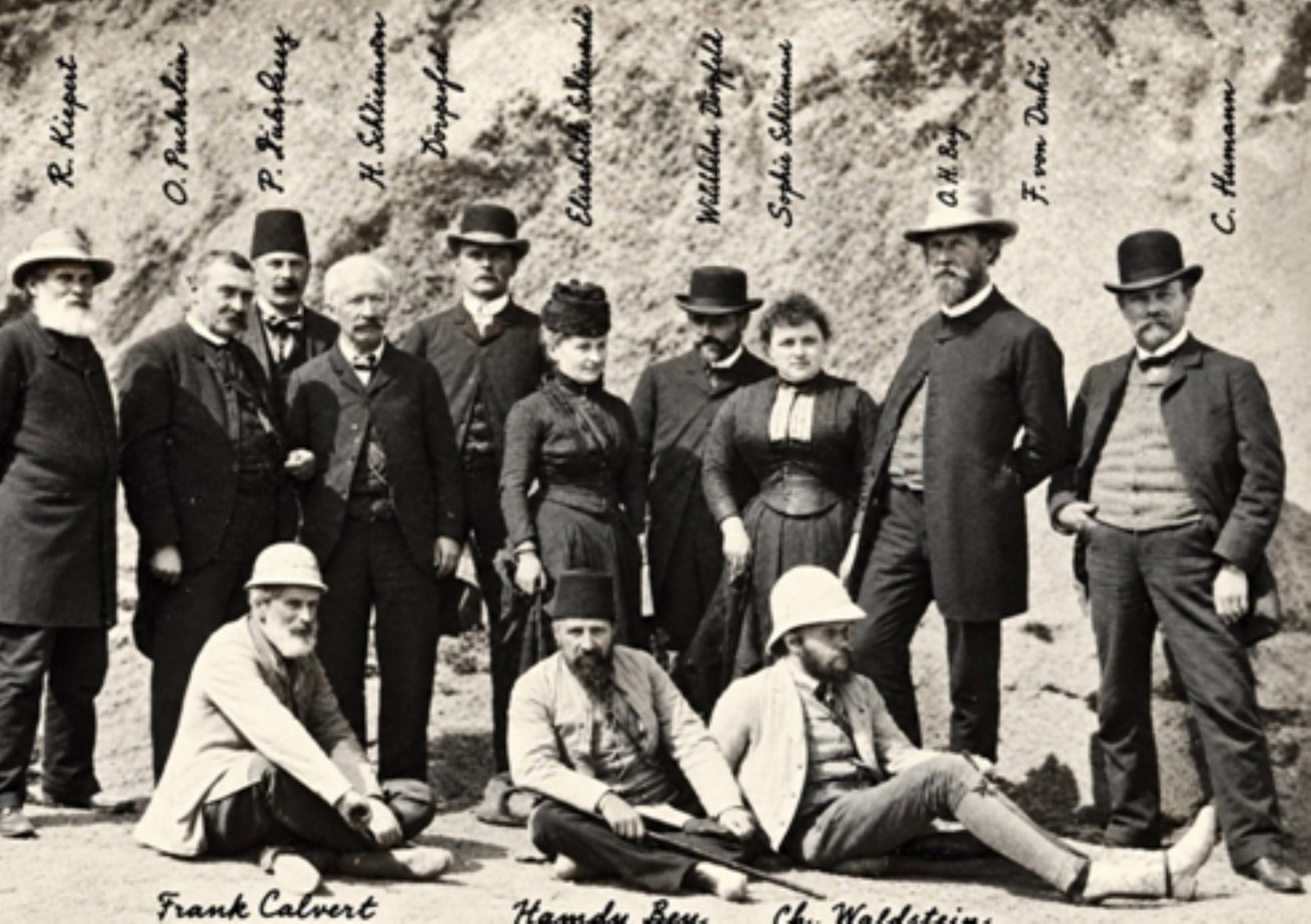
(We are publishing this historical meeting once again. March 1890, Hisarlık. The so-called scientific meeting gathered to discuss whether Troy is really here. All problematic local and foreign people are together. Source: Deutsche Digitale Bibliothek.)
***
When we look at all these dates side by side today, an interesting picture emerges.
Year: 1864/1865.
Carl Humann comes to Bergama. He begins to take the pieces of Bergama's Zeus Altar.
1869.
With the First Regulation on Antiquities issued during the reign of Sultan Abdülaziz, the first general ban against the removal of historical artifacts abroad is brought.
1872.
Schliemann smuggles the Helios metope from Troy, Ottoman land, to Athens.
1873.
"Priam's Treasure" is smuggled from Troy.
1874.
The Second Regulation on Antiquities prepared by Dethier is issued. It is accepted that the artifacts found in excavations be divided into three between the state, the landowner, and the excavator; the way for the share falling to the excavator to be taken abroad is opened.
1878.
With the permission given under German pressure after the Ottoman-Russian war, Humann's new excavations in Bergama begin and the artifacts begin to be transported to Berlin, supposedly officially.
1881.
Dethier dies, Osman Hamdi Bey comes to the head of the Müze-i Hümâyun.
1884.
Osman Hamdi Bey issues the 3rd Regulation on Antiquities. Although it is ostensibly forbidden to take historical artifacts found in excavations abroad, with Article 32 of the law, Osman Hamdi
Bey allows the removal of artifacts he deems appropriate abroad. This creates great suspicions
Twelve years...
Twelve years that changed the fate of Anatolia's historical artifacts.
1896
The Austrian Embassy reports that the sultan has given permission for some artifacts to be selected from the Ephesus excavations to be taken to Vienna.
Osman Hamdi Bey, for some reason, objects, saying that this is contrary to the Regulation on Antiquities in force.
1906
During the reign of Abdülhamid II, the Ottoman Empire's last Regulation on Antiquities is issued. The provisions regarding the protection of historical artifacts are made even more detailed and strict.
The historical process is like this.
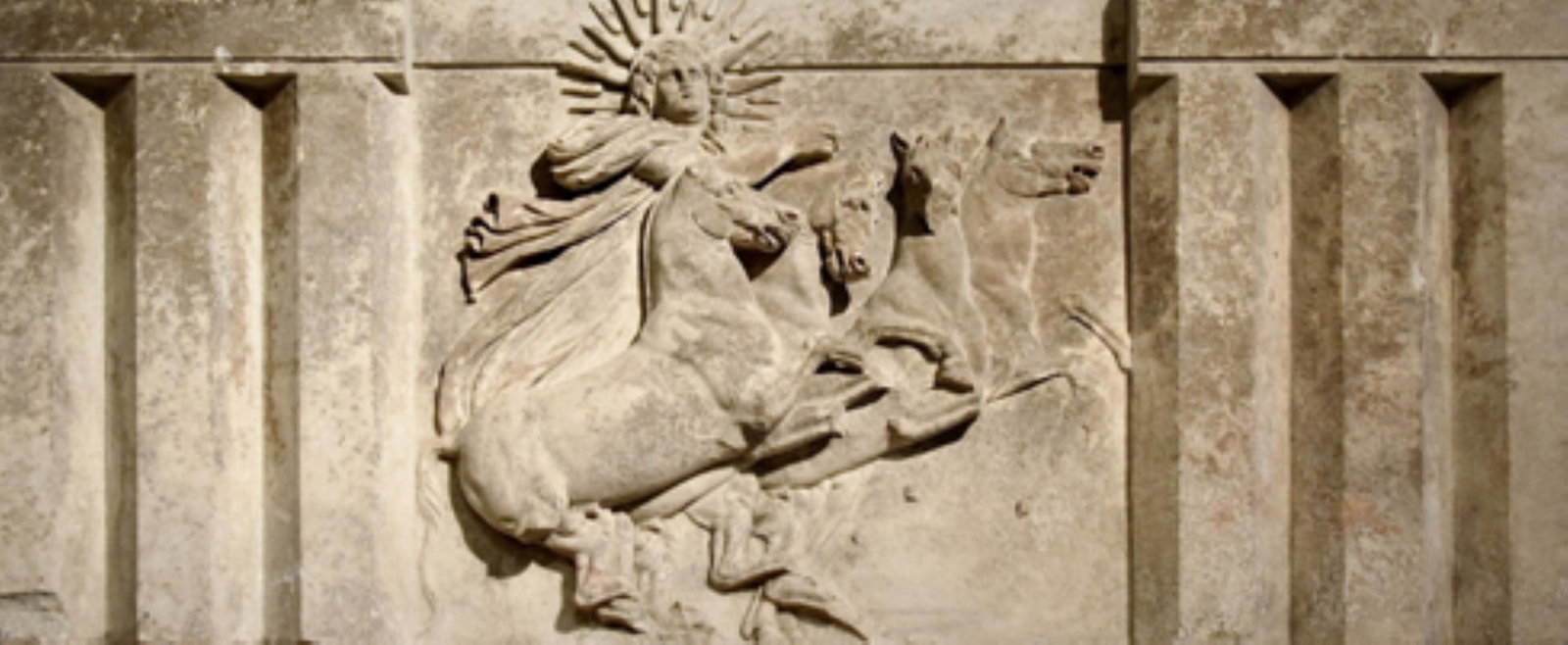
(Troy's Helios Metope. Berlin Museums/Prisons. Vertical grooves/triglyphs on the side)
***
Troy's Helios metope is in the Berlin State Museums collection today.
This marble block, weighing approximately one and a half tons (1500 kg) belonging to the northeast corner of the Troy Temple of Athena, is registered in Berlin records as "LV 21,1"; and in the Museum für Vor- und Frühgeschichte collection with the number "Sch 9582."
In its record, it is dated to 300–280 BC.
Helios, who once stood on the roof of the Troy Temple of Athena, was rising from the sea with his chariot pulled by four horses.
Perhaps from the deep blue waters of the Aegean Sea.
A sparkling sun...
It is in Berlin today.
The large friezes of the Bergama Zeus Altar are also in Berlin.
Those magnificent statues.
A parade of gods.
The Troy Treasures, which Schliemann called "Priam's Treasure," also went as far as Berlin, and after the Second World War, they were scattered to Moscow and St. Petersburg this time.
The pieces of Bergama's Zeus Altar also went to Petersburg, the Soviet Union, by rail from Berlin in 1945 in wooden crates, and returned the same way in 1958.
Three great stories...
The same lands...
The same century...
The same years...
And the same people, laws, states, and museums mixed with each other...
That is why the story of the sun god Helios is not just the story of a marble metope.
It is also the story of how Anatolia's historical artifacts changed hands in the 19th century.
An Englishman and a German had bargained among themselves for the money of a stone that came out of Troy.
But no one had asked the most fundamental question:
Was this stone really theirs?
The Helios metope was neither Calvert's nor Schliemann's.
It was Troy's.
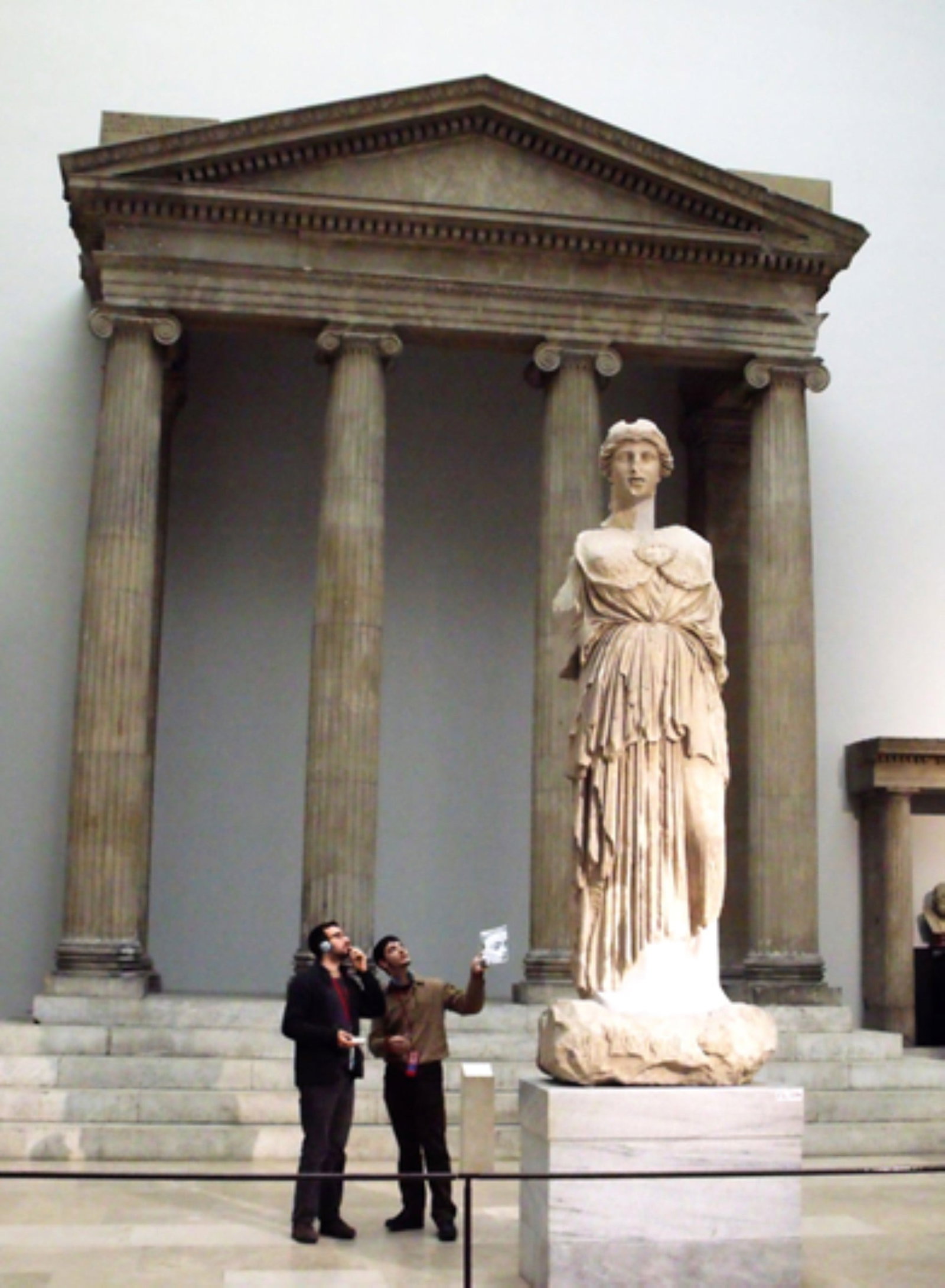
(The door of the Athena Temple and the 3.6 m high Athena statue that Carl Humann took to Germany with/without permission)
The Zeus Altar and the Athena statue were not Humann's either.
It was Bergama's.
Anatolian soil hid them for thousands of years.
It protected them in the harsh arms of history.
When they were brought to light, they were not left where they belonged.
Some were smuggled secretly.
Some were taken with controversial permissions through the paths opened by the laws of the period.
But in the end, the stones were torn from their places.
Today, Helios is still on his four horses.
The sun is still shining in the Aegean sky.
Zeus is still fighting the giants.
The north wind of Madra Mountain is still waiting for him.
But one is not in Troy, and the other is not in Bergama.
Because...
A stone is heavy in its place.
Sefa Taşkın
08.11.2026
Bergama/İzmir
Would you like to get notifications about new developments and save news?
- NotificationsNew developments and breaking news
- SaveNews is stored in the app
Most Read
Petty officer wounded in weapons accident in Şırnak has died

First statement from Çiğdem Batur after investigation launched against her

Is technology for humanity, or for exploiting humanity?
Downpours, snow, and strong winds are coming
Nobel laureate Stiglitz's alternative to neoliberal capitalism: Progressive Capitalism
There is no such thing as clean gold - 1 Who is erasing gold's memory?

Boğazdan yükselen gemi sesleri bana neyi hatırlatır?

An economics piece: Did Ali Koç buy shares too?

The cheapest new cars have been announced
The person who ended their life by jumping from the bridge turns out to be a businessman!