Stating that the chapel located right next to Fethiye Mosque will also be opened to service as a museum, Dr. Archaeologist Murat Sav said, "When significant structural remains began to emerge during the excavation, it was concluded that it would be better to evaluate this place as an archeopark, and a project was carried out for this purpose. The excavations have reached their final stage. Along with the parekklesion section, the courtyard side has been evaluated as an archeopark and museum."
Built in Fatih in the late 13th century by Michael Glabas Tarchaneiotes, one of the prominent figures of the Byzantine Empire, the Pammakaristos Church began to be used as a patriarchate from 1454 after the conquest of Istanbul.
It was converted into a mosque as a memento of the conquest following the conquest of Georgia and Azerbaijan during the Iranian wars carried out in 1601, during the reign of Sultan Murad III.
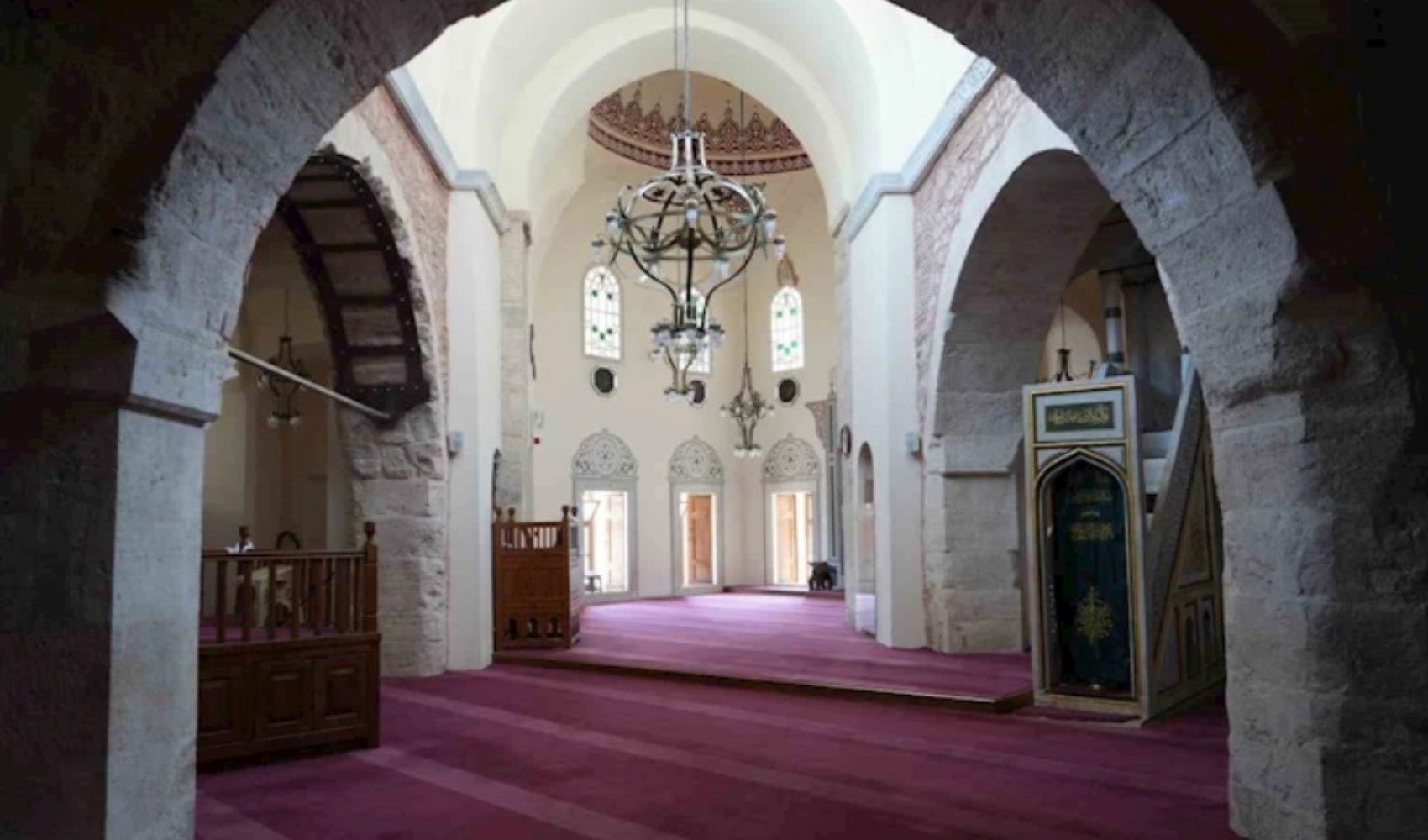
Work has reached its end in the excavation area in front of Fethiye Mosque, which was initiated by the General Directorate of Foundations of the Ministry of Culture and Tourism in 2018. The area, which will be opened to visitors as an archeopark in 2024 following the demolition of the illegal floor leaning against the historical mosque, was viewed from the air.
In the footage, the illegal structure at the end of the magnificent mosque can be seen. The chapel right next to the historical mosque will serve as a museum.
'AN IMPORTANT RITUAL SPACE'
Providing information about the history of Fethiye Mosque, Dr. Archaeologist Murat Sav said, "Fethiye Mosque was first built—I am saying this in its form that has reached the present day—between 1292 and 1294 by Michael Glabas Tarchaneiotes, whom we can consider as one of the leading statesmen of the period. It was built in accordance with Byzantine basic structural principles. It is known by the name Pammakaristos. This means 'all-happy'. About 20 years after its initial construction, a parekklesion space was added to the south side of the structure by his wife, Maria. This is a thin, long space. It is an important ritual space.
In fact, this space is one of the main reasons why the structure is so prominent. There is a poetic narrative that runs on the facade, inside, and outside of the structure. Maria had this written for Michael Glabas. She also built the space for her husband. She also mentions this in that poem.
The poem here is written in an incredible poetic concept that overlaps religious love with the love she felt for her husband. Because the Church of the Holy Apostles in the area where today's Fatih Mosque is located was in a very bad condition, this place was allocated by Fatih Sultan Mehmed upon the request of Patriarch Gennadios himself. It was used as a patriarchate uninterruptedly during the Ottoman period until 1586.
There are also special details here. For example, one of them is that a major repair was carried out on the structure at the stage when it was converted into a mosque, that is, in the late 16th century. Because the structure, especially the east facade, was largely damaged in one of the fires or perhaps one of the earthquakes. It is likely due to the destruction in the area where the apse is located that a mihrab space, built in classical Ottoman construction, which has reached the present day, was added." he stated.
'THERE ARE VALUABLE MOSAICS'
Stating that he explained the detail about Fethiye Mosque regarding Fatih Sultan Mehmed, Sav said, "Fatih Sultan Mehmed had a serious conversation with Patriarch Gennadios about the Orthodox faith. This is the place where he had that discussion. As far as we know from the narrative, that discussion took place in the parekklesion space.
Under this structure, there is a place that was later very likely converted into a cistern in the form of a chapel. Especially inside the parekklesion, there are very valuable mosaics that have survived to the present day. These constitute one of the most important points of Byzantine visual arts.
For example, there are very valuable mosaics, including the figure of Jesus, the baptism of Jesus, as well as the depiction of the four great angels, and the depiction of Jesus as the protector of the universe among the prophets. The area under the structure was generally evaluated as burial sites. It was evaluated as a place where important religious figures were buried. Later, due to need, underground structures could sometimes be converted into cisterns. Because, as is always known, Istanbul's water need was very important."
News Source: İHA