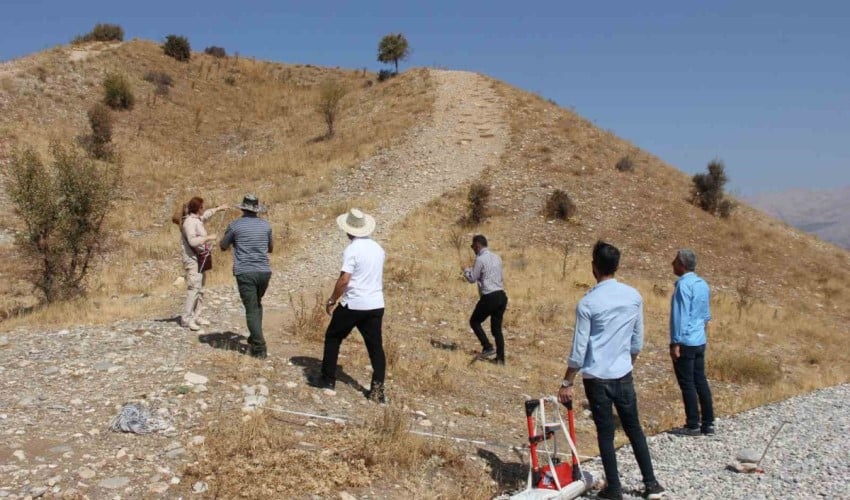
Ankara University Faculty of Engineering Dean and Earth Sciences Application and Research Center Board Member Prof. Dr. Yusuf Kaan Kadıoğlu and Ankara University Department of Geophysical Engineering faculty member Prof. Dr. Selma Kadıoğlu are leading the work on the Karakuş Tumulus.
Adıyaman Director of Culture and Tourism Abuzer Gelse and Adıyaman Museum Director Mehmet Alkan are also accompanying the efforts.
TOMOGRAPHY PERFORMED
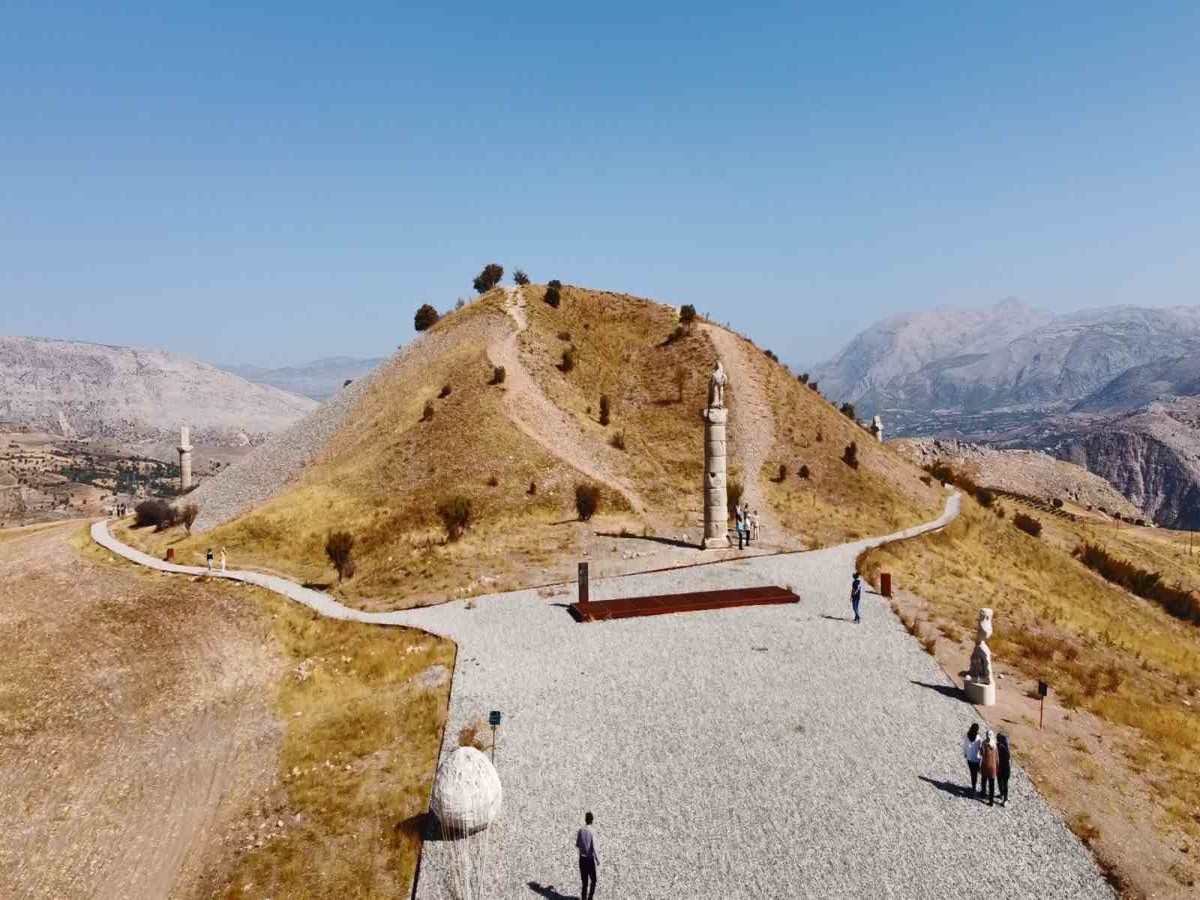
The entire structure of the 30-meter-high, 110-meter-diameter Karakuş Tumulus, known as the 'Queen's' or 'Maidens'' cemetery because it houses the tombs of the queen and women from her family, will be revealed in detail. With this device, structures up to a depth of 35-45 meters will be detected. The locations and sizes of the burial chambers, particularly the entrance doors, will be revealed through this study. Whether or not excavations will be conducted in the tumulus, which is currently undergoing tomography, will also be determined by this work.
It is known that in the 1960s, German archaeologist Prof. Friedrich Karl Dörner entered the tumulus from the south to conduct excavations. Prof. Dr. Yusuf Kaan Kadıoğlu stated that they have the capability to image down to the base of the tumulus and that they possess the necessary system, saying, "We have a system with deep GPR capability. Our task here is to scan the tumulus at specific, frequent intervals and, using signals we send into the ground, image the structures inside without striking a pickaxe."
'WE AIM TO REVEAL IT IN 3D'
In her statement, Prof. Dr. Selma Kadıoğlu said, "Our goal is to collect data from the Karakuş Tumulus and, after processing it, reveal the locations and depths of potential burial sites in 3D using both 2D and 3D imaging. As we walk with this device, we send electromagnetic waves into the ground at 5-centimeter intervals and record them at the nanosecond scale."
Adıyaman Museum Director Mehmet Alkan stated that the work would shed light on their future efforts, saying, "The results of these geophysical and georadar studies will provide us with the necessary information on how to apply excavation methods in the coming years. Decisions will be made regarding the opening of the Karakuş Tumulus or how future excavations will be conducted based on this."
It was learned that the work will be completed within a few days and the report will be issued within a few months.
News Source: İHA