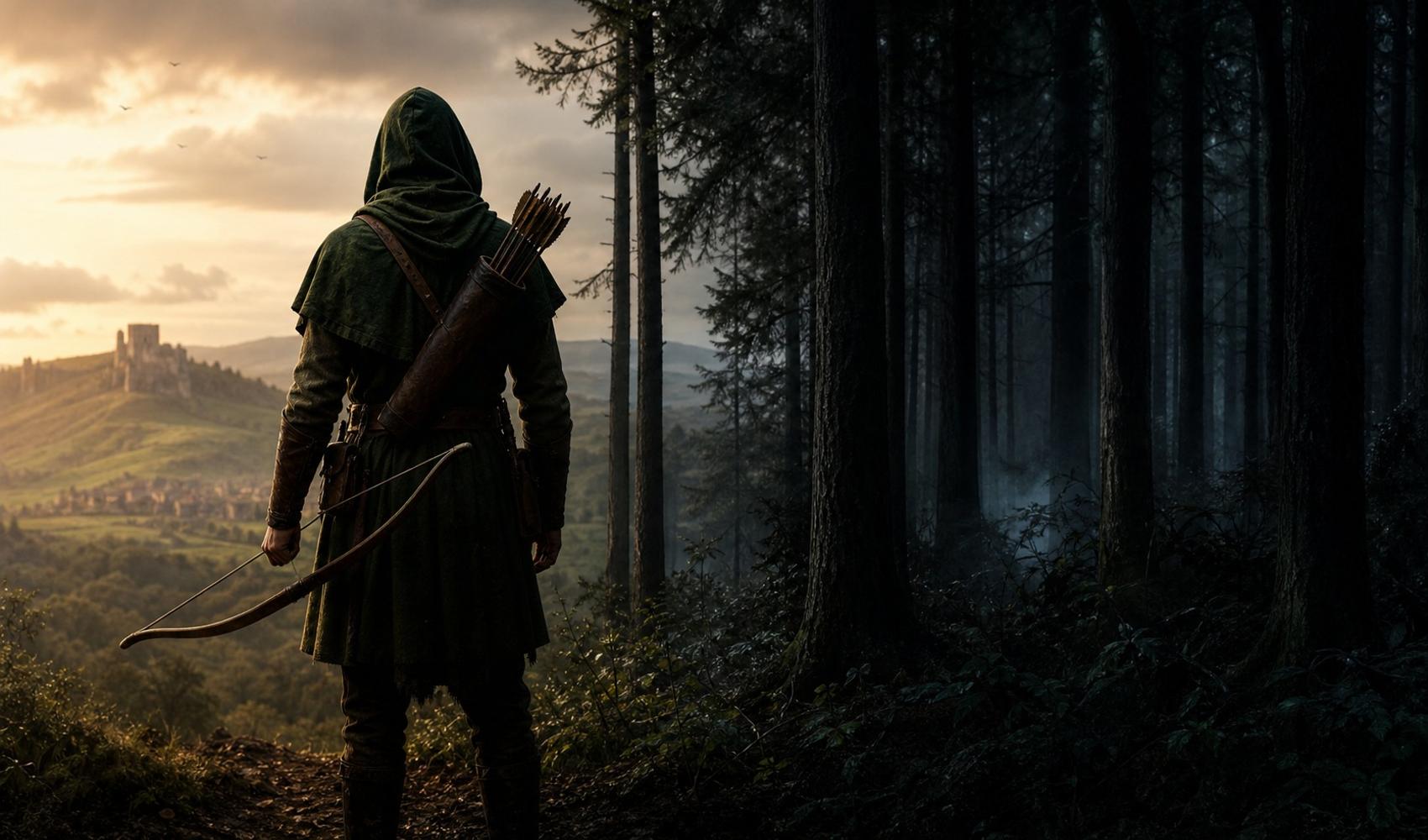
In popular culture, Robin Hood is often remembered as a cheerful and just hero who "steals from the rich and gives to the poor." However, The Death of Robin Hood, directed by Michael Sarnoski, brings the darker medieval roots behind this familiar image back to the fore.
In the film, Hugh Jackman portrays an aging Robin Hood, weary from wars and facing the weight of his own legend. In Sarnoski's narrative, the character speaks of himself in the third person, saying: "He wasn't a hero. He robbed and killed for pleasure, that's all."
The director's new interpretation is not merely an attempt at a modern "dark reboot." As historians and literary scholars have pointed out, the earliest accounts of Robin Hood did not fit the family-friendly mold established today by children's books, animations, and classic Hollywood films.
THE EARLIEST VERSION OF THE LEGEND WAS GRIMIER
Whether Robin Hood was based on a real person has long been debated. However, historians agree that behind the character lies not a single historical figure, but rather the deep inequalities between wealthy landowners and impoverished peasants.
It is accepted that the stories began circulating through oral tradition in the 12th century, with the first written records appearing about 200 years later. In these early ballads, Robin was not the noble Sir Robin of Locksley seen in later accounts; he was depicted as a small landowner who stood slightly above the peasants.
The character of Lady Marian did not accompany the narrative from the beginning either; she did not appear in the story until the 16th century. Although Robin was merciful toward the poor in early texts, his primary goal was not philanthropy. The forces he primarily confronted were corrupt clergymen and nobles who exploited those beneath them.
Medieval historian Amy S. Kaufman, in the afterword of her 2025 novel The Traitor of Sherwood Forest, describes this early Robin Hood as a "morally grey medieval trickster" and a "violent, irreverent outlaw." According to Kaufman, the character was a disruptive figure because he stood against kings, nobles, and the church; yet, in most accounts, he also paid the price for his own flaws.
THE OUTLAW TURNED HERO
One of the major shifts in Robin Hood's image occurred in the 16th century. King Henry VIII's interest in the character and the political-religious transformations of the era influenced the shape of the legend. During the process of breaking away from the Catholic Church, Robin's devotion to the Virgin Mary was erased from the narratives, and as the upper classes embraced the character, his anger toward the nobility was tempered.
Thus, Robin Hood was reconstructed not as an outlaw questioning the power structure, but as a virtuous nobleman fighting corrupt rivals. The archetype of the hero who helps King Richard return to his throne and stands against the villainy of Prince John also became part of this transformed narrative.
19th-century children's books made the character more "sanitized" and benevolent, in line with Victorian morality. In the 20th century, cinema amplified this trend. Errol Flynn's interpretation of a cheerful and brave Sir Robin in the 1938 film The Adventures of Robin Hood became one of the most powerful forms of the character in modern memory.
The 1973 Disney animation solidified this image for mass audiences: Robin Hood, the fox in the green hat, was a lovable folk hero who stole from the rich and gave to the poor. Sarnoski also had his cast and crew watch this Disney film during the preparation process for his new movie; because the chasm between the dark story he wanted to tell and this familiar image formed the tension at the heart of the film.
One of the texts that interested Sarnoski is the medieval ballad The Death of Robin Hood. In this account, Robin is killed by a wicked prioress and her lover. In the new film, the prioress, played by Jodie Comer, is designed as a more complex and compassionate character. Sarnoski says he did not want to make the prioress a "simple evil nun" nor Robin a "simple good hero."
A similar inquiry is seen in Kaufman's novel. The Traitor of Sherwood Forest explores how heroic narratives can influence people, through the eyes of Jane, a fictional peasant girl who admires the Robin Hood legend. After joining Robin's gang, Jane questions whether his alluring legend has led her down the wrong path.
More complex interpretations of Robin Hood are not entirely new in cinema. In the 1976 film Robin and Marian, Sean Connery portrayed an elderly Robin nearing the end of his life, facing the deaths he had witnessed in the past. However, the image that remained dominant in popular culture was mostly the cheerful, righteous, and unquestionable hero Robin.
Today, the reason for this revisionist interest in the legend is not just historical curiosity. Questions about where power is concentrated, how heroes are created, and how stories manipulate the masses also overlap with current debates. According to Sarnoski, narratives in the modern world can quickly push people to take sides and force them into a "hero-villain" duality.
Nevertheless, this return to Robin Hood's dark roots is not expected to completely erase the benevolent figure established by Disney and classic cinema. As Kaufman puts it, Robin Hood has now evolved beyond the actual legend into a larger symbol, much like Santa Claus. The Death of Robin Hood was released in theaters in Turkey on June 19.
News Source: 12punto