Melik ÇELİK - 12punto.com.tr
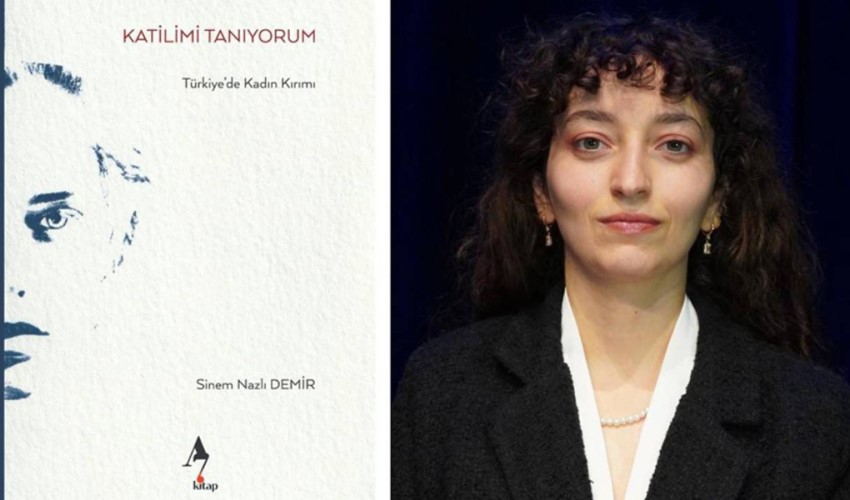
Journalist Sinem Nazlı Demir's book, "I Know My Killer: Femicide in Turkey," which she penned based on interviews regarding the struggles of 29 women, has been released. The work was published by A7 Publishing.
Demir's work, which focuses on the struggles of 29 women, sheds light on the dark side of violence against women through expert opinions as well as the stories of women who have been subjected to violence.
Demir emphasized that the book she wrote is not the first in its field. Stating that her goal of turning her work into a book increased as she continued to report on these issues, Demir explained the entire process to 12punto.
While noting that she only thought about including experts in the book later on, Demir says the following regarding the process of turning it into a book:
"When a report comes in, we cover the news, there is a reaction on social media, we express our reaction, and unfortunately, I realized that we are truly experiencing such cases more than we think. Murder, incest, abuse, severe physical violence, psychological violence, economic violence... For this reason, I said that I am covering this topic a lot at first and I am starting to act in accordance with the understanding of ethical journalism. Therefore, I decided to do a study that brings all of these together."
Demir stated that this entire process negatively affected her psychology and that she is still receiving psychological support. She also mentioned that they censor certain details in reports of femicide that they cannot write in the news. Expressing that she conducted some of her interviews one-on-one, Demir stated that the interviews on incest, in particular, affected her deeply and that the interviews she conducted with women who had been abused by their fathers were a difficult process for her.

"WE CRITICIZE MASCULINITY, NOT THE MAN"
Evaluating the title of the book, Demir noted, "Actually, I am not referring to a specific person here. 'I Know My Killer' is a title written as a satire for the whole society. I do not criticize any individual or development directly. I think they all contribute to femicides. By including people who see femicides only as a women's issue, what I am trying to say in the sentence 'I Know My Killer' is that when a woman is murdered, it is not just the life that the killer lived that leads them to that process; it is those who write the news that the killer follows, those who make the killer search on Google for how to get a 'good conduct' sentence reduction, those who sell weapons to that killer abroad, and those who make anti-women rhetoric shouted at rallies that are actually leading to this process. Of course, killers and criminals must serve the sentences they deserve. But saying 'I hope they get the heaviest sentence' will not lead us to a result. If there is a femicide and a woman is murdered because of her identity, this is actually happening with the influence of the whole society and the encouragement of the killers, so we know these killers, and we think that this problem will be solved when we criticize the entire system, not just a single person. So, it should also be noted that we criticize masculinity, not men."
Clarifying the phrase "Let no one forget what happened. If one of us forgets, let the other remind them" in the book, Demir said,
"When there is a development regarding women's rights in society or when a directive is given, or when femicides decrease, we tend to present this situation as an achievement. However, thousands of women have been murdered in these lands so far. They were destroyed by massacres, killed under the pretext of 'honor' issues, and abused since their childhood. Most of them were not reflected in the press. It cannot be said that Turkey is a livable place for women and children right now, but this does not mean that we are hopeless. Especially while the government says 'we are developing' on some issues; steps such as withdrawing from the Istanbul Convention, opening the issue of alimony for discussion, and statements like 'we will fix the Civil Code,' although they are shown as if they were made in favor of women, actually harm this struggle. For this reason, as some media outlets show, women's rights are not progressing in a good direction. Singular developments do not show that the problems are solved. However, even if we reach a good point, it is important not to forget what was done to us. Because there were those who were harmed, those who were injured, women who lost their lives, and those who were burned during this rightful struggle process. Therefore, no matter what level we are at, it is a phrase said so that we do not forget the people who gave their lives in this rightful struggle process."
ANOTHER NEW BOOK IS COMING
Stating that there will be another book project, Sinem Nazlı Demir said, "In about three or four months, I will address the trafficking of women and children in the world. I plan to work on an international scale. I will have a book project that tells people who think that slavery has ended in the world that modern slavery actually continues in many parts of the world through illegal means over women and children."
Answering the question of whether she feels she is creating a safeguard for women while doing this news or writing the book, Demir said the following:
"There are three great powers: the legislative, the executive, and the judiciary. The fourth power is the press. The press can sometimes get ahead of these powers. While some media institutions support the women's struggle, others undermine it. When a femicide occurs, they use the sentence 'because she wanted her alimony rights.' The perpetrator killed the woman because she wanted alimony. However, a man does not kill a woman because she wanted alimony, but 'under the pretext that she wanted alimony.' Because there cannot be a reason for a murder. We are not looking for the reason for a femicide. You will not call it a 'crime of passion.' There cannot be a crime of an 'affection.' These are very simple, but there are still regions in Turkey where direct, healthy information does not reach. All the news published as 'jealousy murder,' 'infidelity murder,' 'crime of passion,' or 'forbidden love murder' actually drags down the gains of women who have been struggling for years. For example, when a woman who had an affair with a married man was murdered, we encountered news in the press that saw this in a very different way. For example, in the Şule Çet news, they headlined 'Şule entered the plaza with three men.' While there was a woman being murdered and humiliated there, what the newspaper saw was how many men Şule was with and where she went. Perhaps we are creating a safeguard in some areas, but I think Turkey is far behind in the field of ethical women's journalism."
Finally, when we asked about ethical women's journalism and the state of women's journalism in Turkey in general, Demir noted the following:
"Many media organizations in Turkey are patriarchal because we all know that no media organization is impartial. And many of them have to produce news according to the perspective of those who govern. Most of the press workers do not have the chance to directly intervene in the news they write anyway. Therefore, the more patriarchal the institutions are, the more the way the news is presented, the way women's bodies are displayed, and the way the murders are told are in this way, and it is served to the public like this."
News Source: 12punto