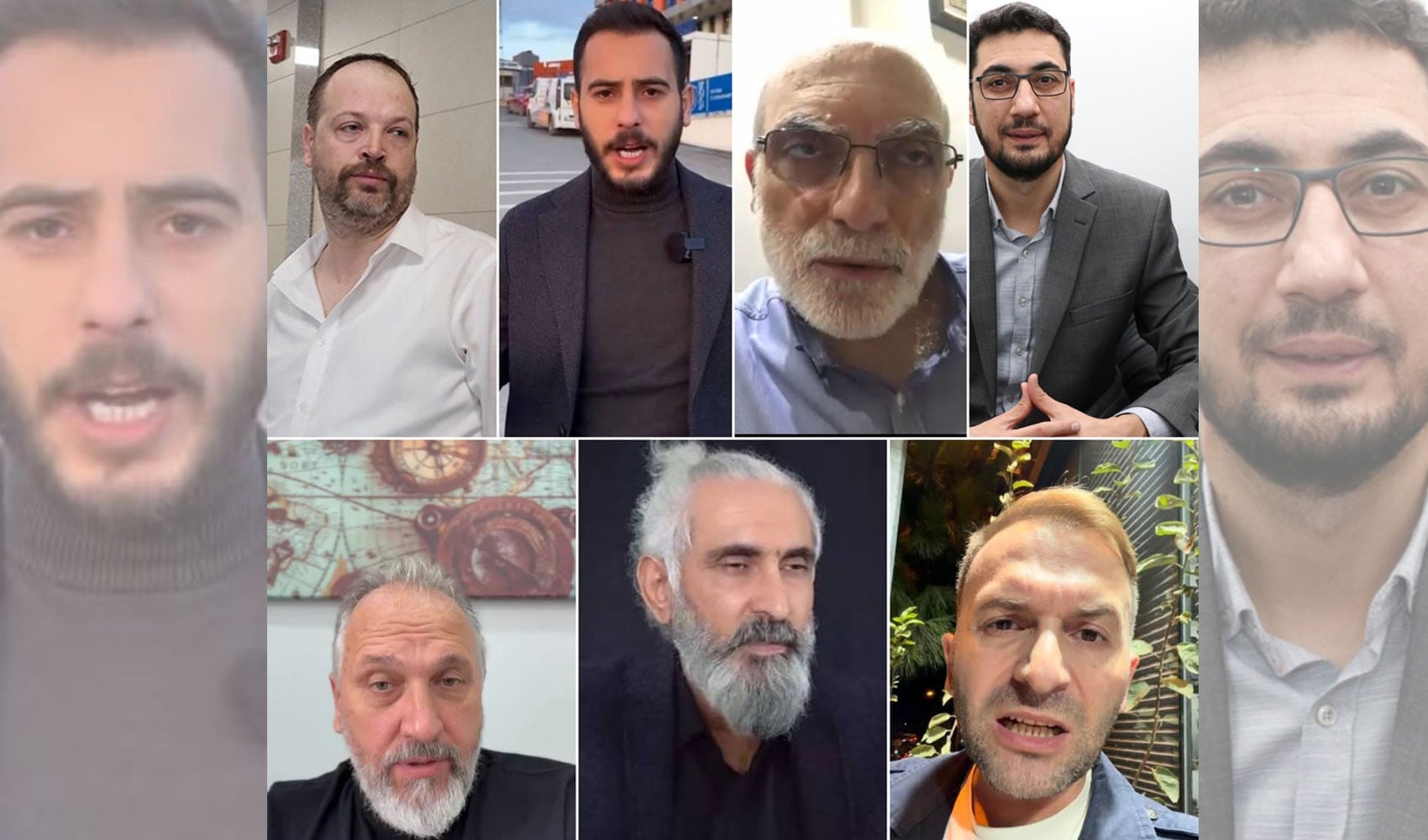
In the hearing at the Istanbul 28th High Criminal Court, 20 defendants connected via the Audio and Video Information System (SEGBİS) from the prisons where they are being held. Eight defendants who are not in custody and their lawyers were also present at the hearing.
Presenting their opinion on the merits, the public prosecutor noted that the Israeli intelligence service formed a remote, online operations team via internet-based mobile applications, and that this team used the names "Abdalla Qassem," "Abu Halid Abdalla Qassem," "Janet Foster," "Ali Al Jafrı," "Şhirin Alayan," "Roman Romanov," "Cemal," "Igor," and "Ilya."
"INFORMATION MUST REMAIN CONFIDENTIAL"
The opinion stated that the aim was to carry out tactical tasks against Mossad's targets in the field using live couriers, and it was expressed that while it was not proven that the information obtained by the defendants was information that must remain confidential for the sake of state security or internal or external political interests, it was information that must remain confidential by its nature.
REQUEST FOR RELEASE FROM LAWYERS
In the opinion, it was requested that the 57 defendants be sentenced to between 8 and 12 years in prison for the crime of "obtaining prohibited information for the purpose of espionage."
Following the opinion, the lawyers for the detained defendants took the floor and requested their release.
Lawyers for the defendants not in custody also requested the lifting of the international travel bans imposed on their clients.
INTERIM DECISION
Announcing its interim decision, the court panel ruled for the release of 18 detained defendants under judicial control, citing the time they have already spent in detention and the lack of a possibility of evidence tampering.
The panel, which ruled to lift the judicial control measure of an international travel ban for 36 defendants, taking into account the current state of the evidence, adjourned the hearing to give the defendants and their lawyers time to prepare their defense against the prosecutor's opinion.
WHAT HAD HAPPENED?
The indictment prepared by the Istanbul Chief Public Prosecutor's Office notes that the Israeli intelligence service formed a remote, online operations team via internet-based mobile applications, and that through this team, it aimed to provide remote resources, transfer money to its sources via live couriers, and carry out tactical tasks against its targets in the field.
The indictment explains that the first contact was established via Telegram and WhatsApp applications coded on mobile phones, social media accounts, LinkedIn, and e-mail, and that communication was maintained through operational Telegram and WhatsApp applications, with no video or voice calls ever being made. It includes findings that payments for the work performed were carried out via international money transfer companies, cryptocurrencies, remittance offices, and live couriers.
The indictment explains that detectives were utilized for tasks requiring professionalism, while individuals who would not arouse suspicion were primarily used for tactical tasks. It states that instructions were given to the individuals assigned tactical tasks to create and manage WhatsApp groups, create and manage websites, design internet news outlets, conduct research, transfer money, document via photo and video, conduct surveillance, commit assault and battery, robbery, and obtain operational lines, as well as to conduct research in Syria and Lebanon.
The indictment, which also states that detectives were assigned tasks such as collecting biographical information, reconnaissance, photo/video documentation, live surveillance, placing tracking devices, finding live couriers, and cyber activities, emphasizes that it was determined that detectives were able to obtain information from the state's database by exploiting system vulnerabilities and through their circles working in critical state institutions.
The indictment seeks a prison sentence of 15 to 20 years for each of the 57 defendants for the crime of "obtaining information that must remain confidential for the state for the purpose of political or military espionage."
News Source: 12punto