
In a joint study conducted by three universities on active fault lines in Bursa, an active 95-kilometer-long fault line extending from Kayapa to Yenişehir, which was not previously featured on maps, has been discovered. The fault, named the Kayapa-Yenişehir Fault, could produce a 7.3 magnitude earthquake according to potential scenarios.
According to a report by Pelin Akdemir from Gazete Duvar; Engin Er, Head of the Bursa Branch of the Chamber of Geological Engineers, stated that the fault line, which remains beneath alluvial soil, could only be revealed through a detailed study.

(Engin Er, Head of the TMMOB Chamber of Geological Engineers Bursa Branch)
THE FAULT IS 95 KILOMETERS LONG
Ankara University, Kocaeli University, and Eskişehir Technical University conducted a joint study examining active fault lines in Bursa, including the newly discovered one. As part of the study, seismic measurements were taken at 25 points between Kayapa and Yenişehir. The measurements identified an active fault line 95 kilometers long, not previously present on active fault maps, with the potential to produce a 7.3 magnitude earthquake.
The study, supported by AFAD, has not yet been published. The title of the study is: The possible source of the 1855 Bursa earthquakes newly discovered through geological and geophysical methods: The Kayapa-Yenişehir Fault, which cuts through the pull-apart basins of the South branch of the North Anatolian Fault Zone.
THE FAULT LINE PASSES BETWEEN TİMSAH ARENA AND THE CITY HOSPITAL
The study mapped the underground area and identified the locations where the fault line passes. The Kayapa-Yenişehir Fault (KYF), which cuts through the pull-apart basin, has a 40-kilometer-long section in the west extending from the Kayapa region to the Bursa Plain, and a 55-kilometer-long branch in the east continuing to Yenişehir. The fault, which extends from Kayapa Creek to the Bursa-west basin, reaches the city center by passing between Timsah Arena and the City Hospital.
From the city center, the fault continues eastward, passing south of the Kumluk area and north of Gürsu, appearing on the Bursa-Ankara road north of Çataltepe. Further east, it passes north of the Erdoğan cemetery area and Seymen, extending to the Yenişehir Plain. The fault merges with the Toprakdere Fault in the east of the Yenişehir basin. The total length of the fault is stated to be 95 kilometers.
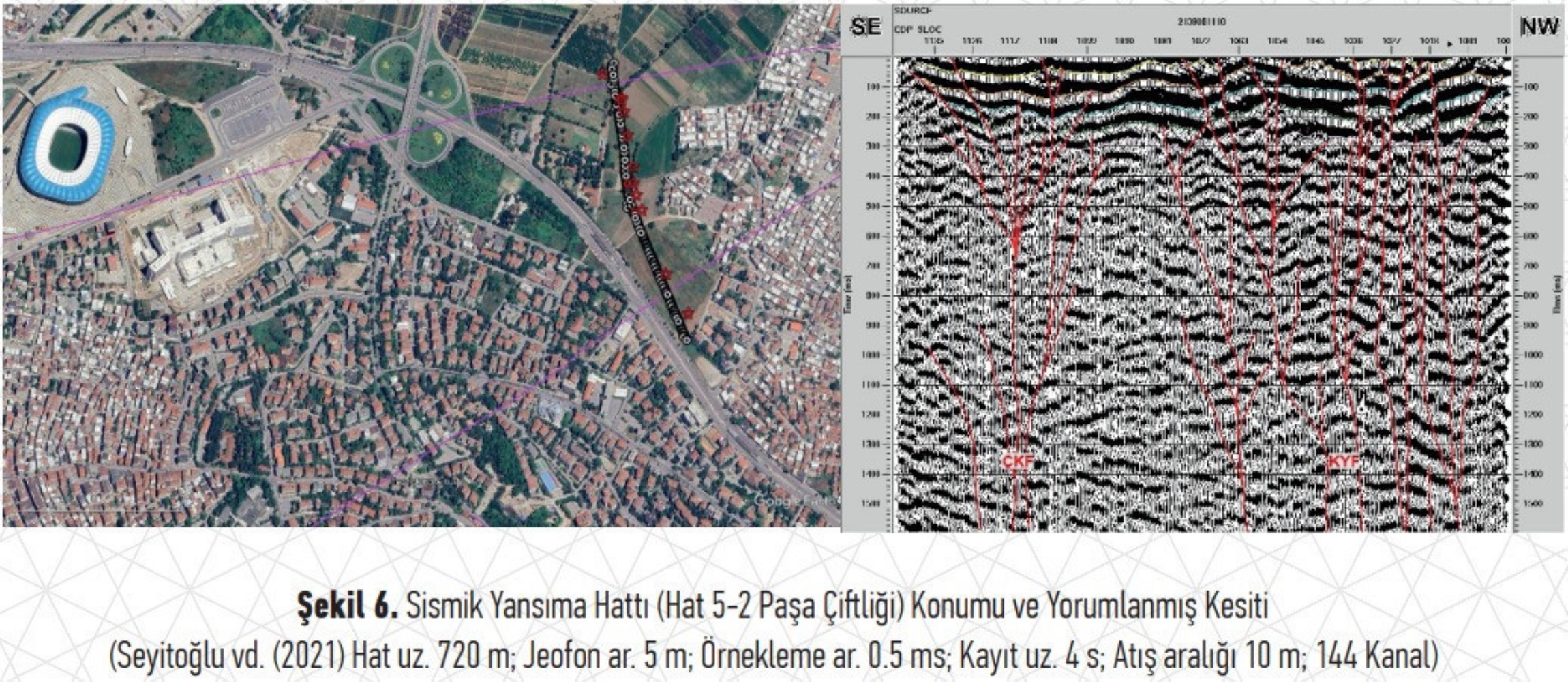
As part of the study, seismic measurements were taken at 25 points between Kayapa and Yenişehir.
'COULD PRODUCE A 6.8 MAGNITUDE EARTHQUAKE IN THE WEST AND 7.3 IN THE EAST'
To calculate the potential magnitude of an earthquake, the stress on the fault line in the region and the earthquakes it has produced in the historical process were examined. According to historical earthquake records in Bursa, the last three damaging earthquakes occurred on April 19, 1850, February 28, 1855, and April 11, 1855. The project assesses that the source of the earthquakes that occurred in 1855 was the western section of the Kayapa-Yenişehir Fault (KYF).
It is stated that there has been no rupture in the Yenişehir section of the KYF for 624 years, since the last damaging earthquake recorded in historical sources in 1400. The lack of rupture on the fault line increases the probability of an earthquake. The slip rate on the fault is estimated to be a maximum of 8.8 millimeters and a minimum of 3.0 millimeters per year. Based on these data and a realistic scenario, it has been revealed that the western section of the KYF, which was ruptured by the 1855 earthquakes, currently has the capacity to produce an earthquake of 6.5-6.8 magnitude. The eastern section of the KYF, which is estimated not to have been broken by the 1855 earthquakes, could currently produce an earthquake of 6.9-7.3 magnitude.
'THE FAULT IS BENEATH ALLUVIAL SOIL THAT AMPLIFIES THE EFFECT OF AN EARTHQUAKE'
Engin Er, Head of the TMMOB Chamber of Geological Engineers Bursa Branch, announced that the newly discovered fault line was not included in the active fault maps released in 2012. Stating, "This is a fault that remains under alluvium. It could only be revealed through such a detailed study," Er said that alluvial soil amplifies the effect of an earthquake.
Er said, "There is an alluvial soil layer reaching up to 700 meters in the Bursa Plain. It is like this; take a glass of water. Place the glass on the table. Just as the water continues to shake even though the glass is still, the same happens in alluvial soils. We saw this in İzmir and on February 6. The February 6 earthquake occurred in Maraş, but the most damage was in Hatay. There is a 200-kilometer distance, but the place with the most damage is related to the soil. Alluvial soils have the property of amplifying earthquakes."
'THERE IS A 624-YEAR SILENCE'
Reminding that the last earthquake in the Yenişehir Plain was in 1400, Er said, "There is a 624-year silence. The accumulated slip is 5.4 meters, and there is a potential to produce a 7.3 magnitude earthquake. If it breaks as a whole, the effect will be 7.05. This scenario is valid for this fault. There is also a fault line that has been silent for about 400 years, passing through İznik and continuing through Gemlik and Mudanya, which produces earthquakes of 5 and above."
'NO BUILDINGS SHOULD BE CONSTRUCTED ON THE FAULT LINE'
Pointing out that paleoseismological studies, which examine the past behavior of a fault line and determine future earthquake danger, have not been conducted in Bursa, Er stated that there should be no buildings on the fault line.
Er continued as follows:
"Currently, there is no drawback to building on a fault line in Bursa. However, there are many fault lines in Bursa. It needs to be studied how many buildings are on the fault line. In Bursa, only the Büyükorhan, Harmancık, and Keles districts do not have fault lines. Every other district has a fault line named after it."
Er added that micro-zoning studies, where all disaster risks are indicated on maps, have not been carried out in Bursa, and stated that urban transformation should be carried out after such a study.
News Source: 12punto