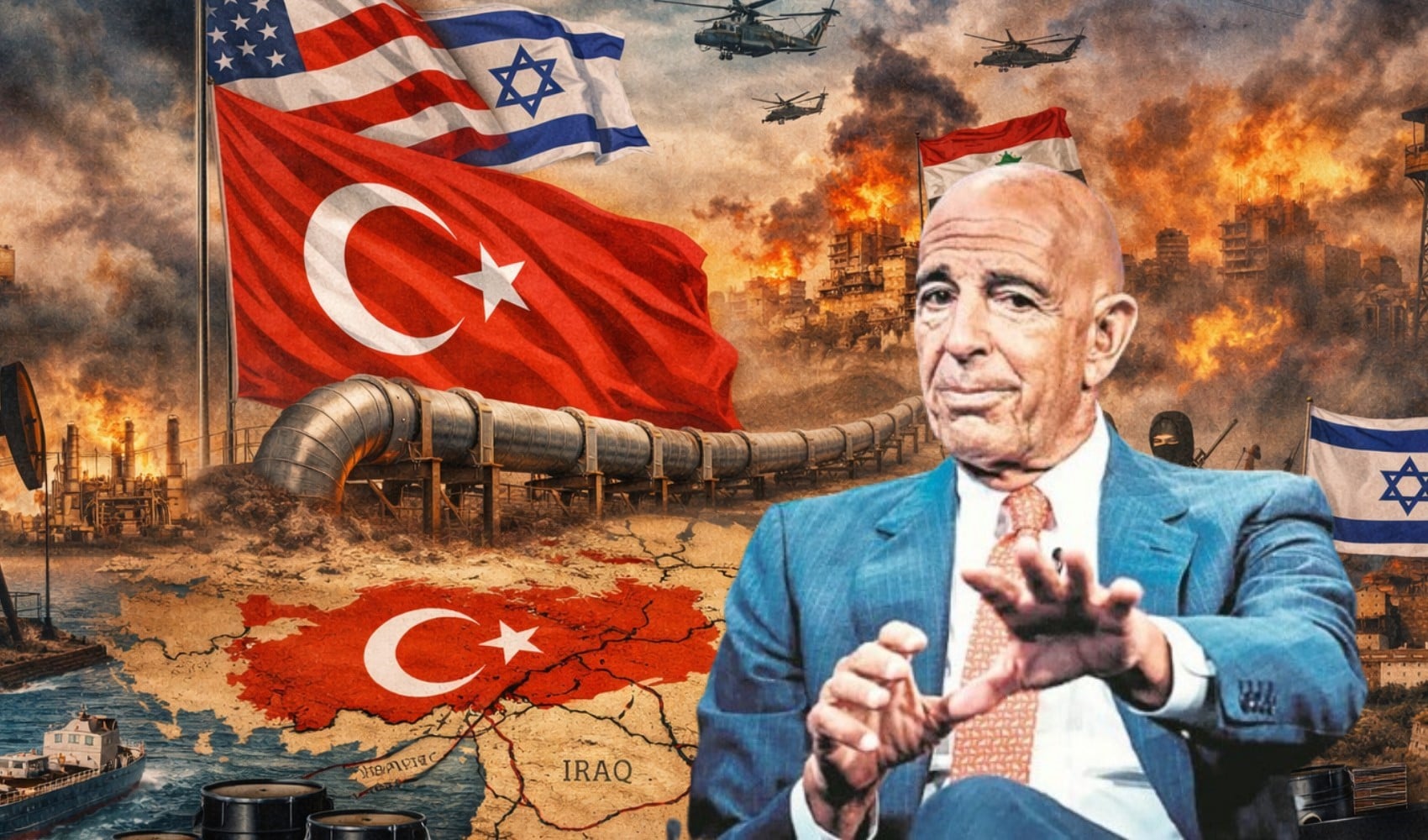
The description of Turkey as an energy corridor connecting four seas by former US Ambassador and businessman Tom Barrack has been sharply criticized by Retired Admiral Cem Gürdeniz. Gürdeniz characterized Barrack's statements as a geopolitical marketing move that is detached from reality and entirely politically motivated. Gürdeniz stated that Turkey's current energy flow capacity is limited and that such rhetoric is actually part of a broader strategy.
THE DIFFERENCE BETWEEN THE STRAIT OF HORMUZ AND TURKEY'S OIL FLOW
Gürdeniz emphasized that the amount of oil passing through the Strait of Hormuz accounts for 20% of global consumption, whereas the oil flow through Turkey is at much lower levels. Pointing out that Turkey currently transports 1.3 million barrels via the Azeri-sourced BTC pipeline and 1.5 million barrels via the Kirkuk-Ceyhan line under optimal conditions, Gürdeniz stated that this total cannot reach 3 million barrels.
UNREALISTIC DREAMS
Gürdeniz expressed that the energy corridor mentioned by Barrack does not actually exist and that the old Kirkuk-Baniyas line extending from northern Iraq to Syria has been out of service for years. Stating that the current situation in Syria is very complex and that Turkey has also made major mistakes there, Gürdeniz noted that political and security problems in these regions make oil flow impossible.
Furthermore, he stated that due to Syria's fragmented sovereignty and the influence of actors in the region, such projects cannot go beyond being a grand fantasy.
The retired admiral pointed out that Barrack's statements are unrealistic and evaluated the complex political situation in Syria alongside Israel's threats and the instability in Lebanon. Emphasizing that the term "stable" is misleading for Syria under these conditions, Gürdeniz stated that Barrack's remarks serve US and Israeli interests.
NOT ENERGY, BUT A POWER ARCHITECTURE
Gürdeniz said that the power structure established by managers of global powers like BlackRock through Turkey aims for much more than energy. Expressing that presenting Turkey as a central country is actually limited to the role of being a transit corridor, Gürdeniz drew attention to the fact that Turkey would only be a carrier in this scenario. He stated that if the valve of this order is in Turkey, Turkey would be an energy hub; otherwise, it would be a part of a system established by others.
TURKEY'S ROLE
Finally, noting that the role assigned to Turkey is merely to be a transit corridor, Cem Gürdeniz said the real question is whether Turkey will become a part of the US/Israeli plan in this global power struggle.
Retired Admiral Cem Gürdeniz's post is as follows:
The “4 Seas” rhetoric of US Ambassador to Ankara Tom Barrack, whose name is frequently mentioned in the Epstein files, is a cheap geopolitical marketing move directed at Turkey that is detached from reality when the conjuncture in Iran, Israel, and Syria is taken into account.
The daily amount of crude oil and derivatives passing through the Strait of Hormuz was 20 million barrels under normal conditions. This was 20% of world consumption.
For today, the oil flow passing through Turkey is around 1.3 million barrels via the Azeri-sourced BTC at maximum capacity; and 1.5 million barrels via the Kirkuk-Ceyhan line, which is Iraqi-owned but Erbil-controlled and not yet fully open, meaning around three million barrels under the best conditions.
Actual flow from Kirkuk–Ceyhan has been either very low or near zero for years due to political crises, arbitration decisions, and security problems. It remained almost completely closed from March 2023 to March 2026.
The lines in the imagination of the former real estate agent Barrack do not actually exist. The old Kirkuk–Baniyas line, which extends from northern Iraq to Syria and from there to the Mediterranean, has been out of service for decades.
Sovereignty in Syria has been fragmented, partly due to Ankara's major mistakes. There is Israeli, US, Russian, and Iranian influence in Syria. In short, the Syrian conjuncture is extremely complex and Syria has the potential to face great instability again.
Israeli government members are issuing constant liquidation decisions and threats against Syrian President Colani.
While instability in Lebanon continues with Israeli massacres, the provocation of Druze and Kurds in Syria and Israeli occupations in the Golan Heights and southern Syria are increasing every day.
Under such conditions, the ambassador's use of the word stable for Syria is a statement that is very far from the facts but serves US and Israeli interests.
On the other hand, there is no pipeline to bring Basra oil north and transport it through Syria or Turkey.
In short, except for the active BTC, there is no new oil flow that will flow to Turkey today other than Kirkuk–Ceyhan. The oil passing through Turkey is at the level of approximately 1 million barrels/day. In the final analysis, it could be 3 million barrels.
In contrast, until the massive gap with the amount passing through the Strait of Hormuz is closed, the rhetoric of an “alternative corridor” bringing together four seas for Turkey is not technical but entirely political.
Therefore, the problem is not where the oil or gas will flow from, but who will control this flow.
On the other hand, the moment a manager of BlackRock, which manages 14 trillion dollars, gets involved, what is being discussed is not energy, but the power architecture built through energy.
Although the role assigned to Turkey is presented as a “central country,” what is actually being offered is to be a transit corridor. That is, just to carry.
As a result, the fantasy presented is not about capacity, but a declaration of a new hegemonic order that is intended to be established.
If the valve of this order is not in Turkey, Turkey will not be an energy hub, but a carrier of a system established by others. This is the real issue. The problem is whether the Turks will be a part of the Israel/US-designed plan.
The “4 Seas” rhetoric of US Ambassador to Ankara Tom Barrack, whose name is frequently mentioned in the Epstein files, is a cheap geopolitical marketing move directed at Turkey that is detached from reality when the conjuncture in Iran, Israel, and Syria is taken into account.
— Cem GÜRDENİZ (@cemgurdeniznet) March 29, 2026
Daily crude oil passing through the Strait of Hormuz…
News Source: 12punto