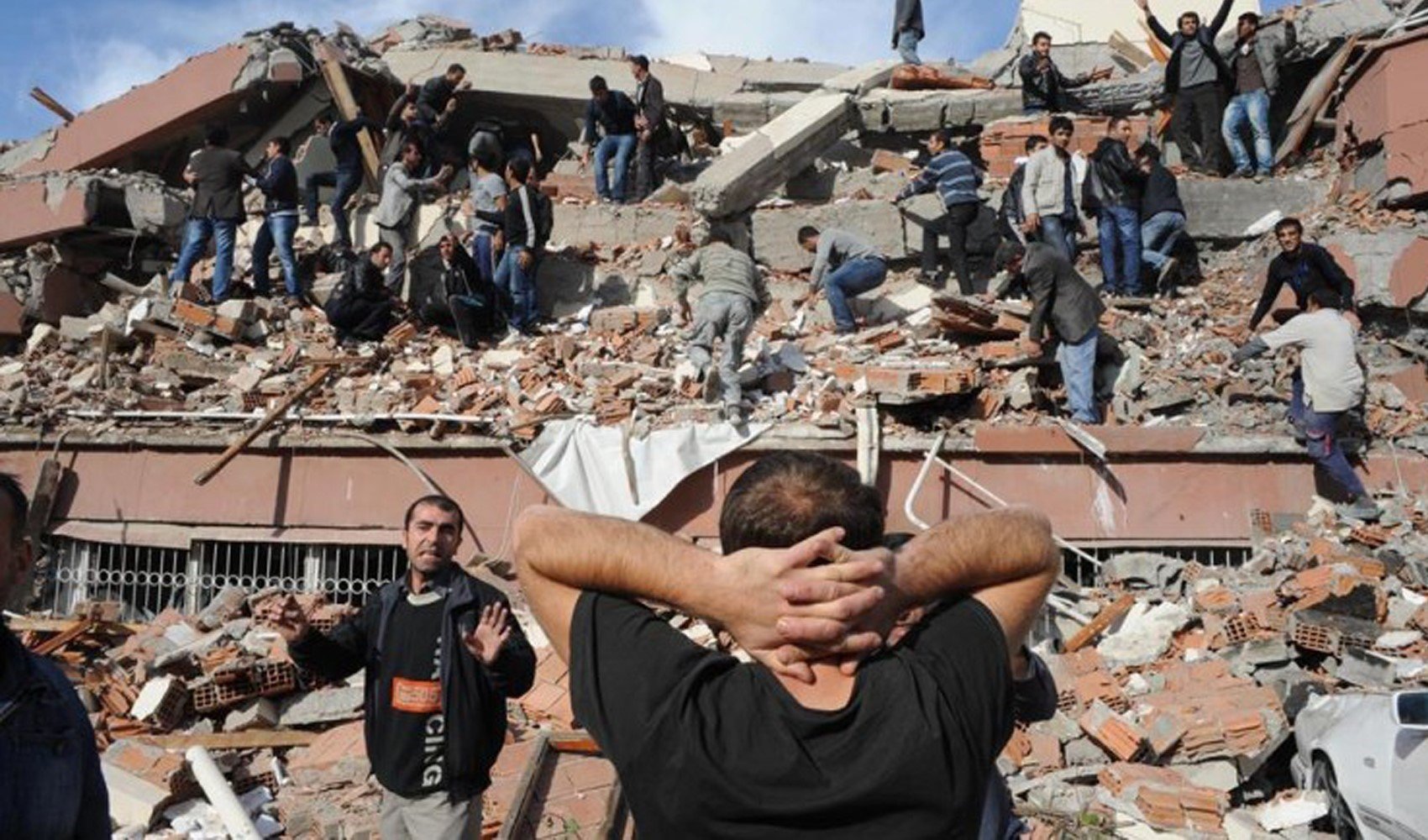
Two years have passed since the 7.7 and 7.6 magnitude Kahramanmaraş earthquakes, which, according to official records, claimed the lives of 53,537 people, left 120,000 injured, caused the collapse or heavy damage of 310,000 buildings across 11 provinces, and resulted in a total cost of 148.8 billion dollars to Turkey, according to the 2023 Parliamentary Earthquake Research Commission report.
Speaking on the second anniversary of the disaster, which is recorded as Turkey's second-largest earthquake, regarding how many lessons have been learned and how prepared Turkey is for another earthquake above magnitude 7, Geological Engineer Aysun Aykan said, "We had repeatedly stated that a major earthquake could occur in Kahramanmaraş, that this area was considered a seismic gap, and that attention should be paid to these regions; many scientists had also warned about this! There are 20 fault lines in Turkey that are under high tension and whose time for rupture has come, known as seismic gaps. The northern branch of the North Anatolian Fault, which passes through the Sea of Marmara, should be characterized as a seismic gap that has not ruptured for 250 years."
"THERE ARE 500 ACTIVE FAULTS IN TURKEY"
Stating that when looking at Turkey's active fault map, there are 500 active faults with the potential to produce earthquakes of magnitude 5.5 and above, Aykan said, "A significant portion of our country is under earthquake danger and risk. According to current studies, active faults pass through the city centers of 24 of our provinces. These provinces under risk are; Balıkesir, Bursa, Kocaeli, Bolu, Sakarya, Manisa, İzmir, Aydın, Muğla, Denizli, Burdur, Kütahya, Eskişehir, Konya, Aksaray, Tokat, Kayseri, Osmaniye, Hatay, Kahramanmaraş, Erzurum, Erzincan, Hakkari, and Bingöl. It is known that 24 of our cities, over 110 of our districts, and over 500 neighborhoods are located on fault zones that produce earthquakes of magnitude 5.5 and above. Considering that there are nearly 100,000 buildings on the safety band of these faults and that nearly one million of our people live in these buildings, the magnitude of the risks our country and our people face is revealed by the last earthquake we experienced. In the event that these faults rupture, the structures on the fault zone will be the first to be damaged. Among these faults, those whose time for rupture has come, i.e., those we define as seismic gaps that pass through residential areas, pose a great risk," she said.
"BEWARE OF 20 FAULTS THAT COULD RUPTURE AT ANY MOMENT"
Pointing out that there are faults defined as seismic gaps in approximately 20 places in Turkey, Geological Engineer Aysun Aykan said, "These are fault segments whose time for rupture has come, where sufficient tension has accumulated, and which could rupture at any moment. Scientific studies show that, especially the Bingöl section at the beginning of the North Anatolian Fault and the part of the North Anatolian Fault that passes through the Sea of Marmara, as well as faults in the areas of Hakkari Yüksekova, İzmir, Antakya, Adıyaman, Erzurum, Ağrı, Aydın, Denizli, and Muğla, are evaluated as seismic gaps and are in the class of faults that have the potential to produce earthquakes in the near future. However, we do not know the exact time of the earthquake. Similarly, the Balıkesir-Gökçeyazı Fault Segment, which passes through the Balıkesir city center and has the potential to produce a 7.2 magnitude earthquake, is a piece that has not ruptured for 2,000 years; we especially need to draw attention to the danger of these places. One of the largest earthquakes Turkey has ever experienced is expected in the Sea of Marmara. An earthquake of over 7, reaching a maximum magnitude of 7.6, is expected; therefore, in such an earthquake that could occur in the Marmara Region, not only Istanbul but all the cities of Tekirdağ, Kocaeli, Bursa, Balıkesir, and Çanakkale will be affected," she said.
Emphasizing that when looking at the earthquake distributions on the northern branch of the North Anatolian Fault passing through the Sea of Marmara, the last earthquakes occurred in 1509 and 1766, and considering that there are 200-250 year recurrence periods, this area should be evaluated as a seismic gap, Aykan said, "All provinces with a coast on the Sea of Marmara will be affected by a major earthquake that will occur here. 28 million people will be affected. The earthquake, whose historical period was in 1766, was felt in a wide geography from Austria to Italy and caused destruction throughout the entire Marmara Region. Imagine that a recurrence of such an earthquake would cause a lot of destruction throughout the entire Marmara Region. According to national and international studies; after the 1999 earthquake, there was a 65 percent probability that an earthquake greater than 7, with a maximum magnitude of 7.6, would occur in the Sea of Marmara within 30 years. 25 years have passed since this period. Statistically, a major earthquake occurs in our country every 7 years. Already, an earthquake greater than 7 occurs in the Marmara vicinity every 50 years. Our country experienced great destruction with the Kahramanmaraş earthquake. That is why we need to take the necessary precautions and complete our deficiencies," she said.

"THE FAULT IN BURSA HAS BEEN SILENT FOR 624 YEARS"
Aykan continued her words as follows:
"According to historical earthquake records in Bursa, the last damaging earthquakes occurred in 1855, and in the earthquake, which is called the 'Little Apocalypse' among the public, great destruction occurred; almost all the minarets of 150 mosques were destroyed, 2 domes of the Grand Mosque were destroyed, historical buildings and official institutions were destroyed, fires broke out in the city, and loss of life and economic losses were experienced."
Stating that as a result of a joint study conducted by Ankara University, Kocaeli University, and Eskişehir Technical University, the newly discovered Kayapa-Yenişehir Fault passing through the city center is not shown on the current active fault map, Aykan said, "According to these studies, it is thought that the source of the earthquakes that occurred in 1855 was the western part of the Kayapa-Yenişehir Fault (KYF) and that the earthquake that occurred in 1400 took place in the Yenişehir section of the KYF. A long time, such as 624 years, has passed since the earthquake in 1400. The potential for an earthquake to occur here to be over 7 is very high," she said.
Stating that there are many fault lines in Bursa and therefore it should be studied how many buildings are on the fault line, Aykan said, "There is a fault line passing through the borders of almost every one of the 17 districts in Bursa. These faults are the Bursa Fault, Zeytinbağı-Mudanya Fault, Mustafa Kemalpaşa Fault, Uluabat Fault, Soğukpınar Fault, İnegöl Fault, Orhangazi Fault, İznik-Mekece Fault, Gençali Fault, Gemlik Fault, Barakfakı Fault, Orhaneli Fault, and Oylat Fault. Micro-zonation studies, where all disaster risks are indicated on maps, have not yet been done in all districts of Bursa. This study must definitely be done," she said.
"WE NEED TO CREATE CITIES SAFE AGAINST EARTHQUAKES"
Aykan said, "Earthquakes occurring in Turkey show that even in medium-sized earthquakes, loss of life and economic losses are experienced. Even buildings designed according to current earthquake regulations and inspected for construction are affected by the earthquake; we saw a concrete example of this with the new buildings that collapsed in the February 6, 2023, Kahramanmaraş earthquakes. Due to the inability to provide economic, social, and structural needs at a sufficient level in parallel with rapid population growth, our cities unfortunately cannot show resistance against nature-induced hazards, and significant losses occur in our country due to the disasters that occur. There are many factors that cause a structure to collapse during an earthquake.
Whether it is new or old, the ground not being suitable, material quality, or errors made during the project phase are some of these factors. The earthquakes we have experienced in our country show that; the reasons why earthquakes turn into disasters; I can state that design errors, the failure to perform construction supervision properly, the slowness in urban transformation, unauthorized changes made by residents in load-bearing systems such as beams and columns, and buildings sitting on active faults are among the most important reasons. With today's science and technology, it is possible to build solid buildings against earthquakes.
If you perform the ground and foundation surveys, which are the first step of safe construction, correctly, you can build a building safe against earthquakes with correct ground parameters, design suitable for the ground structure, and construction supervision. First of all, it is extremely important that the municipalities that issue building permits implement the current legislation and perform construction supervision. Since it is known that a significant portion of residential areas in Turkey are located on active faults; active faults that will create surface ruptures should be marked on 1/1000 scale zoning maps, and a 'safety band' should be created on both sides of the fault, and restrictions should be placed on building and building-type construction in this area. Risky buildings should be strengthened if necessary or evaluated within the scope of urban transformation. Earthquakes are natural phenomena, and earthquakes will continue to happen. We all know that an earthquake will happen here. We need to take precautions based on the information we know," she said.
"AN EARTHQUAKE OVER 7 IN THE AEGEAN SEA WILL CAUSE A TSUNAMI ON TURKISH COASTS"
Claiming that the earthquakes occurring in the Aegean Sea are caused by the African plate subducting under the Anatolian plate, Aykan said, "We see that the earthquakes in the Aegean Sea are concentrated towards the northeast of Santorini Island. Seismic intensity was experienced on Santorini Island last in 2012 and lasted longer than 14 months. There was an eruption on Santorini, a volcanic island, last in 1600 BC, and the ancient Minoan civilization ended due to the eruption. Due to the eruption, a 73-square-kilometer part of the island was submerged. In the event of an earthquake of magnitude 6.5-7 and above in the Aegean Sea, a tsunami can be expected on the Aegean coasts; this would have a devastating effect on the Turkish coasts; the tsunami could cause damage in coastal areas at sea levels. Especially our citizens in the provinces of Aydın and Muğla need to be very careful," she said.
News Source: 12punto