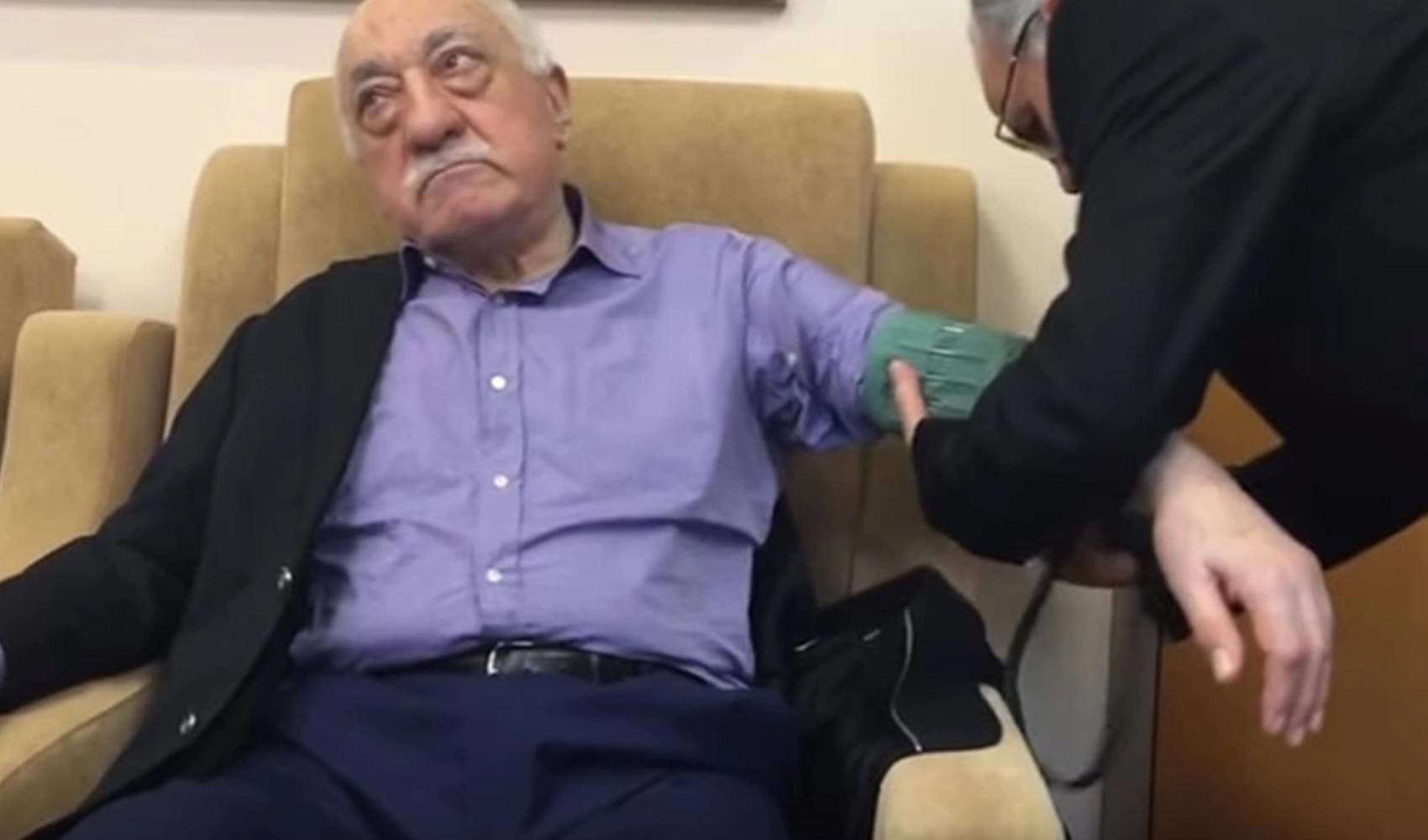
FETÖ's media outlet Herkül has announced that FETÖ ringleader Fethullah Gülen has died. Sources close to FETÖ have also confirmed the news.
So, who was Fethullah Gülen and what kind of damage did he leave behind in Turkey's last 60 years?
Here is the portrait of Gülen by Alican Uludağ from DW Türkçe...
Starting out as a preacher and building a "community" structure that spread first across Turkey and then to every corner of the world, Fethullah Gülen passed away while being wanted in Turkey on charges of leading an "armed terrorist organization" and for the July 15 coup attempt. It was claimed that Gülen, who set out with the goal of "infiltrating the capillaries of the state," would return from the USA, where he had lived since 1999, "like Khomeini."
ERGENEKON, BALYOZ, MILITARY ESPIONAGE, MIT...
During the period when he was in partnership with the AKP, he gained extraordinary power in Turkey: he was accused of being the name behind political operations such as Ergenekon, Balyoz (Sledgehammer), Military Espionage, and KCK. However, paths with the AKP diverged first with the February 7 MIT crisis, then the closure of private tutoring centers, and subsequently the December 17-25 operations. The July 15 coup attempt, in which soldiers allegedly linked to Gülen were involved, resulted in the liquidation of the Gülen structure in Turkey.
Who is Fethullah Gülen, who left his mark on Turkey's last 60 years in this way?
Fethullah Gülen was born on April 27, 1941, in the Pasinler district of Erzurum, as the second of eight children. He received his first religious knowledge from his father, who was an imam. Gülen, who completed his primary education, which he had left unfinished, through external exams, received religious education from various "hodjas" during this process. At the age of 17, he met the Nur community. He joined the Yeni Asya branch of the Nur Community.
HIS APPOINTMENT TO IZMIR
Gülen began his duty as a preacher in Edirne in 1959, affiliated with the Presidency of Religious Affairs. He served there for about four years. Returning to his hometown after his military service, he was among the founders of the Erzurum branch of the Association for the Struggle Against Communism in 1962, and carried out activities against the left. Later, he served as an imam first in Edirne and then in Kırklareli.
His appointment to Izmir in 1966 became the turning point of Fethullah Gülen's life. Here, he worked both as an instructor and as the director of the Kestane Pazarı Quran Course. During this period, a core cadre began to gather around him, and the foundations of his community were laid. He served there until the military memorandum of March 12, 1971, and increased the number of his sympathizers with his sermons. Gülen, who made young people his target audience in particular, had his sermons recorded on cassettes, distributed under the counter, and his propaganda reached other provinces. Names such as Mustafa Özcan, Abdullah Aymaz, İsmail Büyükçelebi, and İlhan İşbilen, who were among his first students, reached the upper echelons of the Gülen structure today.
FROM NUR HOUSES TO LIGHT HOUSES
He established the "Nur Houses" for the first time in Izmir Tepecik in 1966. However, over time, within the scope of the community's "Golden Generation" project, these houses changed their name to "Light Houses" (Işık Evleri) starting from 1994. From the 1970s onwards, Gülen broke away from the Yeni Asya Community and established his own community.
The first link of the community established by Gülen was "education." Students were educated and recruited within the framework of Gülen's ideas, especially in the "Light Houses" affiliated with the community. In the long run, those raised within the structure were placed in important levels of the state, primarily the Police, the Turkish Armed Forces (TSK), and the Civil Service.
During this process, Gülen, who was under close surveillance by the state, was removed from his post in January 1971 on the grounds that he took students to meetings in "Nur Madrasas." After the March 12 memorandum, he was arrested in Izmir on May 4, 1971, by the Martial Law Command. He was released on November 9, 1971, in the "Nurculuk" case with 54 defendants opened at the Izmir Martial Law Court. The court sentenced Gülen to three years in prison in 1972.
However, this sentence was overturned by the Military Court of Cassation in 1974.
Although Fethullah Gülen was arrested during this period, he specifically avoided confronting the military. In a speech, Gülen, who called May 27 a "left-guided movement," did not neglect to praise the memorandum by saying, "March 12 is not a revolution or a coup. It is a warning that alerts the government on certain issues."
After being released, he continued to preach in Edremit, Manisa, and Izmir. He tried to create a religion-focused "third way" by using the period when the right-left conflict peaked, especially in the 1970s, to his own advantage.
SEPTEMBER 12
Fethullah Gülen was also on the list of those to be detained in the September 12, 1980 military coup. Resigning from his preaching post in 1981, Gülen managed to escape for six years despite the arrest warrant issued against him by the martial law command. He was caught in Burdur in 1986 with an ID belonging to his brother, but was released a day later, allegedly due to the intervention of Turgut Özal. The other 13 people who acted with him at the time Gülen was caught would later come to important positions in the Gülen structure.
After the September 12 coup, Gülen also praised September 12 in an article titled "The Last Outpost" written in the October 1980 issue of Sızıntı Magazine, saying, "We salute the Mehmetçik (Turkish soldier) once again, who came to our aid like Khidr where our hope was exhausted." He wanted to meet with the leader of the coup, Kenan Evren, but received a negative response during this process.
After Gülen was released, he turned the vacuum created by the coup into an opportunity. Starting from 1989, he continued his sermons voluntarily, independently of the Presidency of Religious Affairs, in Izmir and Istanbul. He used the Yeni Valide Complex in Üsküdar, Istanbul, as a center and gave sermons for 62 weeks. These sermons continued until 1992.
20-YEAR ESTABLISHMENT PERIOD
The period from the 1970s to the 1990s was the period for Fethullah Gülen to establish his community and form his core cadre. Gülen, who initially called themselves a "community," later began to define himself as a "service movement." The period of "infiltration" of those raised in the Light Houses into state cadres began.
After the 1990s, while "infiltration into the state" accelerated on one hand, the period of coming out into the open in the civil sphere and conducting "legal activities" began. The community also began to institutionalize and become a corporation. It tried to improve its relations, especially with the world of politics. At the same time, it pursued a strategy of opening up to the world.
Especially with the collapse of the Soviets, the number of schools opened in the Turkic Republics in Central Asia, Balkan countries, and African countries increased.
BANK ASYA
Gülen, who also gained strength in the economic field, opened Bank Asya in Altunizade on October 24, 1996. The opening was attended by the Deputy Prime Minister and Minister of Foreign Affairs of the time Tansu Çiller, Minister of State Abdullah Gül, the then Mayor of Istanbul Metropolitan Municipality Recep Tayyip Erdoğan, and former ministers such as Abdülkadir Aksu, who cut the ribbon.
On the other hand, the number of companies opened in fields such as food, education, health, and media increased. Many large holdings emerged, and universities were opened. Thousands of students graduated from private schools every year.
In the 1990s, Gülen developed warm relations with politicians such as Turgut Özal, Recep Tayyip Erdoğan, Abdullah Gül, Bülent Ecevit, Tansu Çiller, Süleyman Demirel, and Mesut Yılmaz. At the same time, these years were a period when the discourse of "interfaith dialogue" was widely used.
ESCAPE TO THE USA
Within the scope of "reactionism" (irtica), which was seen as a threat during the February 28 period, Fethullah Gülen was also closely monitored. However, Gülen criticized Necmettin Erbakan during this process and avoided clashing with the military during this period as well. On March 27, 1997, on Samanyolu TV, which he attended, he said, "The military wanted the problems to be solved through democratic means."
During this process, Gülen offered to transfer the schools belonging to his community to the Ministry of National Education. However, it caused controversy when Gülen, in a "confidential" conversation leaked in 1999, pointed to the importance of staffing, especially in the judiciary and civil service, saying, "These are our guarantees in those units for the sake of the future."
As of the end of the 1990s, the judiciary's focus began to turn more towards Fethullah Gülen. The then Ankara Police Chief Cevdet Saral prepared a report revealing Gülen's structure within the state. The then Ankara DGM (State Security Court) Prosecutor Nuh Mete Yüksel launched an investigation against Gülen on the allegation of "attempting to overthrow the constitutional order and establish a theocratic state in its place."
Upon this, Fethullah Gülen went to the USA on March 21, 1999, citing health problems, and never returned.
PERIOD OF 'SEIZING THE STATE'
The AKP coming to power alone on November 3, 2002, gave the Fethullah Gülen structure a sigh of relief. Erdoğan, who had weak cadres within the state, used the cadres loyal to Gülen, especially in the 11th year of his rule. The first period of the AKP was a period when the numerical and operational power of the Gülenists within the state reached its peak. At the same time, their staffing within the state was largely completed.
On the other hand, the judicial pressure on Gülen decreased during the AKP period. The TSK, which saw Gülen as a threat, brought the issue of "Nurculuk Activities in Turkey and Fethullah Gülen" to the agenda at the National Security Council (MGK) meeting held in 2004, and it was decided to prepare an action plan against this at home and abroad and to notify the government.
This decision was also signed by the then Prime Minister Erdoğan. However, the AKP did not implement the decision to fight against Gülen.
The Ankara 11th High Criminal Court issued an acquittal decision for Gülen in 2007 on the grounds that the crime did not occur. The decision was upheld by the General Assembly of the Court of Cassation in 2008.
REMARKABLE YEAR: 2007
The year 2007 was the beginning of Gülen using his operational power within the state. Gülen's power within the Police and the judiciary began to emerge from 2007 onwards. First, segments opposed to the AKP were targeted. Many political investigations such as Ergenekon, Balyoz, Military Espionage, and KCK were opened during this period.
Prosecutors like Zekeriya Öz and police chiefs like Ramazan Akyürek, who managed these operations, were later accused of being loyal to Gülen. Segments opposed to the government and Gülen faced this process with judicial operations. Especially in the TSK, soldiers belonging to the Gülen community were brought to the Atatürkist cadres that became vacant, with the support of the AKP.
Soldiers who actively participated in the July 15 coup attempt were made generals during this period. These promotions within the TSK continued until before the July 15 coup attempt.
The constitutional amendment made in 2010 resulted in Gülen becoming dominant in the judiciary. Gülen explained the importance of this referendum with the words, "It is necessary to raise the dead in the graves and make them vote." After the referendum was accepted, judges and prosecutors connected to the Gülen structure were brought first to the HSYK (Supreme Board of Judges and Prosecutors) memberships and then to critical positions in the judiciary.
MIT, TUTORING CENTERS, AND DECEMBER 17 CRISES
The Gülen movement, which reached the peak of its power within the state, reached the power to conduct operations against the ruling party. The first crisis between the AKP and the community was experienced on April 7, 2012, when an attempt was made to detain MIT personnel between Hakan Fidan. Erdoğan challenged the community at that time by saying, "Hakan Fidan is my secret keeper. If you are going to take him, take me." Erdoğan called on Gülen to return from the USA by saying "Let this longing end" at the Turkish Olympiads he attended on June 14, 2012.
In 2013, the crisis between the AKP and the community turned into a war with the AKP preparing a legislative proposal to close the private tutoring centers.
On December 17, 2013, a corruption and bribery operation was organized in Istanbul, in which Reza Zarrab and the children of some ministers were detained. An indictment was prepared against Muammer Güler, Zafer Çağlayan, Erdoğan Bayraktar, and Egemen Bağış. On December 25, the investigation regarding names including Erdoğan's son Bilal Erdoğan and some business people turned into an operation. However, the detentions were not carried out upon the instruction of the government. The Gülen structure was also held responsible for the stopping of the MIT trucks in 2014. Erdoğan said to Gülen during this period, "What did they ask for that we didn't give?"
With the December 17-25 operation, the Erdoğan government decided to liquidate the Fethullah Gülen movement. Gülen cadres within the state, primarily in the judiciary, police, and bureaucracy, began to be dismissed. In 2014, it was seen as a "parallel state structure" by the MGK.
In June 2016, the "FETÖ umbrella indictment" was prepared against 73 people, including Fethullah Gülen, on charges of establishing, managing, and being a member of a terrorist organization. The indictment described that the organization had reached the power to stage a coup. However, before the indictment was accepted by the court, a military coup attempt took place on July 15, 2016. In the indictments, it was alleged that the soldiers who participated in the coup attempt were members of the Gülen structure. Again, a video of Adil Öksüz, who was caught at the Akıncı Air Base but released in a suspicious manner, with Gülen also emerged.
WHO WILL REPLACE HIM?
Many lawsuits have been filed against Fethullah Gülen to date. He became a defendant in many cases such as the December 17-25 operations, the Selam Tevhid investigation, the stopping of the MIT trucks, the July 15 coup, and the Necip Hablemitoğlu murder. The main accusation in the indictments was that Fethullah Gülen was trying to overthrow the constitutional order and establish a state based on religious foundations in its place and return to Turkey "like Khomeini."
He was accused of infiltrating critical units of the state, primarily the TSK, Police, Judiciary, and MIT. After the July 15 coup attempt, approximately 125 thousand public officials were dismissed on the grounds that they were connected to Gülen.
After Fethullah Gülen's death, a "community" that has been largely liquidated in Turkey remains behind. However, Gülen's structure abroad is still standing. Now all eyes are on who will replace Gülen.
Names such as Mustafa Özcan, Suat Yıldırım, and Şerif Ali Tekalan stand out among the candidates. Whether the Gülen structure will divide after his death, whether there will be a power struggle, and who will manage this "power" is currently unknown.
News Source: 12punto