



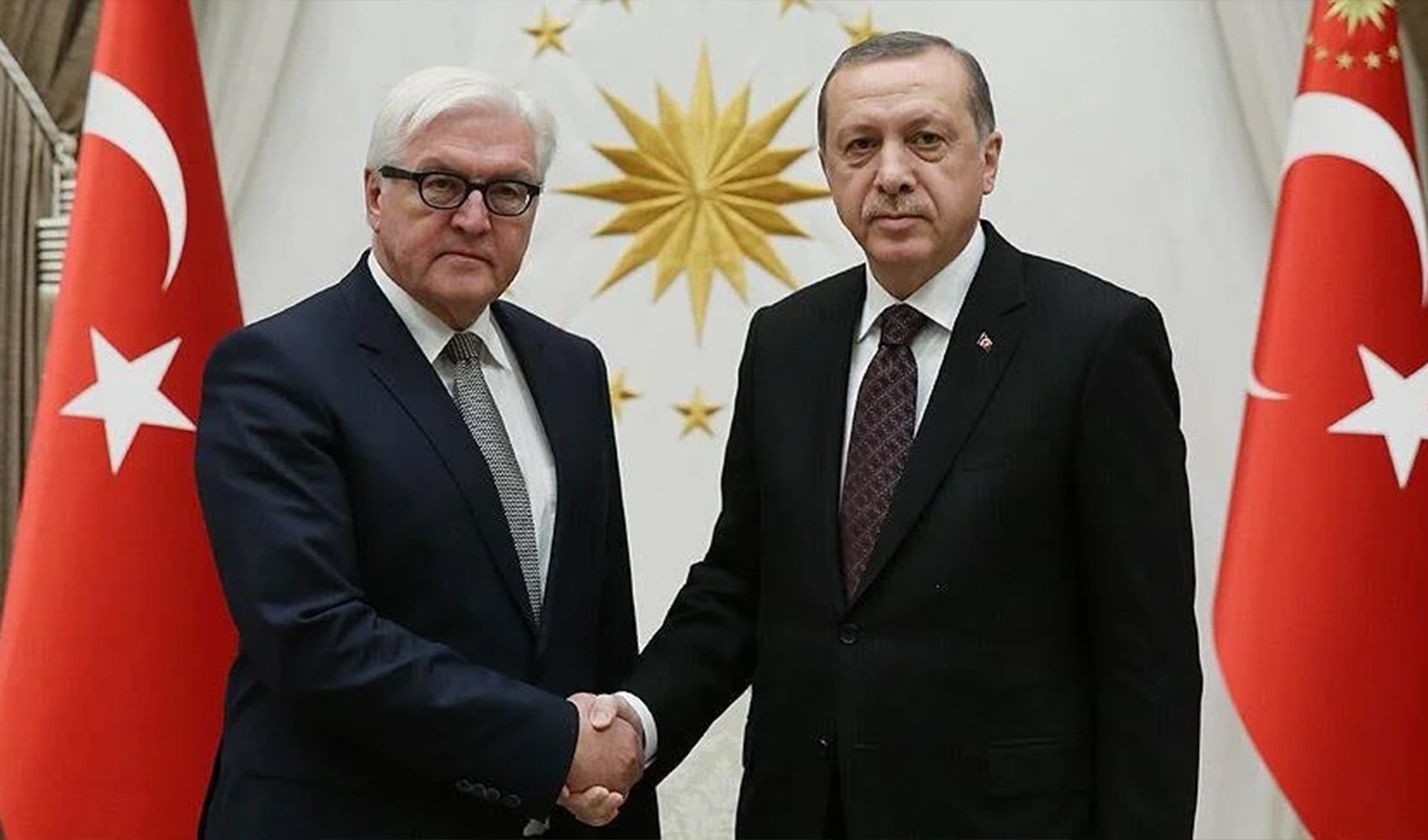
Akif Çağatay Kılıç, Chief Advisor to the President on Foreign Policy and Security, evaluated the visit to Turkey by the German President after 10 years and the agenda items.
Question: What does a visit by a German President after 10 years mean for Turkey?
Akif Çağatay Kılıç: Before Mr. Steinmeier, if I recall correctly, Mr. Gauck had also visited. Since then, there have been other presidential visits, but as you said, this is the first time after a 10-year interval.
Naturally, a president coming to visit the president of another country signifies a point where there is a desire for relations to gain much more momentum.
At the same time, as I mentioned, with the historical labor agreement and the deepening familiarity between our mutual citizens, we can see this visit at the point we have reached as a sign, a token, to demonstrate how deep and close Turkey-Germany relations are. Of course, there are places Steinmeier will visit during his stay. We will also talk about issues on which we do not agree. In other words, in international relations, it is not the case that you will agree on everything. There are issues we view, interpret, and evaluate differently. But there are also many issues where we see eye-to-eye and can act together. The visit is important to us.
Question: What are the expectations from Germany regarding the course of relations with the EU?
Akif Çağatay Kılıç: Our expectation from Germany is, frankly, the implementation of the negotiation process within the framework of the EU acquis that they claim to be committed to. We know that during the previous political administration, that is, the Merkel era, while there was an open and clear working environment, Ms. Merkel always expressed that she did not actually want Turkey's EU membership.
Therefore, although there was rhetoric that 'we will remain committed to the agreements' on this issue, EU membership was naturally not encouraged. In the current three-party coalition government in Germany—the SPD, the Greens, and the Liberals—there is no stance that opposes Turkey's EU membership. However, when you look at the speed of the negotiation process, no acceleration is observed there either.
I hope that we will be able to see the other side adopt a clearer approach while these issues are also being discussed within the framework of this visit.
Question: Will the decisions taken regarding Turkey and the TRNC at the EU Leaders' Summit be brought to the agenda? What are Turkey's expectations from Germany, especially regarding security in Cyprus and the Eastern Mediterranean?
Akif Çağatay Kılıç: Our Ministry of Foreign Affairs has made a statement on this matter. Our Minister of Foreign Affairs has also expressed his views on this issue very clearly and explicitly.
In light of the information we have discussed and talked about here, as well as past events, we naturally have a different expectation from Germany. We expect Germany not to allow certain biased political approaches against Turkey to progress or be used within the negotiation process.
According to the information we have obtained, there were certain headings or phrases that were requested to be much more advanced, and efforts were made to ensure these were not included. However, as you have also mentioned, we observe a writing style in the section of the report concerning Turkey that unfortunately manifests certain prejudiced approaches.
Question: Will there be a request regarding the military blockades imposed on Turkey?
Akif Çağatay Kılıç: First, we must state this: Turkey and Germany are NATO members; we are NATO allies. As NATO allies, we have certain responsibilities toward each other. As Turkey, we are an ally that attaches great importance to our responsibilities within the framework of the NATO alliance and strives to fulfill them in the best possible way.
Unfortunately, we do not always see sufficient allied support from some of our allies—and I say this with regret, Germany is a part of this. There are certain blockades applied against Turkey by Germany regarding the supply of various military materials. We know that this has a political side.
This stance, which arises due to certain approaches put forward by some political parties in the parliament, saddens us. These will, of course, be on the table. While there are some points where we have made progress, there are also points where we are stuck. It is not right to impose any official or unofficial restrictions on a NATO ally in military cooperation, whether it concerns military equipment, defense industry products, or other areas, and it is contrary to the spirit of the alliance. These will naturally be a topic of discussion.
Question: One of the fundamental issues between Germany and Turkey is the Turkish presence there. When we look at recent developments, we see that along with a general decline in prosperity in Germany, the democratic space is shrinking and there are serious problems regarding freedom of expression. The Turkish community is the most affected by this. Will this issue also be brought to the agenda?
Akif Çağatay Kılıç: Unfortunately, we have recently observed an increase in racist approaches and racist attacks, especially Islamophobic attacks.
There are some biased approaches toward some of our non-governmental organizations and think tanks. We can see the intellectual structure behind these. This issue is also among the topics that our President will raise with Steinmeier. During the meetings between the delegations, different ministries, ministers, and institutions will share these topics while in communication with each other.
While there are various reasons for this, there was most recently an arson attack in Solingen again. We are following the matter closely. Through you, I would like to say the following to our citizens living there and their relatives in Turkey who are following the issue:
As a state, our institutions, we, our President, and our government are closely following the developments there and the events that occurred before and after the arson attack. We are in very close contact with the authorities there. We are sharing our views and thoughts very clearly, without any hesitation, and we are stating that we will follow up on this. Therefore, we will do and will continue to do everything in our power to protect the rights of all our citizens to the end.
Question: As a chief advisor working on national security, you know there are some operations in Iraq right now. How is Germany's relationship with terrorist organizations evaluated?
Akif Çağatay Kılıç: At this point, we must say this: regarding our fight against terrorism, we see that the situation regarding the terrorist organization in Germany, the PKK and its different versions, the YPG/PYD terrorist organizations, is showing signs of improvement. We observe that certain visual elements are banned in many different places and that permission is not granted for the use of some rags. This,
does not mean that the presence of the terrorist organization in Germany has been completely ended or that the possibilities for them to be in Germany have been completely eliminated in any way. But when we look at it from the perspective of the PKK terrorist organization, we observe that some steps have been taken and some work is being done. I hope that these will continue much more clearly and more intensively.
Regarding FETÖ, there is confusion in Germany, as there is in some other countries where they have fled. In other words, because official German authorities do not view FETÖ as a terrorist organization, certain situations arise. However, they also see that this structure is not a legitimate one. They recognize that FETÖ members are involved in criminal activities, particularly financial crimes, and that they are using certain financial resources there in violation of the law.
Similarly, we see that FETÖ is laundering money in violation of the law within global trade or the global financial system, and that they are attempting to spread lies—what we call disinformation and perception operations—via social media. Our fight against FETÖ will continue until the end. Here, of course, the work of our Disinformation Center, established by our Directorate of Communications, is very important for Turkey. We inform our counterparts that FETÖ's approaches have caused serious confusion worldwide and that they are involved in criminal activities, and we tell them to see this and act accordingly. All of these will, of course, be on the table.
Question: Can new windows of opportunity be opened in the field of economy with this visit?
Akif Çağatay Kılıç: From an economic perspective, our citizens, who are involved in utilizing the economy's significant financial resources and possess a young generation, have already become influential in the business world. In other words, in terms of economic relations, there is already a very serious investment in established Turkish companies in Germany, and they are now represented—we are represented—within the German political structure. German companies' investments in Turkey are also at a high level. Therefore, with this cooperation, there are also opportunities to go and invest together in third or fourth countries and different regions, which is already being done.
In other words, there is now a mutually intense commercial relationship. This will naturally deepen and progress.
But if we can overcome the obstacles in the defense industry or other areas that have been imposed through certain political restrictions, we will proceed much more easily. Therefore, in this sense, I hope the visit continues in a way that paves the way.
Question: Will Germany's support for the Gaza genocide also come up in the talks?
Akif Çağatay Kılıç: The situation in Gaza has truly reached a point that all of humanity can no longer bear. A brutal massacre, a genocide, is taking place there. Regarding this, we see that those who unfortunately stood by Israel unconditionally and without any preconditions in the period following October 7 are now trying to stop Israel at this stage. But they cannot stop it. Israel continues its massacres and murders. There is now a very serious reaction against the Netanyahu government even among the public within Israel.
You see the tension escalating in the region with the loss of human lives and the slaughter of women, children, and innocents. At this point, after today, there is not much left to discuss with those who do not raise their voices against Israel.
Germany has a history regarding Jews living in its country and in Europe. Because of this, one might understand a slightly more cautious approach. But at the point we have reached now, rather than remaining silent, even speaking out weakly against what the Israeli government is doing is unacceptable. We must see and understand that we are not talking about a historical issue but a current one, that a massacre and a genocide are taking place today, and if there is anyone who does not understand this, we must shout it out.
Our President's stance since October 7 has been clear and evident. We expect this from the whole world, especially the USA and EU countries. We do not think that enough pressure is being put on Israel or that enough voices are being raised; more voices need to be raised. This issue will, of course, be on the table.
News Source: AA









