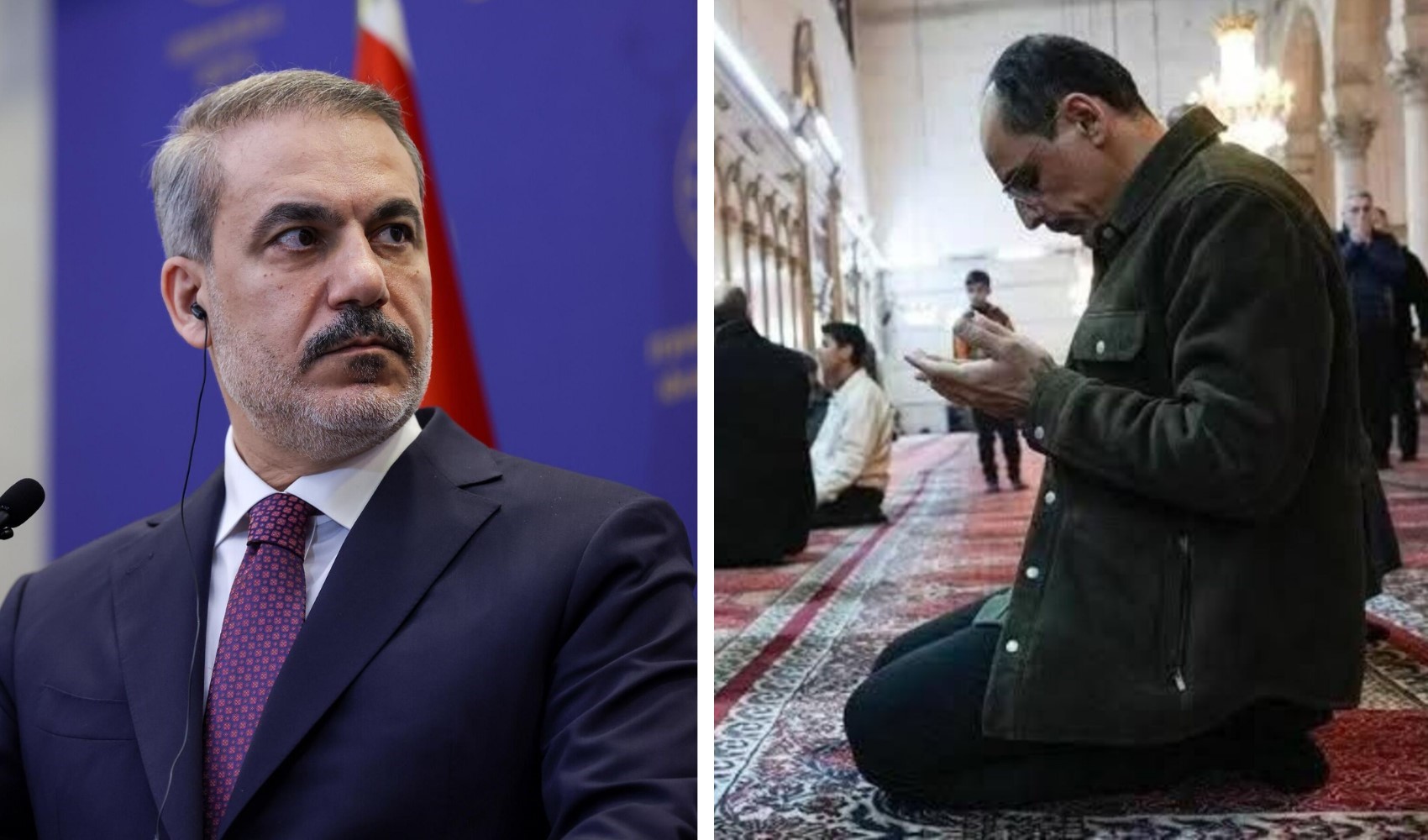
Foreign Minister Hakan Fidan made statements regarding the current agenda to the Saudi Arabia-based Al Hadath television.
Touching upon the developments in Syria, Fidan stated, "We have become intertwined with history, geography, culture, and faith; we have become inseparable. Therefore, when this troubled period in Syria began, the Syrian opposition and those in the north leaned on Turkey, and especially millions of displaced refugees saw Turkey as their homeland, as their home, and we opened our arms to them," emphasizing that it was very important for the Syrian opposition to find a foothold in Turkey.
Underlining that Turkey has worked very hard for the Syrian opposition to resolve the issue in a constructive manner, Fidan noted that the Astana process was very important in this regard, but that the Assad regime did not lean toward a solution for various reasons and remained caught in an equation.
Fidan said, "He was either going to share power with his own people, make peace with his people, or he was going to share power with hegemons and forces coming from outside, forces that defended him against his people. Of course, when he shared this power with Russia and Iran, they fought together, but they could not get the decisions they wanted because every country had different interests, and after a point, when Assad failed in making peace with his people, in bringing back millions of people, in providing services to the people currently in Syria, in providing basic services, and in the economy, the system collapsed on its own."
To the question, "There is a rumor, a claim that actually, in an international context, they sat at a table and reached a consensus on Assad's departure, and then the process that led to the fall of Damascus was set in motion, and the way was paved for HTS's advance. What do you say to this?" Minister Fidan replied that Turkey was not part of such a process and continued as follows:
"After the operation began, after the operation was launched by HTS and other opposition groups, we made an intense effort to ensure it happened in the most bloodless, problem-free, and least costly way, but before that, we did not come together with any country or any group to engage in such planning and work."
INTENSE DIPLOMATIC TRAFFIC BETWEEN TURKEY, RUSSIA, AND IRAN
Fidan stated that in the processes regarding Syria, Russia, Turkey, and Iran are in very intense and regular diplomatic traffic to ensure the continuation of the ceasefire on the ground and to resolve problems, adding that Turkey has always brought the views of the opposition to the table.
"We took the views of the regime to a point with Iran and Russia. We have a relationship with them based on mutual respect; we know each other, and when the process began, we spoke with them. There is no point in repeating the same scenario from 2006, 2016, or 2015. Bashar Assad, unfortunately, you came to his aid, you helped in repelling the opposition, but because he could not show success in providing services to his people, in getting the system back on its feet, or in making peace with his people, we are facing such a picture today," said Fidan, adding that both Russia's and Iran's internal assessments have shown them the result as well.
Fidan pointed out that Turkey, as an important element of the region and an important friend of the opposition, having a dialogue with them on certain issues to manage this process with constructive language has also been effective, emphasizing that this dialogue will continue.
Regarding the question of who called Bashar Assad and what the event was that caused him to leave the country, Minister Fidan replied, "We know that our counterparts were in a certain level of contact with Damascus; they told us that day, but I do not have information on which one spoke to him directly or at what level, but what I know is that the message was conveyed."
Emphasizing that the allegations that Turkey enabled Assad's departure from Syria by cooperating with certain authorities are not true, Fidan pointed out that this is not something Turkey would do and that Turkey had no role in this matter.
Fidan stated, "The Russians announced themselves that they organized and carried out this business. We have no role in this matter."
MIT CHIEF KALIN'S VISIT TO DAMASCUS
Regarding National Intelligence Organization (MIT) Chief İbrahim Kalın's visit to Damascus, he stated that Kalın carried out this visit by being in broad consultation with both regional countries and Western countries, and noted the following:
"How should both regional countries and world countries communicate with the new administration in Damascus? Through the contacts we made, we saw a general perception and demand there, and there were certain principles that everyone more or less agreed upon. These were that terrorist organizations should not take advantage of Damascus in the new era, especially that minorities should be treated well... especially Christians, Kurds, Alawites, and Turkmens. There were various formed views such as the establishment of an inclusive government later on, and that it should not be a threat to its neighbors."
Fidan said that Kalın conveyed the views of the international community, the region, and Turkey to the other side and received the other side's input, reminding that based on this input, a meeting was held in Jordan's Gulf of Aqaba on December 14 and talks were conducted.
In his speech, Fidan touched upon Turkey's policy in Syria, underlining that this policy has been multi-dimensional for 13 years, and the most important of these was to prevent refugees from coming to Turkey due to Assad, who would not make peace with the opposition.
Fidan explained that Turkey therefore worked with opposition elements that held control on the front lines, and continued:
"Especially the Syrian National Army, the National Liberation Front, these were the places Turkey worked with one-on-one. In Idlib, 4 million Syrian citizens were living under the control of Hayat Tahrir al-Sham (HTS). It was possible for them to come to Turkey during a certain crisis. We were always in a certain coordination to ensure these crises did not arise and that the presence there continued stably, and during that process, we had the opportunity to get to know the delegation.
We always conveyed our advice and counsel to them, especially on what a modern management perception is and what modern management systems are like. What we see right now is that the number one priority of the delegation and other components is not to repeat the mistakes Bashar Assad made and to bring the prosperity and stability they deserve by embracing the people. We need to help them in doing this, and they must not make mistakes."
Fidan responded to the question of whether he had met with the HTS leader before by reminding that he had served as MIT Chief for 13 years.
Reminding that the Syrian crisis had taken up 13 years of his working life since the day it began, Fidan noted that he had always had contact with certain actors as a minister as well.
"WE DO NOT WANT IRANIAN DOMINATION, WE DO NOT WANT TURKISH DOMINATION, WE DO NOT WANT ARAB DOMINATION"
Stating that Turkey had put this issue on the table in the region even before this new period in Syria began, Fidan conveyed the view of AKP Chairman and President Recep Tayyip Erdoğan on the matter.
Fidan said, "We need to develop this language in the region; we do not want Iranian domination in the region, we do not want Turkish domination, we do not want Arab domination. Let neither the Arabs in the Gulf dominate each other, nor dominate another place from there, nor should we dominate another place, nor should the Iranians dominate a place. Now all states, we are moving from 2024 to 2025, have matured to the necessary extent, their infrastructures are strong. There is a very strong Saudi Arabia, a very strong United Arab Emirates, a very influential Qatar, Kuwait. Egypt is truly doing its best. Now we need to come together and, within a culture of cooperation, by respecting each other's borders and sovereign rights, going beyond respect and committing to protecting each other, by standing shoulder to shoulder, we need to establish our own interests and our own order in the region."
Pointing out that otherwise, the region is interfered with from the outside, polarization is exploited, and this leads to long-term, bloody, and costly conflicts in the region, Fidan indicated that there is no need for this and that the peoples of the region can live together in an open and transparent manner.
Fidan said, "We are all relatives anyway, we are all Muslims, we are all of the same religion. It is possible to come together and define our interests, requests, and sensitivities with great maturity and professionalism, and to do all of these—economic, political, military—in this geography, just as alliances are formed in Europe, North America, and other places," adding that this geography's soil is fertile, and its people are productive, hardworking, and honest.
Expressing that states have now matured and there is much we can do by coming together, Fidan noted the following:
"This is our message. The idea of domination, imperial ideas must be shelved. Someone trying to manage other countries in the region using proxies, someone trying to do something else by paying money in the background, trying to protect their interests... These produce an action-reaction, and as one reaction produces another action, we enter a vicious cycle. The region has learned enough to get out of this vicious cycle now. Our region has truly been in an incredibly large spiral of fire for the last 20-30 years.
Those in the Gulf were affected by the Yemen problem, we were affected by the Iraq and Syria problems. I think Iran will also learn lessons in the new era; we must also help Iran in a constructive way. We must help the new administration in Syria by conveying our requests. I believe that Turkey, Saudi Arabia, the United Arab Emirates, Egypt, and Qatar can come together, along with Jordan, and take very serious steps in solving critical problems in the region; we started this with the meeting in Aqaba. The important thing is for the states to be sincere."
News Source: AA