




Historian İlber Ortaylı, who met with the family of 15-year-old Mattia Ahmet Minguzzi, who tragically lost his life in Kadıköy, shared important messages regarding the debates on "children driven to crime" in Turkey, alongside the pain experienced. In a note shared on social media, Ortaylı emphasized that legal circles and the bar association are not reading the issue correctly, and that a criminal law perspective requires both a cool-headed and mature outlook.
Criticizing the approach of lawyer Kardelen Ateşci and some bar association members who claim that all children are innocent and victims, Ortaylı said, "It is not right to put Ahmet Minguzzi, who lost his life after being stabbed in the marketplace, in the same category as children caught stealing bread."
Stating that in an era where 16-year-olds voting is being discussed, the issue of law should not remain limited to slogans, Ortaylı reminded that the foundation of criminal law is the cool-headed evaluation of material evidence.
Drawing attention to the difficulties faced by the Minguzzi family, Ortaylı also addressed the threatening messages sent to the family and the lawyers of the case. Stating that these threats have reached international dimensions, Ortaylı called on the Ministry of Justice and lawmakers to take swift and effective steps in the fight against crime and aggression.
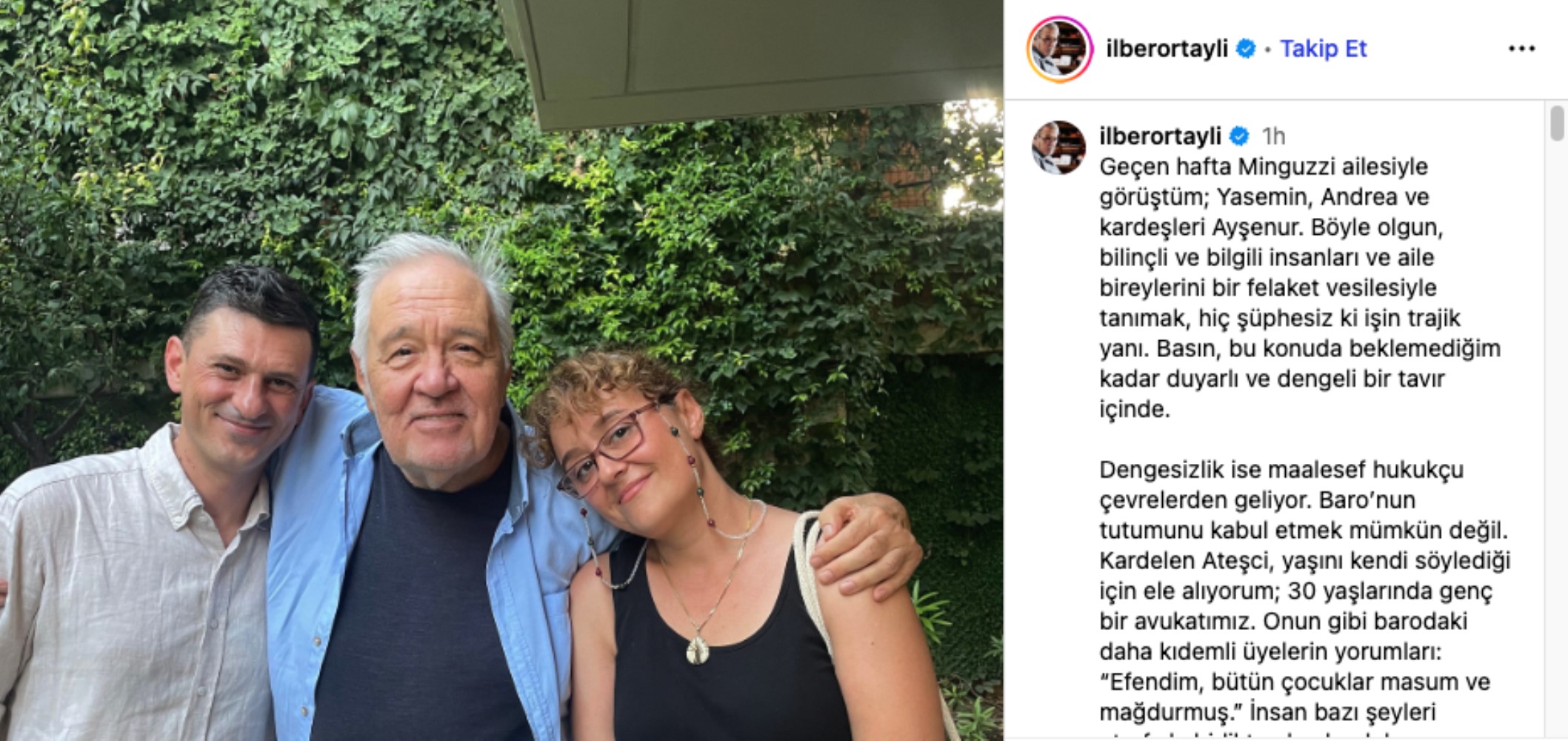
The full text of Ortaylı's statement is as follows:
"I met with the Minguzzi family last week; Yasemin, Andrea, and their siblings Ayşenur. Getting to know such mature, conscious, and knowledgeable people and family members on the occasion of a disaster is, without a doubt, the tragic side of the matter. The press is taking a more sensitive and balanced stance on this issue than I expected.
The imbalance, unfortunately, comes from legal circles. It is impossible to accept the Bar Association's stance. I am addressing Kardelen Ateşci because she stated her age herself; she is a young lawyer in her 30s. The comments of senior members in the bar like her: 'Sir, all children are innocent and victims.' One speaks about certain things by considering them with their surroundings. Legal practice should not consist solely of dry information in a file. That is, it is true that both Ahmet Minguzzi, who was stabbed in the marketplace, and someone caught stealing bread are equally victims. However, someone like the one caught stealing bread is not involved in this incident. That is a third imaginary paradigm. Comparing the situation of killers approaching the age of 20 with a small child stealing bread does not seem very logical.
In one corner of the world, 16-year-olds voting is being discussed, and there are societies where they do vote. While such developments are taking place on one side, nothing but slogans came out of the statement made by our young lady from the bar association's unit for children. Yet, legal practice, as my esteemed faculty colleague Prof. Dr. Ümit Kocasakal expressed very well this week, consists of 'evaluating material evidence and the case with a cool head.' It is very clear that criminal law—even Roman law, even Islamic law—contains strict rules and logical coolness. Lawyers are professionals who must master common principles, concepts, and institutions across centuries and locations.
That is why I do not find it right at all for young lawyers to turn some information they learned in school into slogans. When we look at a criminal case, an incident, repeating phrases like 'the poverty of the country, what 20 years of developments have turned people into' does not solve the problem. Anyone in the marketplace can say those things.
A criminal lawyer—I am saying this to young lawyers—needs to read a bit of Dostoevsky and Chekhov, as much as the file. At the very least, they should bring together and compare the characters of Jean Valjean and Inspector Javert in Victor Hugo's Les Misérables. A person matures through such studies as well.
I consulted my dear friend, Administrative Law Professor Tekin Akıllıoğlu, who is truly a venerable jurist, when I wrote a small essay on cemeteries. He came to me with very interesting passages from French literature by André Malraux about how cemeteries represent civilizations. Legal practice, without a doubt, should not distance one from the file and the concreteness of the case in front of them. You must be like a Roman jurist. But at the same time, you must not forget that you are in a logical unity and search with your colleagues who have lived in all times and ruled over all times.
In the 2nd century B.C., the Romans were at war with the city of Falerii. Falerian school children wandering outside the city were captured and brought to the Roman commander Camillus. They said, 'You can take them hostage and keep the city from defending itself.' Camillus's answer was, 'If I wage war against children, I am a scoundrel.'
The parents and family of the child who was perversely murdered in the marketplace, in the final joy of his innocent life, are also not left in peace. Finally, I saw the threatening messages sent to my friend, lawyer Rezzan Epözdemir. It is clear that the matter has gone far beyond child innocence and victimization. Gangs that resort to strange perversions like grave threats, consisting of killer defendants who are of voting age, are carrying out these activities via Uruguay and England. The situation is not at all as we know it. Although it is clear that the law to be enacted and changed will not have retroactive effect, that is, it will not cover the past; but crime, audacity, and aggression are increasing day by day, and other things are emerging behind them. The Ministry of Justice and lawmakers must not delay in taking action.
We draw the Bar Association's attention: You represent one of the three pillars of justice. We advise and request that you do not attract unnecessary reaction. This is necessary for the salvation of us all."
News Source: 12punto









