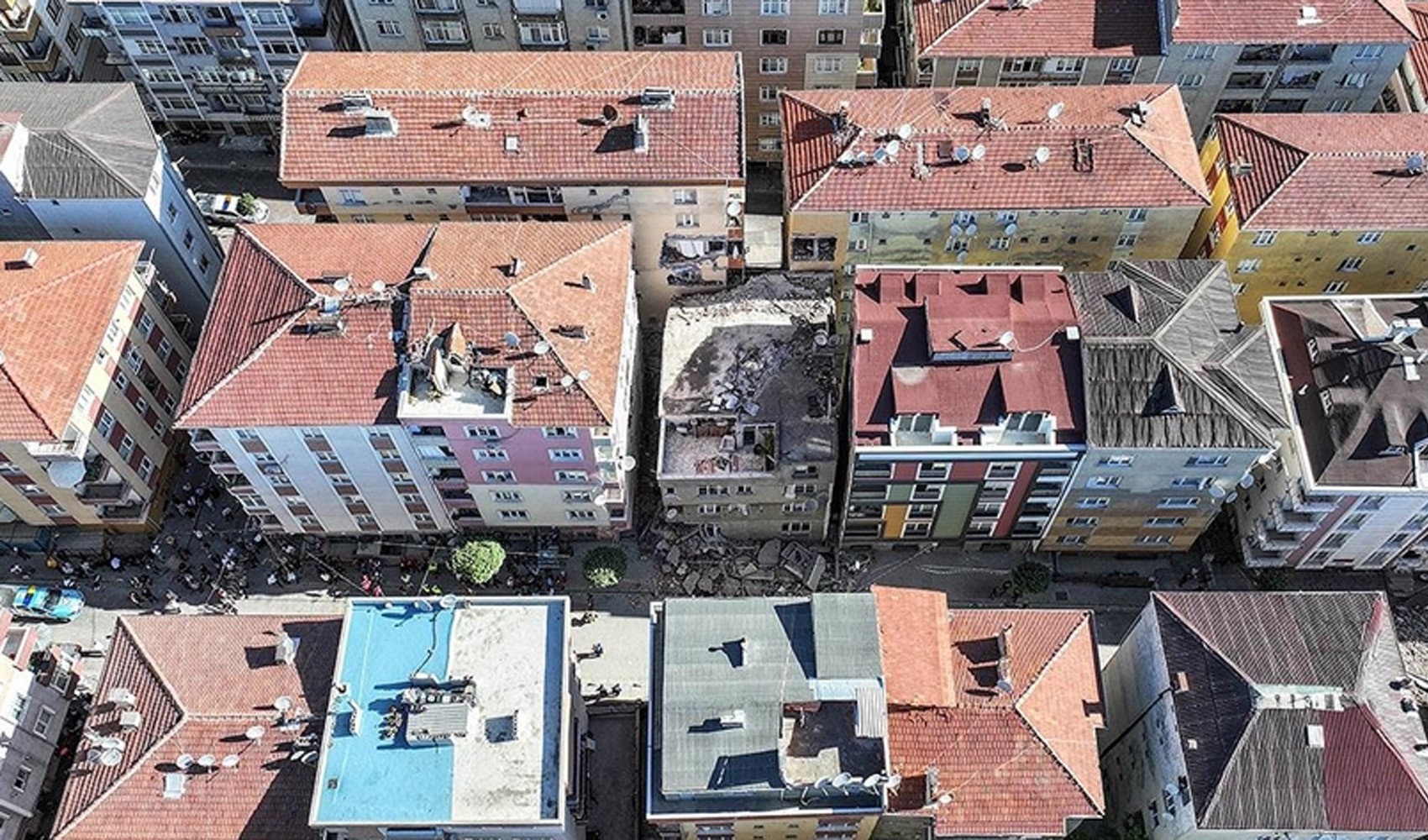
Less than a month after a 3-story building collapsed in Küçükçekmece on June 2, another collapse occurred in the city. The partial collapse of a 7-story building in Bahçelievler, which had 3 illegal floors, in the morning hours raised the question of how many buildings in the megacity are at risk of spontaneous collapse.
Experts, stating that the most important reasons for the spontaneous collapse of buildings are that they were built without engineering services, using low-quality materials, and that extra floors were added later, pointed to the high number of buildings in Istanbul that are in danger of spontaneous collapse.
Prof. Dr. Ali Koçak, a faculty member at Yıldız Technical University (YTÜ) Department of Civil Engineering, stated that the biggest problem with the building that collapsed in Bahçelievler was that it was illegal.
Stating that he examined the building's materials, Koçak said, "I looked at the concrete and the rebar. It is not suitable material for a 7-story building. The workmanship is the same. Extremely poor-quality construction was carried out. Building 7 stories without receiving any engineering services is a separate problem in itself. One of the biggest reasons for the building's collapse is that the columns and beams lost their load-bearing capacity. It could no longer carry the building."
Noting that the columns of the building that collapsed in Küçükçekmece also suffered from extreme corrosion, Koçak said that the common features of both buildings were that they were low-quality, built without engineering services, and were illegal.
"THEY HAVE COMPLETED THEIR ECONOMIC LIFESPAN"
Prof. Dr. Koçak said, "These types of structures have now completed their economic lifespans. They cannot carry their own loads. That is why they have started to suffer significant damage. Since they have completed their economic lifespan, these structures must be removed."
Noting that in Europe, such buildings are necessarily revised and inspected according to regulations whenever there is a change in building codes, Koçak stated that in Turkey, regulations have changed 4 times since the 1975 earthquake code, but the buildings have not been identified.
Koçak noted that it was said that inspections and planning should be done immediately after the 1999 earthquake, but it was not done, and said, "Now we say that these structures built before 1999, especially buildings over 30 years old, should be urgently evacuated, demolished, or strengthened and reopened for use. But they must be examined, identified, and the risky buildings must be brought to light."
"WHAT WE NEED TO DO IS IDENTIFY THE BUILDINGS"
Prof. Dr. Koçak emphasized that local governments should carry out these tasks more carefully, and continued as follows:
"First, they need to know very well what the current building stock is and which buildings are risky. Then they will sit down with the Ministry and ask, 'How are we going to rehabilitate these risky buildings?' If necessary, universities and professional chambers will be involved, and it will be said, let's develop a method for them. 'How are we going to make these buildings orderly, how are we going to prevent loss of life?' Our main goal should be to prevent loss of life. For this, what we will do is to identify the buildings, reveal their inventories, and determine the method. Didn't they always say before the election, 'Our priority is the earthquake, increasing the quality of buildings.' Now we have to do this. While we were saying after 1999 that our buildings should not collapse in an earthquake, we are now saying that our buildings should not collapse on their own. We got used to the earthquake, let's at least not get used to this."
Stating that they have examined many buildings as a university following the February 6 earthquakes centered in Kahramanmaraş, and that core samples have been pouring into the university, Koçak said, "I went and looked at many buildings, I said, 'Do you have a method? Your building turned out to be risky, what will you do next?' No, it stayed like that.
Perhaps strengthening has not been done in even 1 percent of the total buildings examined. But at first, our citizens came out with a frenzy, 'Oh, let's have our building examined, we are afraid of the earthquake.' Yes, we are afraid, but now we have started to be afraid of our buildings collapsing on their own."
"THERE ARE AROUND 50 THOUSAND SUCH BUILDINGS"
Regarding the number of risky buildings in Istanbul, Prof. Dr. Koçak stated, "The Ministry said that there are around 600 thousand risky buildings in Istanbul. The Istanbul Metropolitan Municipality announced it as 300 thousand. 50 thousand of these are definitely in this state. I can say this very clearly. Because these are buildings over 40 years old. This place is also like that, built in 1980. In 1995, 2-3 floors were added illegally on top. Unfortunately, we have around 50 thousand such buildings. That means we have at least 1,000 such buildings in every district."
Warning citizens to check whether a building has an occupancy permit and whether it has received engineering services when buying or renting a house, Koçak said:
"They should go to the relevant municipality and ask, 'I am renting this place, is it earthquake-resistant, does it have DASK (Compulsory Earthquake Insurance)?' When buying a building, if it is pre-2000, they should definitely not buy it without very good research and very good identification. They should also have buildings bought after 2000 checked by getting engineering services. They should only buy their buildings after an examination. Otherwise, the cheapness of the building, its location, etc., do not matter at all. They should only buy the building by questioning everything: the ground it is connected to, the quality of the building, engineering services, and whether a good building inspection has been carried out."
"POOR QUALITY BUILDINGS WERE BUILT"
Prof. Dr. Hasan Yıldırım, a faculty member at Istanbul Technical University (İTÜ) Department of Civil Engineering, explained that before 1999, buildings were built unconsciously by foremen without calculating concrete quality and rebar usage, and without receiving engineering services, and that there was no strict control and supervision as there is today, and the pain of this was experienced in the earthquake.
Yıldırım stated that after the earthquake, although not perfect, inspections were introduced and buildings began to be built with engineering services.
Pointing out that buildings in poor condition should be divided into two, Yıldırım said:
"One, buildings built unconsciously without being an engineer, and two, buildings built according to old regulations. It is not that buildings that received engineering services according to old regulations will not collapse in an earthquake. But if they had examined the ground according to the conditions of that day and designed it according to that ground, most of the buildings would be solid. When built consciously, there are buildings that even meet today's regulations. Buildings that collapse on their own fall into this category. No engineering services received, this much cement, this much sand...
Everyone says, 'They used little cement.' What happens if they use a lot of cement? There used to be bags of cement. 40 percent of these were additives, they were not completely pure cement. They were pouring concrete as they pleased, 6 bags for 160 concrete, 7 bags for 225 concrete. They were buying what hardware stores sold on the market. They were cheaper than pure cement.
Since there were no cements like today's CEM 1 42.5, 52.5, there was a problem in achieving the strength even if you used that dosage correctly and the material was clean. Plus, on top of that, when the materials used that day, such as shell materials from the sea in Istanbul or some sand and some gravel from the stream in Anatolia, were combined, poor quality buildings were built before 2000. This building already has no load-bearing capacity."
"IT WILL COLLAPSE EITHER IN AN EARTHQUAKE OR ON ITS OWN"
Pointing out that buildings can collapse for two reasons, not just out of the blue, Prof. Dr. Yıldırım said:
"First, if you make changes to some things in the building, such as columns or walls, without showing it to an engineer, I am not thinking about this. One should think about the second in these buildings. 1, 2 or 3 floors were added, concrete was poured by hand, the cement and materials used... When tests are done, we will see the concrete, we will speak more clearly. Let's take a core sample now. So the core turned out to be solid. Was the foundation made according to that ground? Just because the concrete quality turned out to be good does not mean the building is good.
If it collapses out of the blue, the concrete quality was not good, and the rebar rusted. When the rebar rusted, it caused the concrete to swell. One day it reaches a strength it cannot withstand, and if you add a few floors to a place that cannot carry itself, it does not collapse the day you do it, but as the days go by, corrosion and rust progress, concrete openings occur, and it becomes unable to carry itself.
When it reaches the threshold value, where it no longer has the strength to endure, that building goes towards collapse. This is most likely the case of a building with no calculations and poor material quality having weight added to it and eventually being set in motion. The summary is this: if you build a building unconsciously, whether you add a floor to it or not, it will eventually collapse either in an earthquake or on its own."
Stating that a clear figure cannot be given regarding buildings in danger of spontaneous collapse in Istanbul, and that the earthquake already destroys buildings that reach this degree, Yıldırım said, "I don't think there are many, and that they will collapse on their own. Maybe 5 percent will come out, but one shouldn't speak clearly. But there are many buildings likely to collapse in an earthquake."
News Source: AA