Interview: Şenol Çarık /12punto.com.tr
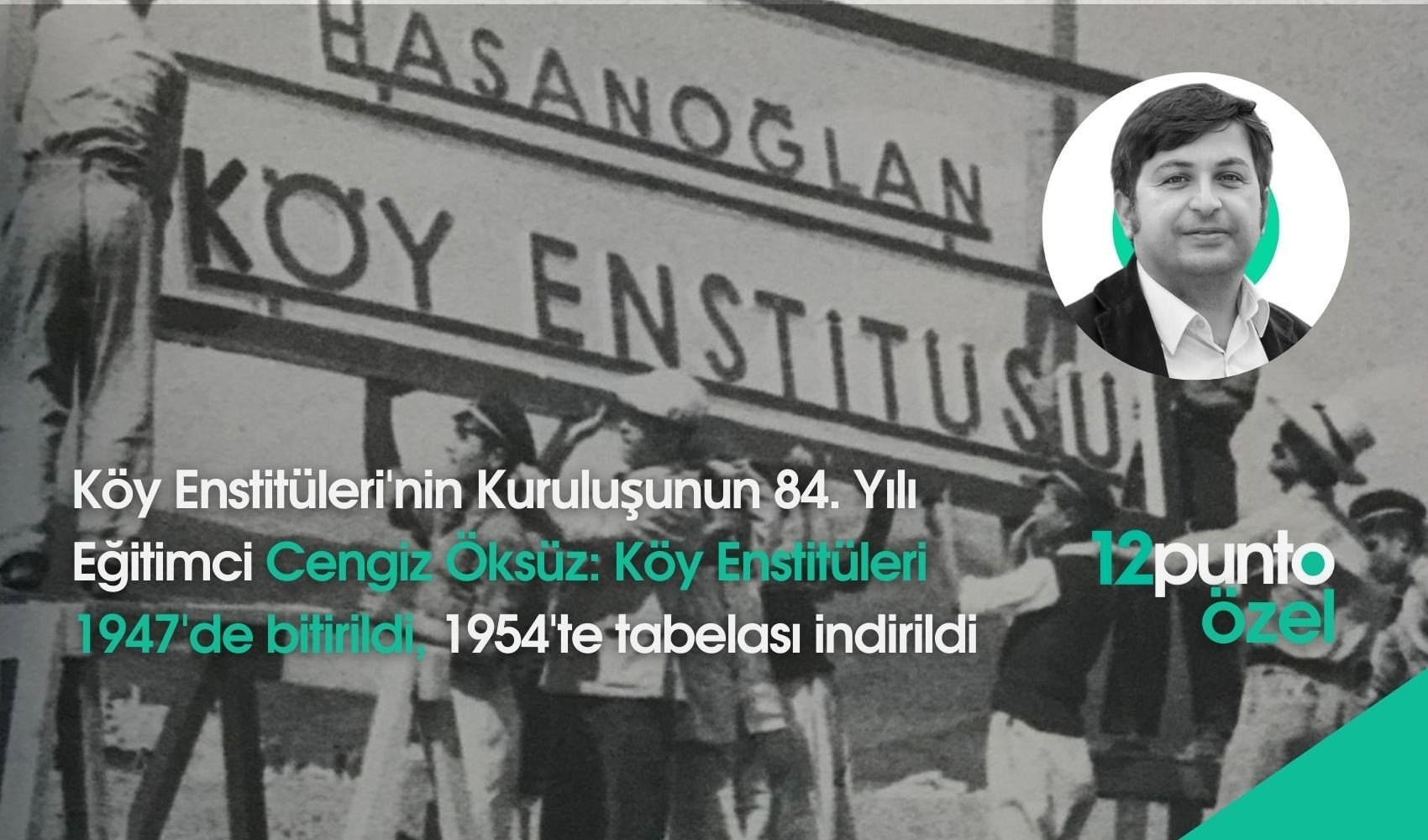
Speaking to 12Punto and emphasizing that the Village Institutes were an educational revolution, Cengiz Öksüz, an educator and Istanbul Branch President of the New Generation Village Institutes Association, said, "The fact that the Village Institutes were an educational revolution is not just a national matter, but a global one. This stems from their originality. It is very meaningful that even after all these years since they were closed, they are still being commemorated and celebrated with growing interest. The events we have experienced in education and politics in recent years only increase the importance of the Village Institutes," he said.
"İNÖNÜ STOOD BEHIND THEM UNTIL 1946"
Stating that there were 40,000 villages in Turkey in the 1930s, Öksüz noted that 35,000 of these villages had no schools, and in the 5,000 villages that did, the schools only offered 3 years of education. Pointing out that most teachers were not graduates of teacher training schools, Öksüz noted that this issue was discussed at the 4th General Congress of the CHP in 1935.
Cengiz Öksüz continued as follows:
"At the congress, they discussed 'how will we enter the villages?' During this congress, Atatürk appointed Saffet Arıkan as Minister of National Education. Arıkan was a comrade-in-arms and a staff officer whom Atatürk trusted deeply. Saffet Arıkan appointed İsmail Hakkı Tonguç as the General Director of Primary Education. Tonguç's nickname was 'Peasant İsmail'. One cannot understand the Village Institutes without knowing the life of Tonguç.
It was İsmail Hakkı Tonguç who founded the Village Institutes, not Hasan Ali Yücel. I want to state this clearly. It was Tonguç's product; Hasan Ali Yücel stood behind him. İsmet İnönü stood behind them until 1946."
"WE MUST ENTER THE VILLAGE AS BLACKSMITHS, BEEKEEPERS, AND COOPERATORS"
Expressing that teachers sent to villages could not settle or survive there, Öksüz said, "Teaching the ABCs was not enough, because even those who learned would forget it in the village after a few years. Tonguç said, 'We must enter the village not just as teachers, but as builders, blacksmiths, beekeepers, and cooperators. If the education we provide is not geared toward production, we cannot sustain education in the village.' This is stated in Law No. 3803: 'Teachers useful to the village'," he stated.
"PRODUCTION SHOULD NOT BE IGNORED"
Stating that in recent years, only the enlightenment aspect of the Village Institutes has been emphasized, which is important but incomplete, Cengiz Öksüz said, "We should not ignore the production side of the institutes. İsmail Hakkı Tonguç sent technical personnel and carpenters to the villages. 20 Village Institutes were opened. Tonguç built 20 modern villages. He transformed what he took from the village and sent it back with skills in their hands. This is very important. Unfortunately, our middle schools, high schools, and universities alienate people from the environment they come from."
Öksüz continued:
"THE FIRST CO-ED BOARDING EDUCATION WAS IMPLEMENTED"
For the first time in Turkey, co-ed boarding education was implemented in the Village Institutes. Primary education became co-ed in 1926, and high schools in 1930. Co-ed boarding education did not happen in the city, but on the mountain peaks.
What did those who were trained and went to the villages do? They established cooperatives. Tonguç's goal was this: Let no one exploit the peasant. Let them not be used like beasts of burden. Let the peasant sell the products they produce with bargaining power. Because until then, the peasant was selling what they produced for pennies and buying what they needed at very high prices.
There was a Cooperative Branch in that period. All Village Institute teachers were cooperators. Just as they played a musical instrument...
'THE VILLAGE INSTITUTE MODEL IS AN ORGANIZATIONAL MODEL'
When talking about the Village Institutes, the aspect of organization is skipped. The village teacher went to organize the village. The Village Institute model is an organizational model. İsmail Hakkı Tonguç never called the Village Institutes 'schools' anywhere; he called them 'institutions', he called them 'organizations'. These are always skipped.
It starts from the first school in the village, then the head teachers, primary education inspectors, above that the Village Institute, above that the Higher Village Institute, let's not forget the health branches, and above that, there is the institution.
With the Village Institute Organization Law No. 4274, Tonguç broke the influence of governors, district governors, and national education directors to a certain extent. The Village Institute planned the school in the village. The Village Institute appointed the teacher to the village and planned the teacher's house. Those first appointed were given horses, cows, donkeys, oxen, land, and plows. To repair the peasant's plow, to practice modern agriculture... The reason why the Village Institutes are still talked about and commemorated today is because of this freedom."
"THE VILLAGE INSTITUTE CONCEPT SHOULD BE ADAPTED TO CITIES TODAY"
Stating that the Village Institutes were ended in 1947, educator Cengiz Öksüz said, "In 1954, the signs were taken down. The Village Institutes, which trained 'personnel useful to the village' until 1947, trained teachers from 1947 to 1954."
Emphasizing that the Village Institutes cannot be established in villages today with the same original conditions, Öksüz said, "Today, in cities, schools based on the concept of applied education, education through work, can be built under names like 'City Institutes' in cooperation with municipalities and a government that sides with the people. The problem today is the problem of agriculture. It is the same all over the world... If there is no agriculture, industrialization remains crippled," he stated.
News Source: 12punto