BAHADIR SELİM DİLEK
A month has passed since Hayat Tahrir al-Sham (HTS) launched the offensive that toppled Bashar al-Assad in Syria in 13 days, facing almost no serious resistance. The 61-year-old Baath regime collapsed with such speed that the whole world was left in utter disbelief.
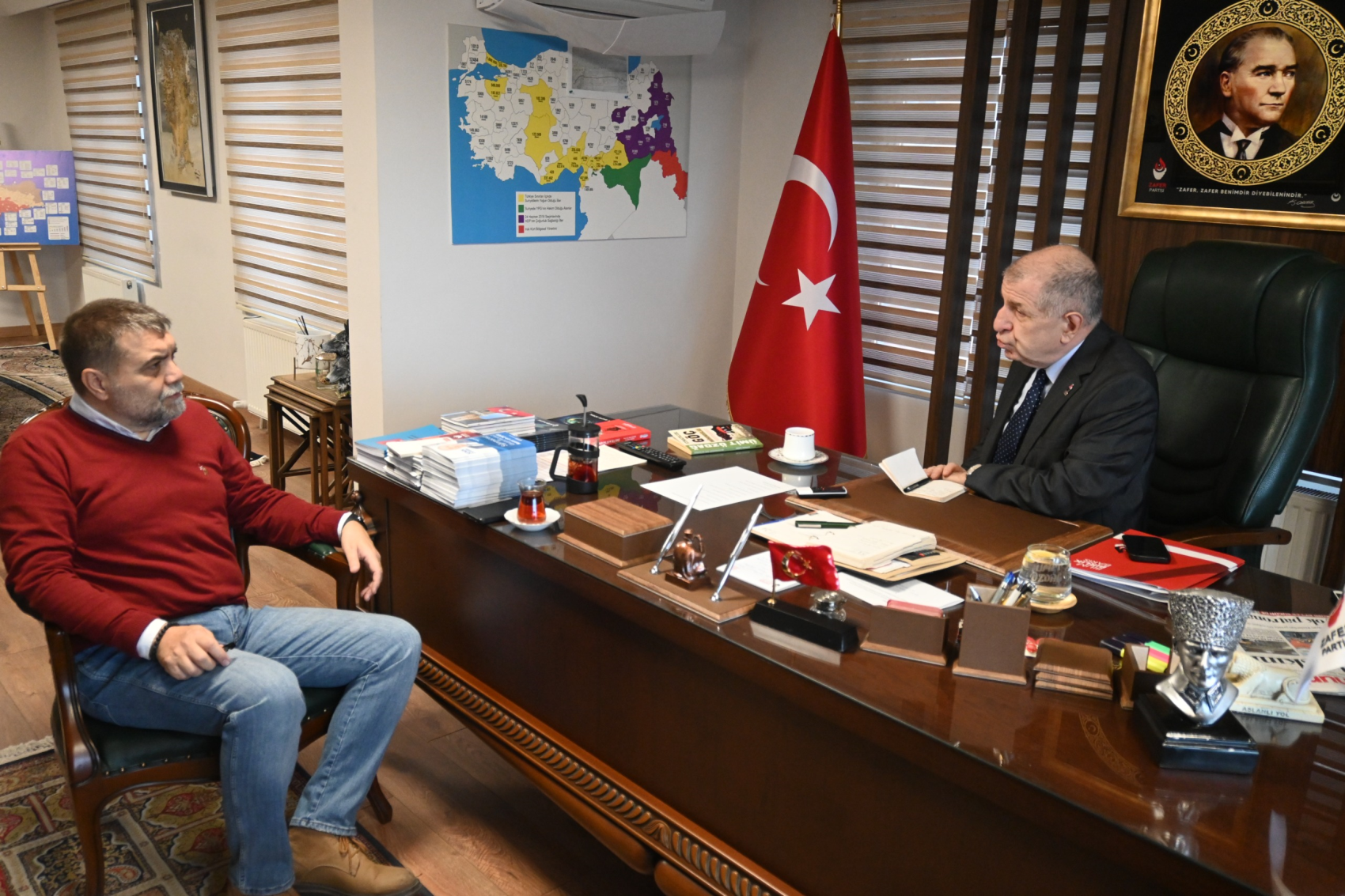
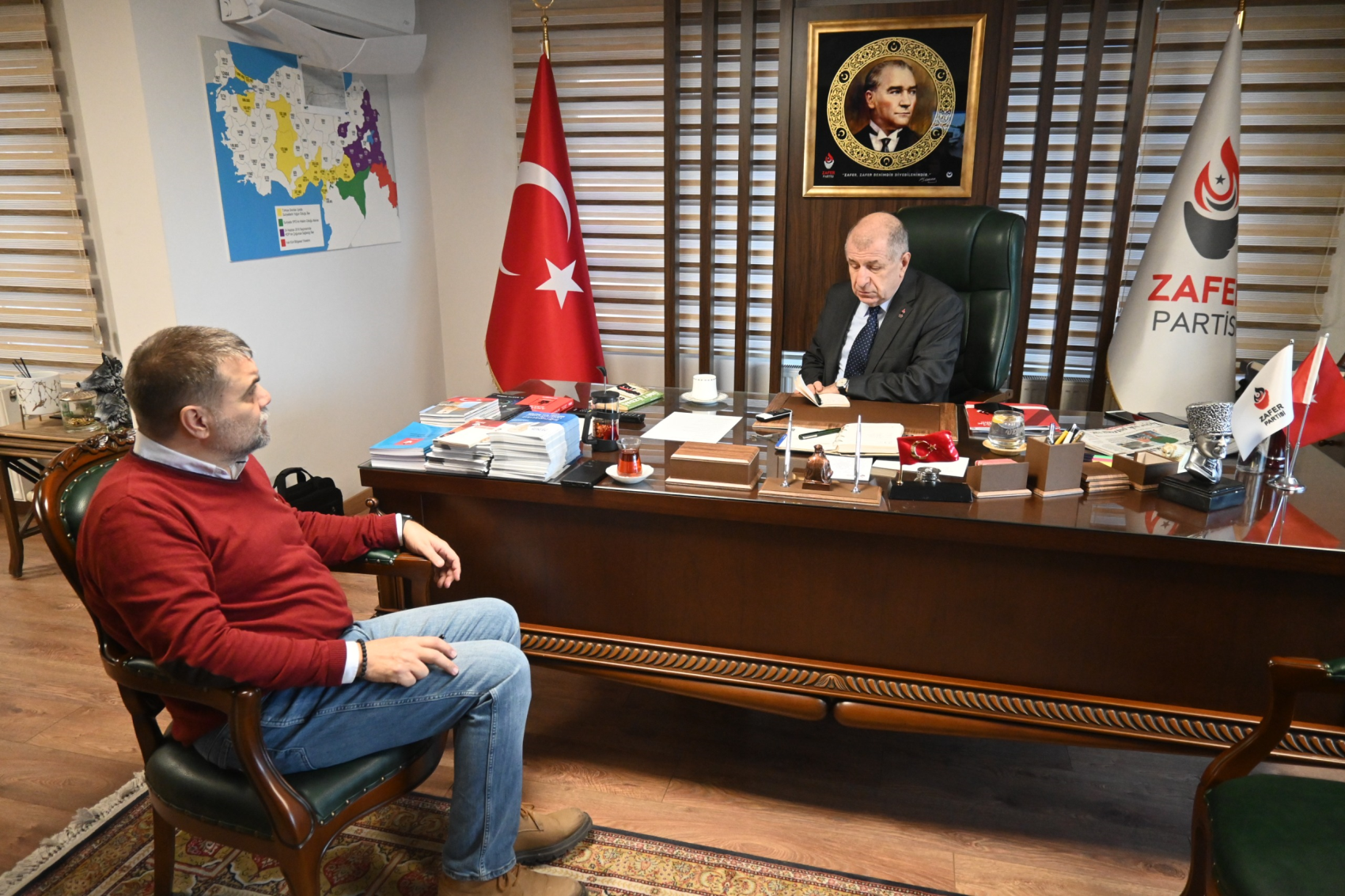
We discussed the ins and outs of the Syrian issue with Zafer Party Chairman Prof. Dr. Ümit Özdağ, who, in addition to his political identity, also wears the hat of an expert in international relations, strategy, and intelligence.
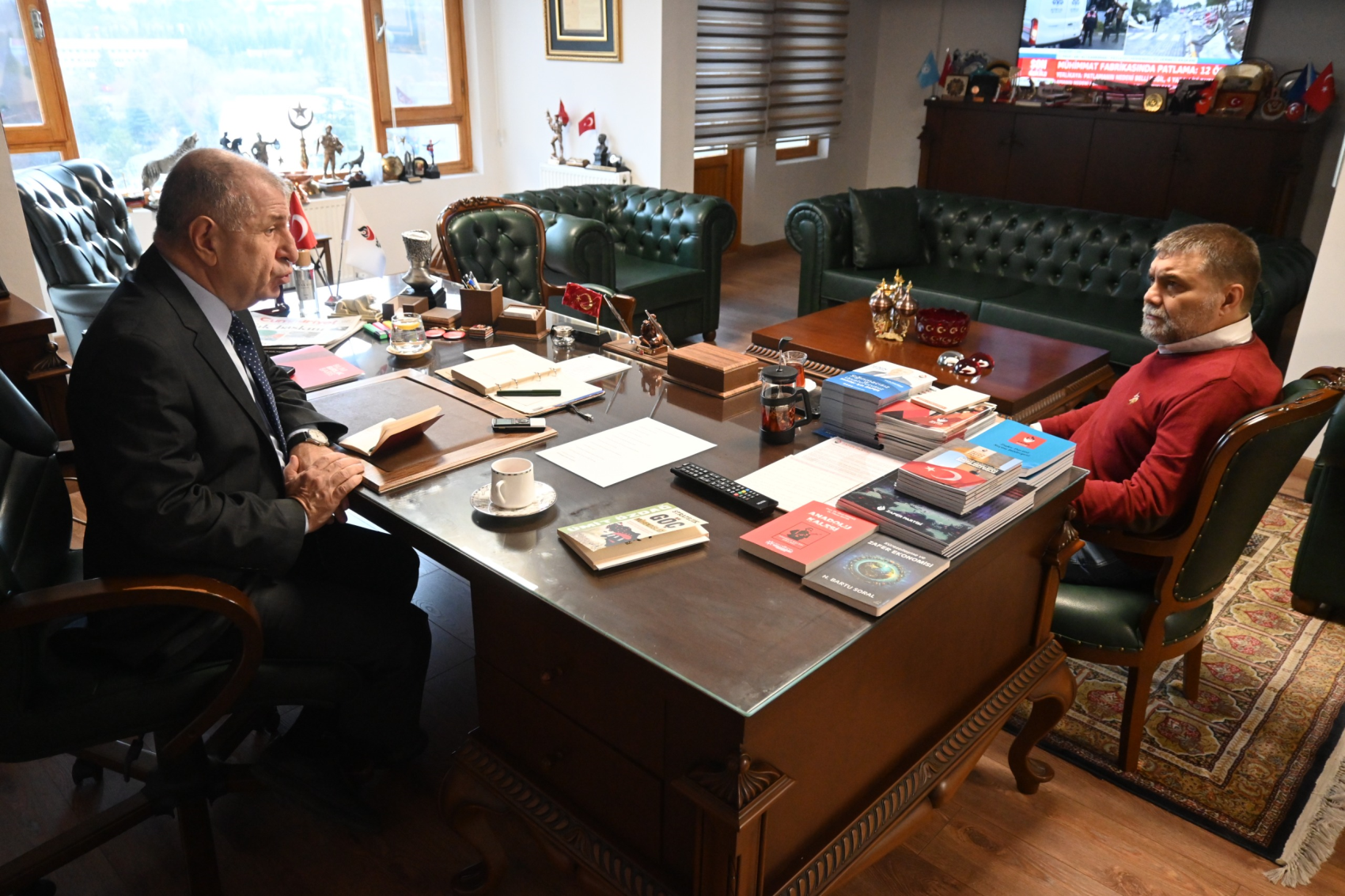
He provided remarkable behind-the-scenes information and stated that the developments in Syria are linked to the domestic Kurdish opening, saying, "The negotiation process in Turkey is actually a process intertwined with the Syrian uprising."
While underlining that the owners of this operation are Israel and the USA, he pointed to the importance of the "strategic cooperation agreement" signed between Assad's two important allies, Russia and Iran.
Here are the answers Ümit Özdağ gave to 12punto's questions:
-How do you see the current point, were you expecting such success from HTS?
For about 5 months, information had been coming in that there would be an operation and that this operation would be supported by the FSA and the Syrian National Army.
In fact, the operation was about to start but was stopped due to pressure from Ankara. Just as we received the news and heard about it, we understand that the Iranians also received the news.
-Did they contact Turkey?
The former Quds Force Commander asked Hakan Fidan if there was an operation, and he said there wasn't. In short, everyone knew an operation was going to start. Now we are learning, especially from reports in the British press, that the preparations for an attack to overthrow Bashar al-Assad actually began a year ago, not 5-6 months ago.
The US has a military base in the Al-Tanf region, you know, in the Jordan region on the Lebanese border. They were trying to prevent Iranian crossings from Iraq to Syria using that base. They started preparing and informing a paramilitary unit that would form there—it was about 300 people, and the number increased later—for this operation. They were paying the members of this unit 300 dollars, 12 times what Assad paid his own soldiers.
In the meantime, of course, we know that after the start of the Gaza operation, Israel not only hit Gaza and subsequently Hezbollah in Lebanon, but also carried out a strategic bombardment in Syria against Hezbollah forces. Russia, due to the war in Ukraine, had also withdrawn a significant portion of its air force and elite ground forces from Syria and deployed them to the Ukrainian front.
In short, in military terms, the power of Assad's two allies, Russia and Iran, in the Syrian field had greatly diminished, and Hezbollah, Iran's sub-ally, had also received a heavy blow from Israeli attacks. Moreover, Hezbollah's forces in Syria were in a state of great demoralization due to the heavy attacks in Lebanon. In such an environment, the only guarantee that this attack would not happen was actually the Astana agreement and the Astana alliance made between Turkey, Russia, and Iran.
-How did this guarantee disappear?
Turkey revealed that it withdrew from the Astana alliance on the morning of November 27. Of course, we cannot say that the Russians and Iranians knew about this beforehand. The HTS attack began. We also know that an electronic warfare operation was carried out that morning that cut off communication within the Syrian army. According to some, CENTCOM did this; there is no other information that anyone else did it. As Putin put it, when 350 HTS militants entered Aleppo, the 30,000 regime soldiers and Hezbollah militants in the city began to evacuate Aleppo.
-Well, why didn't they resist, why couldn't they resist? Is the issue psychological? Or some military...
But we see again from Iranian sources that the commander of the Iranian forces in Aleppo who wanted to resist was shot and killed by a Syrian general during a meeting. We also know that executions were carried out at the general level within the Syrian army. And we know that there was a 50 km counter-attack by Hezbollah, and that this attack was stopped by Hezbollah members saying "why are we fighting" because no orders were coming from Damascus, and they retreated.
In short, the front collapsed in a way that no one, including Erdoğan, expected. The Syrian army disappeared; frankly, it surrendered without fighting. Erdoğan must have thought that a defense would be established around Hama and Homs, as he was also surprised and said, "I hope they reach Damascus without any accidents or trouble."
-Isn't that sentence interesting?
Now, this is perhaps one of the most interesting expressions ever used in the history of rebellion and war. I mean, what is being talked about is not a tourism trip between Aleppo and Damascus, but rebel forces descending from north to south to overthrow a government, to overthrow a state. Indeed, they arrived without any accidents or trouble, without any conflict. So the system fell apart. This is a bit like the dissolution of the Iraqi army. You know, the Kesnezani order infiltrated from within and ensured that large units dissolved without fighting. We had heard that the Americans paid large sums of money to buy off generals; it is understood that the same work was done here. But the details will emerge later.
-How will the government in Turkey use this internally?
Of course, a perception of a great victory is now being tried to be created in the AKP media. First, we can reveal whether this issue is a victory, and for whom it is a victory, by answering the question of whose project this is. You know, Israel was founded in 1949. After it was founded, it had to prove its existence in the region with three wars. The '49 war, the '67 war, and the '74 war. It achieved significant successes in '49 and '67. It inflicted heavy defeats on all the surrounding Arab armies. It was always aware of this, too. Israel needed friends within an Arab sea. There were two nations in the region: Iran and Turkey. It developed good relations with both of them. However, in the 1960s, it discovered the KDP in Iraq, which was called the Prussia of the Arabs.
-Is the close relationship with the Kurds after this date?
Yes, KDP-MOSSAD relations began. In the 1974 War, neither side won nor lost. Upon this, we see Henry Kissinger calling Bernard Davis and asking what can be done to divide the Arabs, who were applying an oil embargo by acting together for the first time since the Abbasids. Bernard Davis, working with a team, gives him this answer: Let's divide the nation-states into ethnic and linguistic autonomous regions, as in the Ottoman period.
-Then...?
Then in 1982, in the Kivunim Journal, which is the publication organ of the World Zionist Organization—it means Directions in Turkish—Oded Yinon wrote an article there, and in this article, he said that Israel's security could be possible by dividing Iraq into three as Kurdish, Sunni, and Shia, and Syria into four as an Arab state in Aleppo, another Arab state in Damascus that is a rival to it, a Nusayri state, and a Druze state. The reason he moves from these four parts here is this; in 1936, the French occupation forces also divided Syria like this in an administrative sense. Note that although he mentions Kurds in Iraq, he never mentions Kurds in Syria. The Kurdish ratio in Syria was very low then, and it is very low now. It is very low proportionally now as well. It is the third largest ethnic group in this sense. Arabs, and then Turkmen come second.
-Correct me if I'm wrong, Kurds are not native to Syria, right? Did they migrate to the region later?
There are those who came later, but there are also those who were there in trace amounts. In the Qamishli region. In short, we see that Oded Yinon's project has been developed and continued. You know, during the process of the collapse of the USSR in 1990, Iraq invaded Kuwait, followed by a military operation against Iraq, and a de facto state structure was created in the north. And this was followed by the occupation in 2003. Now, in the 34 years between 1990 and 2024, two Arab states in the region have been divided, and in one, a Kurdistan has been created legally, and in the other, de facto. Israel occupies the Golan Heights and controls the water resources. And it is in search of establishing a strategic contact with the PYD and PKK via the road extending to Deir ez-Zor. When the situation is viewed from this framework, the owner of this operation is Israel, it is the USA, and in this framework, it is a successfully executed Israeli operation.
-Where does Turkey stand in this operation?
We know the point where we first clearly heard that a regime-change operation would begin in Syria from the British Foreign Secretary asking the French Foreign Secretary at a meeting in 2009, "We are putting a destabilization operation into effect in Syria, will you join us?"
So how were Israel relations in 2009, how were Syria relations? Excellent. How were they in 2010? Excellent. Excellent until 2011. This project is not our project. That is, when this project started, there was no intention in the AKP's mind to topple the Bashar al-Assad regime in Syria. In fact, they were holding joint cabinet meetings, making investments. In fact, a delegation of businessmen led by the Minister of Industry went to the region two months ago.
So this operation, the Syria operation, is, in a large sense, an Israeli, British, American operation; the Erdoğan and Davutoğlu duo jumped on this operation much later, in 2011. But before that, a negotiation process was started with the PKK in Turkey to make this operation possible. Because if there were no negotiations with the PKK, Turkey would not allow the PYD to be used in this way in Syria. In other words, the negotiation process in Turkey is actually a process intertwined with the Syrian uprising.
-What happens next?
Now, after the overthrow of Bashar al-Assad, a stateless situation has emerged, HTS has taken over, and in the meantime, Israel has blown up all the heavy weapons and arsenals that HTS could use, in a sense reducing HTS to Kalashnikov power. And on the other hand, the state-of-the-art weapon systems in the hands of the PYD continue to exist. Does the PYD have a weakness? Yes, it has more limited human resources compared to Arabs. But this is not an insurmountable problem. It is possible for the PYD to supplement these human resources from Iraq and also from Turkey.
Now, HTS leader Golani is trying to get himself elected as the interim president by establishing a national congress of between 1,200 and 1,500 people. There is no one invited to this congress, that is, as a party. Invitations will be made name by name. Of course, we don't know yet whether others will accept this. And they say that the draft Constitution in Golani's mind is currently a unitary state. With Turkey's pressure as well. However, there is a Syria that is de facto divided into three. This is the Nusayri region, the Sunni Arab region, and the PKK region controlled by the PYD. There is one more reality: the second largest ethnic group in Syria is the Turkmen.
How does Turkey view this issue?
We see that the demands of the Turkmen in their own regions are not viewed positively from Ankara. And we see that the US and HTS have remained silent on this issue so far. In short, Syria has a very big test ahead of it. Golani is not a democrat. It is not possible for him to be, given the tradition he comes from. That is, it is not possible for us to say that the Bashar al-Assad dictatorship is gone and a parliamentary democracy has come in its place. The attempt to establish the state as a Sharia state will cause both the PKK/PYD, the Nusayris, and the Syrians who support the secular system to react, and if such a development occurs, which is very likely, the Syrian society will also experience a division on this axis. On the axis of Sharia and secularists. This could result in the secularists gathering around the strongest wing. That is, former Baathists and the PYD could come together, Nusayris could come together. Indeed, the 4th Division, which you know was the strongest regime military force, is currently in the PYD region. They went to Iraq and returned to the PYD region.
-Where do Iran and Russia stand in this process? Have they really been defeated on the field?
Iran and Russia signed a strategic alliance agreement. And this strategic alliance agreement is of great importance; although I do not know the details, as far as it has been announced to Iran, this agreement seems to give full access to all Russian weapon systems.
-What does this mean?
This means the following: Russia is sending this message to the US and Israel: If you attack nuclear power plants here, saying they are making nuclear weapons, you don't need to attack; I will give the weapon to Iran myself. After forming this front, Russia will try to protect its own port region, which is a very large region. For this, it will negotiate with HTS. But on the other hand, I think Iran will definitely engage in destabilizing actions with its allies within Syria.
-So what is the situation inside our country?
Now, in Ankara, there is a government that is focused on domestic politics, cannot cope with the economy, and has no possibility of doing so, telling tales of conquest in Syria; this is such a geography. Hakan Fidan and Golani watched Damascus from above in the evening. I would like to ask Hakan Fidan this: If you had binoculars with you and looked, you would have seen the Israeli army.
-There are a few points that caught my attention. A terrorist organization, the UN has accepted it as a terrorist organization. This organization is now accepted as legitimate and acceptable. Moreover, this has no equivalent in international law. What will happen when you want to engage with them? Does a precedent emerge from this?
I am not interested in the theoretical dimension of the matter.
It concerns us in one dimension...
I know, but I am not interested at all. History shows us that the victors become legitimate. This is not just in the HTS incident. Look, Israel was also founded by terrorists.
Irgun...
Yes, the Irgun organization carried out terrorist acts against the British. It was characterized as a terrorist by the British.
Coming towards us, it is a question mark in my mind; there is an opening issue through the Constitution...
How, if the first opening is related to the Syrian civil war, the second opening is also related to the Syrian civil war. Because government circles in Ankara think that the statement Öcalan will make will be a call not to the PKK, but to the PYD, that this call will be made before March, and thus with the Öcalan call to be made before March, the PYD will be integrated into the Syrian system; for example, if Öcalan says, "It doesn't matter if you are called as a party, even if Golani calls you as a person, go and defend your rights there," which is a very important thing, it becomes clear that this is done in coordination.
-For example?
For example, if he says, "Don't ask for federalism, settle for an autonomous region," it is another indicator that there is coordination. In short, hopes are pinned on Öcalan's statement for both Turkey and Syria. And the government, while releasing Öcalan, has to meet some of Öcalan's demands. How can it meet these demands? It can meet them by making a constitutional amendment. In short, the need for a constitutional amendment is closely related to the developments in Syria and the PKK laying down its arms and dissolving itself.
-What do they want?
They want Article 66 of the Constitution to be changed, Article 44, the education article, to be changed, the way for autonomy to be opened, and the Kurdish political identity to enter the Constitution. This constitutional amendment will not pass through this Parliament. That is why the possibility of them holding an early general election in June 2025 is very high. In this election, they cannot give economic promises to the public; instead, they will have victory stories to tell.
-You said it won't pass through this Parliament, but if you look at Özgür Özel's messages, he has started to go further than the AKP on the Kurdish issue. Isn't there a possibility that they will make a constitutional amendment together?
Of course, this is a possibility, but I don't know if he can convince all the deputies in the CHP. There are also many patriotic deputies in the CHP.
-He doesn't need all of them. If only 20 deputies support it, Erdoğan saves the issue.
If the process develops like that, he is already taking the DEM into their fold. The deputies that the CHP brought in will also get involved in this business, and if the pro-Kurdish team from the CHP also joins this, we may face such a possibility. As the Zafer Party, since we are not in parliament, we will be faced with the necessity of turning all of Turkey into a parliament.
News Source: 12punto