Global geopolitical tensions and conflicts in the Middle East driving up oil prices have also been sharply reflected in fuel prices in Turkey.
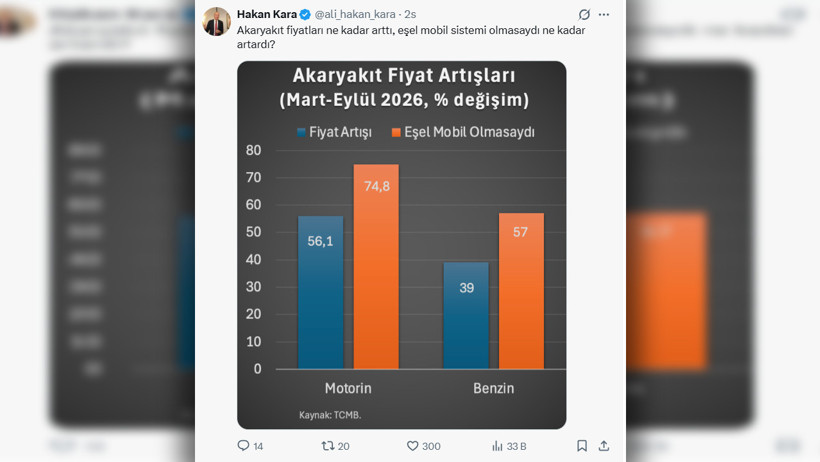
Data from the Central Bank of the Republic of Turkey (CBRT) shared by former Chief Economist Prof. Dr. Hakan Kara on his social media account revealed the extent of the increase in pump prices during the March-September 2026 period.
According to the chart shared by Kara, diesel prices rose by 56.1 percent and gasoline prices by 39 percent during this six-month period. The data also showed that the rise in fuel prices was partially limited by the sliding scale (eşel mobil) system.
WITHOUT THE SLIDING SCALE SYSTEM, THE INCREASE WOULD HAVE BEEN HIGHER
According to the calculations in the chart, if the sliding scale system had not been applied, the increase in diesel would have reached 74.8 percent, and the increase in gasoline would have reached 57 percent. This table indicated that a portion of the rise in pump prices was absorbed by public finance through tax adjustments.
According to budget data submitted to the Grand National Assembly of Turkey (TBMM), the sliding scale application, which was put into effect in March 2026, led to a significant decrease in expected Special Consumption Tax (ÖTV) revenues from oil and natural gas. While 662.1 billion Turkish Lira in ÖTV revenue was targeted from oil and natural gas for 2026, the actual realization is expected to remain at 321.2 billion Turkish Lira.
It was stated that the amount of ÖTV foregone through the sliding scale system reached 205.8 billion Turkish Lira; when the 20 percent VAT effect on the ÖTV is added, the total tax waiver was reported to have reached 247 billion Turkish Lira. Thus, it was calculated that ÖTV revenues obtained from oil and natural gas decreased by 39 percent in 2026 compared to the previous year.
If normalization is achieved in international markets, it is projected that ÖTV revenues from oil and natural gas will increase by 171 percent to 870.6 billion Turkish Lira in 2027.
GASOLINE PRICE CUT REFLECTED AT THE PUMP
The decline in Brent crude oil prices to 104 dollars was reflected as a price cut for gasoline in Turkey. Starting from midnight connecting Monday, October 19, to Tuesday, October 20, a price reduction of 4.30 Turkish Lira was applied to the liter price of gasoline. No price changes were made for the diesel and LPG groups.
| City/Region | Gasoline | Diesel | LPG |
|---|---|---|---|
| Istanbul European | 79.60 TL | 96.70 TL | 41.20 TL |
| Istanbul Asian | 79.40 TL | 96.50 TL | 40.60 TL |
| Ankara | 80.60 TL | 97.80 TL | 41.29 TL |
| Izmir | 80.80 TL | 98.00 TL | 41.20 TL |
News Source: 12punto