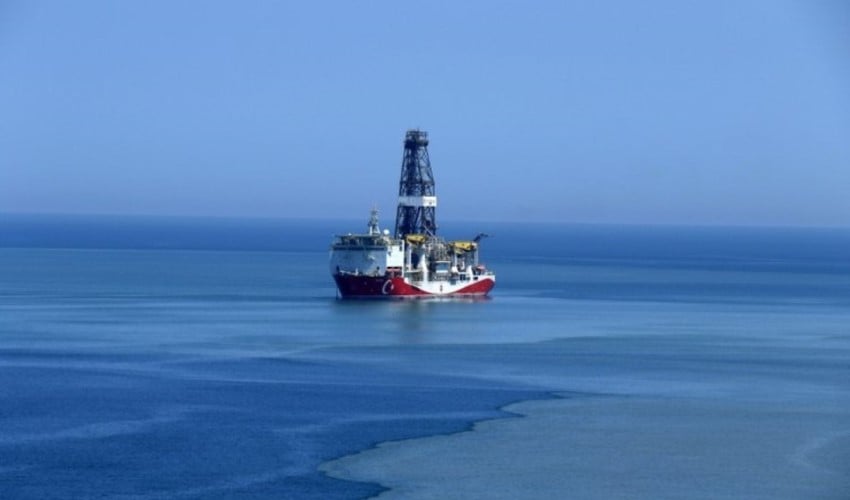
Analyses of samples taken off the coast of the Çayeli district in Rize have revealed that the liquid leaking to the sea surface is oil.
Prof. Dr. Nafiz Maden, a geological engineer and department head at the Faculty of Natural Sciences of Gümüşhane University, set out to sea in September to collect samples to determine whether there are oil reserves in the Eastern Black Sea. He collected samples from layers found on the water's surface approximately 7 miles off the coast of the Çayeli district and sent them to the Turkish Petroleum Corporation (TPAO) to determine their oil potential. The results of the samples sent to TPAO reached Maden. The analysis results received by Maden revealed that the liquid leaking to the surface of the sea is crude oil.
“OUR LEAK THERE IS A NATURAL OIL SOURCE”
Making statements on the subject, Prof. Dr. Nafiz Maden said that it has been proven that the leak in the samples is a natural oil source. Prof. Dr. Nafiz Maden stated, “Last September, we took a sample from the oil leak off the coast of Çayeli, Rize. This leak has been known for a long time, for many years. In fact, during the Ottoman era, in 1910, before the First World War, the Ottoman State, the Sublime State, brought engineers from abroad and started investigations regarding this region. This leak is not something we found for the first time; we went and took samples from there. These samples were subjected to geochemical analyses at the Turkish Petroleum Corporation R&D Center. When we took these samples, people had this question in their minds: Is this waste? Is it an oil derivative? Is it bilge water from a ship? People had such a question mark in their minds. We conducted the geochemical analysis to eliminate this question mark. These analyses finally reached us. Gas chromatographs were taken from these analyses, and total petroleum hydrocarbon values were found. It turned out that there were 59 milligrams of total petroleum hydrocarbons per liter in the samples we took. Again, as a result of the analyses performed, and as a result of these gas chromatographs, it was revealed that the oil in the sample taken is of natural origin, is crude oil, and is not any oil derivative or oil residue. Our leak there is a natural oil source. We have revealed this,” he said.
“OIL PRODUCTION WILL BEGIN AFTER THE RESULTS OBTAINED FROM DRILLING”
Stating that oil production could begin after the results obtained from the drilling to be carried out, Maden said, “In the process from now on, a step like this will be followed. Currently, the Turkish Petroleum Corporation's Barbaros Hayrettin Paşa ship is anchored at the Port of Trabzon. My opinion is that the Black Sea is a difficult sea. Therefore, I recommend that these seismic surveys not be carried out in this winter season. Of course, the expert engineers of Turkish Petroleum will also make their own plans. Starting these surveys in the spring months would be much better. In the research to be carried out, two-dimensional and three-dimensional seismic surveys will be conducted. Besides this, perhaps geological samples will be taken from the seabed, core samples will be taken, or sediment samples will be taken. These will be evaluated at the Turkish Petroleum Corporation's data processing center along with gravity and magnetic seismic studies. They will try to determine where this oil reservoir leaking to the sea surface comes from. As a result of these determinations, the next stage will be moved to. The Fatih, Yavuz, Kanuni, or Abdülhamit Han ship will drill there. After the results obtained from the drillings, it will move on to oil production and will be offered to the service of our country and our citizens,” he expressed.
“1 TON OF OIL RISES TO THE SEA SURFACE PER DAY”
Stating that 1 ton of oil flows to the sea surface per day, Maden said, “There are fifty-nine milligrams of total petroleum hydrocarbons in a liter of water. So, it turns out that this seawater has been polluted by oil. This is with the abbreviation TPH, meaning total petroleum hydrocarbon; what happens to this oil? It flows on the surface of the sea. The light part evaporates if the weather is sunny and mixes with the air. If the heavy part is also there, it settles back to the bottom of the sea in the form of asphaltite. As a result of the calculations made off the coast of Çayeli, and the calculations made from geophysical and satellite data, 1 ton of oil flows to the sea surface per day. If we project this to a year, 365 tons of oil per year rise to the surface just in the form of a leak. It is also necessary to reveal how much more is in the reservoir. This oil leak is not only in Rize in the Eastern Black Sea. Considering that we have oil leaking from four places in the Eastern Black Sea from Sinop to Hopa, and even off the coast of Batumi, Georgia, I think the Eastern Black Sea could be productive in terms of oil. I believe that the main source of this formed oil is within our exclusive economic zone. The studies we have conducted show that,” he stated.
News Source: 12punto