The Education Reform Initiative (ERG) has documented the decay in the education system.
According to a report by Mustafa Bildircin from BirGün, it was stated that per-student spending in Turkey is 4,400 dollars in primary education and 5,110 dollars in secondary education. It was noted that in terms of per-student spending, Turkey ranks last among OECD countries, following Mexico and Colombia.
EDUCATION EXPENDITURES
The data shared in the report regarding education expenditures also drew attention. According to the report, which utilized TÜİK data, the share of household spending within total education expenditures has been steadily increasing, reaching 21 percent as of 2022, while public education spending hit its lowest level in the last 10 years as of 2022. Accordingly, the share of public spending in total education expenditures, which was 70.7 percent in 2012, declined to 68.7 percent in 2022.
INTEREST IN PRIVATE SCHOOLS HAS INCREASED
The increasing weight of the private sector in education was also reflected in the ERG report. The report underlined that the upward trend in the rate of students enrolled in private education institutions continued in the 2022-2023 academic year. It was stated that 9.5 percent of students in formal education in Turkey were enrolled in private schools during the 2022-2023 academic year.
REGIONAL INEQUALITY REFLECTED IN THE REPORT
Data on early childhood education revealed regional inequality in Turkey. According to the report, which utilized MEB data, the net schooling rate for the 3-5 age group was 51 percent in 2022-2023, while the schooling rate for the 5-year-old age group was 85 percent. It was reported that the schooling rate for the 3-5 age group in Turkey was 84.7 percent for girls and 85.2 percent for boys. According to data highlighting the inequality between regions in preschool education, the net schooling rate for 5-year-olds, which is 94.5 percent in West Marmara, remained at 78.1 percent in Southeastern Anatolia.
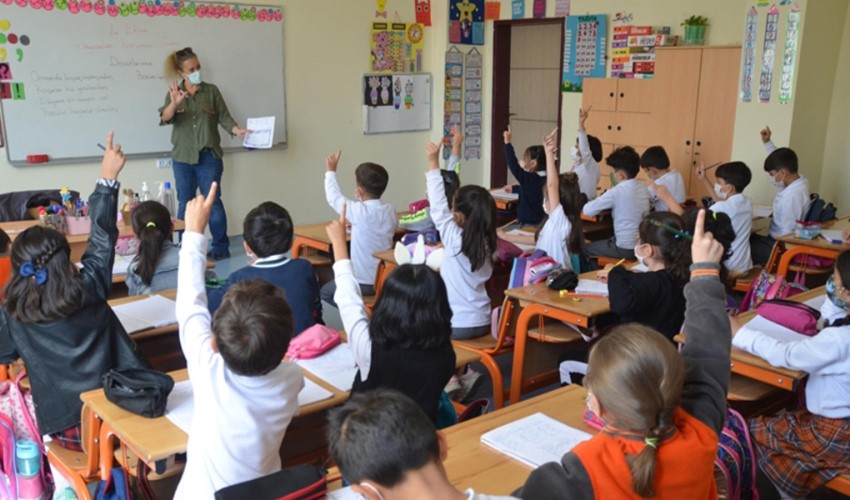
The report also examined the current state of educational environments. According to data reminiscent of the public perception of "quality education for those who can afford it," the average number of students per classroom in secondary education, which is 10 in private schools, rose to 24 in public schools. The average class size in public kindergartens, which is 30, was calculated as 10 in private kindergartens. According to data shedding light on the scale of resources allocated to religious education, the number of students per classroom, which is 24 in academic high schools, was recorded as 14 in high schools providing religious instruction.
Another piece of data revealing the privilege provided to religious and vocational education concerned the rate of students in double-shift education; under the "Double-Shift Education" heading of the report, the following numerical data stood out: "In 2022-23, 42.5 percent of students in primary school, 35.6 percent in general middle school, 11.6 percent in Imam Hatip middle school, 7.0 percent in general secondary education, 1.9 percent in vocational and technical secondary education, and 0.8 percent in religious instruction secondary education received education in schools with double-shift systems."
11 THOUSAND 738 CLASSROOMS ARE UNUSABLE
Other prominent issues in the field of education were reported as follows: "There is very little difference between the starting salaries of teachers and the highest salaries they can earn in Turkey. According to 2022 data, the difference between the salary high school teachers receive at the highest point of their careers and the salary they receive when they start the profession is less than 20 percent in Turkey. The difference is 33.3 percent on average in OECD countries.
The inexperience of volunteers who went to the field to provide psychosocial support to children in the earthquake zone caused negative experiences for beneficiaries in many cases.
Many schools were destroyed or damaged due to the earthquakes. According to the latest assessments, 936 schools in the earthquake zone became unusable due to the earthquakes, and this number is 11 thousand 738 for classrooms. In Hatay, 45.4 percent of classrooms became unusable.
21.8 percent of families in the earthquake zone emphasize that none of their children have gone to school since the earthquake. The rate of families who say all their children go to school is 61.9 percent. Economic problems, the distance of schools, and the deteriorating psychological state of the children are cited among the reasons for children remaining out of education."
News Source: 12punto