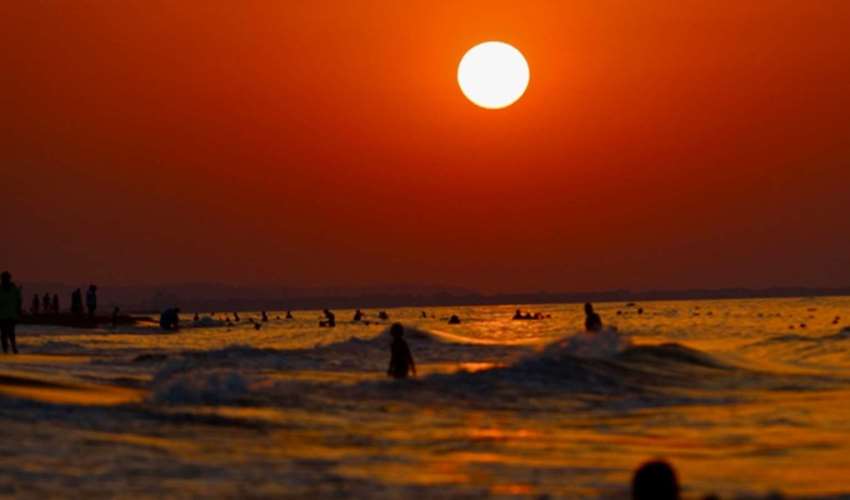
This summer, as global average temperatures reached record levels, record values were also recorded in sea water temperatures.
Barış Salihoğlu, Director of the METU Institute of Marine Sciences, which has been regularly measuring temperature values in the seas surrounding Turkey since 1984, evaluated the data obtained from their measurements since January of this year.
Reporting that sea surface temperatures started at very high levels in January, Prof. Dr. Salihoğlu stated that spring temperatures remained below average, and with the arrival of high summer temperatures, the highest values were seen in sea surface water temperatures.
Pointing out that the highest temperatures ever recorded in January were reached in different parts of the Mediterranean, Salihoğlu said, "While the January average in the Gulf of Iskenderun is 18-19 degrees, we entered this year at 20 degrees. The figures are the same in the Gulf of Mersin, Antalya, and Fethiye. The winter started very warm, and we saw records in these places."
Salihoğlu noted that in the Sea of Marmara, where the average January temperature is 8-10 degrees, it reached 12 degrees in the first month of this year, and in the Western Black Sea, where the average is 8 degrees, it also reached 12 degrees.
SUMMER TEMPERATURE VALUES
Explaining that maximum temperatures are generally reached in the Black Sea at the end of July and mid-August, and that a similar situation exists in the Sea of Marmara, Salihoğlu shared the following information:
"In the Western Black Sea, sea surface temperatures had previously exceeded 26 degrees, and this year they reached around 26 degrees. Since the beginning of August, sea surface temperatures have started to drop due to the effect of the northeasterly wind (poyraz). The effect of winds is less in the Eastern Black Sea; as of the end of August, there are temperatures of 27.5-28 degrees, which we call anomalies—temperatures above what is observed. In the Sea of Marmara, Bandırma and Erdek continued at 24 degrees, and the Gulf of İzmit at 23.7 degrees, remaining at average levels, and the strong northeasterly wind seen since the beginning of August caused the waters to cool and mix."
"TEMPERATURES IN THE EASTERN BLACK SEA MAY BE HIGHER THAN EXPECTED"
Emphasizing that sea surface temperatures remained at their highest levels throughout August in the Mediterranean and Aegean, Salihoğlu said, "We expect sea surface temperatures in the Mediterranean and Aegean to be above the September averages. The Marmara and Black Sea have undergone significant mixing; we will wait and see if these areas will exceed average temperatures. Unless a serious heatwave comes due to El Niño or other reasons, the figures will continue at average values. Temperatures in the Eastern Black Sea may be higher than expected."
THE EFFECT OF WARMING ON THE SEAS
Salihoğlu stated that with rising temperatures, the seas are turning into a more stratified structure, and because the warm water on the surface is lighter, this water reduces mixing in the sea and affects the ecosystem, increases evaporation, and changes the water masses reaching the depths.
Noting that the warming of the Mediterranean causes warming in the deep water of the Marmara, which forms its lower layer, and that the Aegean Sea is the region least affected by climate change due to its wind structure, Salihoğlu underlined that the cold intermediate layer in the Black Sea, which previously started at 70-80 meters and could reach a thickness of up to 150 meters, is no longer seen.
Barış Salihoğlu shared the following details about the changes in the seas:
"Because the density on the surface of the Black Sea is low, mixing with the depths was already low, and this has started to increase significantly; with the disappearance of the cold intermediate layer, oxygen-free waters are increasingly approaching the surface, and this situation is currently changing the entire ecosystem from top to bottom. It is already a sea with intense pressure from pollution, fishing, and invasive species, and when you add physical changes on top of that, you reduce the entire resilience of the ecosystem. The resilience of the Sea of Marmara has decreased significantly; oxygen had decreased below 25 meters due to pollution, and surface temperatures are increasing further, trapping the ecosystem here and reducing oxygen. The Marmara is currently at a marginal point, at a threshold. It could shift toward a point we never want. The structure in the Mediterranean is constantly changing; rising temperatures have led to the spread of Red Sea species toward the Aegean and from there to the Marmara and Black Sea. While marine productivity is increasing in some regions, it is decreasing in others. In coastal areas, especially in regions like the Gulf of Iskenderun and Mersin, we are increasingly seeing a decrease in oxygen levels due to the impact of climate pressure."
"CLIMATE-RESILIENT MARINE ECOSYSTEMS" PROPOSAL
Salihoğlu listed the measures that should be taken as follows:
"We must bring pressures such as pollution and hunting in all our seas under control, plan the seas, and increase protected areas; otherwise, we cannot create climate-resilient seas. Just as we say 'climate-resilient cities,' we need to plan the sea in the same way and implement climate-resilient marine ecosystems. The Marmara, which reflects the ecosystem of both the Mediterranean and the Black Sea, is already in such a place that a change here will affect the other seas, and changes in the other seas will affect here. We have seen this effect in the past; a 'collapse' or 'regime shift' is expected to have a domino effect."
News Source: 12punto