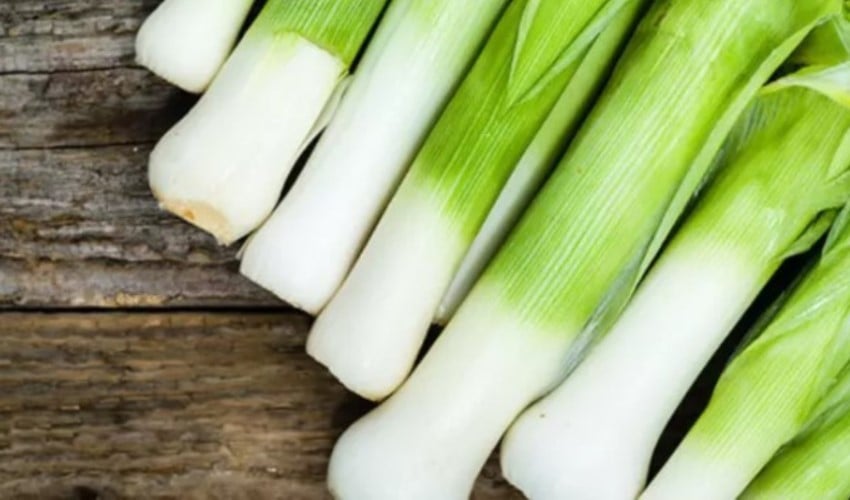
Stating that leeks belong to the Allium family—the same family as onions and garlic—and are grown primarily in the Central and Eastern Mediterranean regions, Prof. Dr. Karabulut noted that the origin and cultivation of leeks date back to ancient times.
Pointing out that leeks, which have a culinary history spanning thousands of years, were also cultivated by ancient civilizations such as the Egyptians and Mesopotamians, Karabulut said, “Over time, they spread to various regions of Europe and gained an important place in various regional cuisines.
Today, leeks are grown in many parts of the world and are preferred for their mild onion flavor and versatility in cooking.
It is known to be grown on the Mediterranean coast, and findings suggest that it grows easily in desert climates, particularly in moist soil. Arguing that it contains a substance similar to opiates, which have sedative properties in pharmacology and medicine, the Romans in particular ate leeks at the end of their meals to facilitate sleep. They reported that they fell asleep easily in this way,” she said.
Expressing that leeks, which are widely grown around the world as a spice and condiment, also contain secondary metabolites such as volatile oils for health purposes, Karabulut stated, “Polysaccharides, phenols, and other sulfur-containing compounds. These active substances not only give Allium plants their unique aroma but also provide fragrance. The unique scent of different Allium plants primarily contains different cysteine precursors, mainly alliin and isoalliin.
Organic sulfides are one of the main bioactive components found in plants, and the consumption of sulfur-containing vegetables has a positive effect on human health. It is known for its rich organic sulfides,” she added.
NUMEROUS HEALTH BENEFITS
Noting that low-calorie leeks are an excellent source of antioxidants containing sulfides, as well as vitamins C, K, and beta-carotene, Professor Aysun Bay Karabulut said, “Because leeks have anti-inflammatory properties, they also have anti-aging properties.
It is thought that its ability to protect eye health, specifically through the zeaxanthin it contains among carotenoids, is mediated by vitamin K. It protects against the risk of cataracts and age-related macular degeneration.
Scientific studies mention that it maintains healthy bones and reduces the risk of osteoporosis. Leeks are healthy for your heart and contribute to a reduction in your heart rate. They are a good source of folate and B6. Let us also note that they reduce the risk of stroke. By trying to keep homocysteine levels in balance, they prevent the narrowing of arteries by reducing vascular damage and the formation of blood clots.
Due to their kaempferol content, they help the body produce nitric oxide, a triggering gas. Thus, they lower blood pressure and regulate blood circulation by allowing the arteries to relax and expand. Other B vitamins in leeks include thiamine (B1), riboflavin (B2), niacin (B3), and smaller amounts of pantothenic acid. The beta-carotene and vitamin C content in leeks is very high,” she said.
EXCELLENT FOR SKIN HEALTH
Emphasizing that leeks, also known as a source of antioxidants, have beneficial effects on skin health, Karabulut stated that leeks are widely used in cosmetology because they block harmful UV rays that the skin is exposed to, and are used especially for masks, cleansing, and purification processes.
REDUCES CANCER RISK
Stating that leeks also reduce the risk of cancer due to their high sulfur content and glutathione, Prof. Dr. Karabulut said, “Like other Allium vegetables, leeks reduce the risk of cancer, especially breast and colorectal cancer, due to their sulfur content. In addition, leeks contain dietary fiber that nourishes our body. It contributes to the strengthening of healthy gut flora. Leeks contain high levels of iron and lutein, which is beneficial for gut flora. Especially when examined biochemically, it also prevents anemia, which we call hemolytic anemia, due to its high iron content.
Manganese, which is important for oxygen transport to tissues and regulation, balances nerve function. Leeks also contain potassium; their low sodium ratio helps lower blood pressure,” she said. Stating that leeks are known as a winter vegetable due to their incredible durability, Karabulut added that they are also grown in the autumn and spring months.
THINGS TO CONSIDER WHEN CONSUMING
Stating that leeks contain many vitamins and minerals, Karabulut noted that they are beneficial to health if consumed regularly and in the right amounts. However, expressing that, as with any food, excessive consumption of leeks can lead to unwanted problems, Prof. Dr. Karabulut said, “Leeks are both a powerful diuretic and a food that regulates the digestive system. If leeks are consumed more than necessary, there will be a problem with fluid loss in the body. In addition, it causes the digestive system to work faster. This leads to diarrhea. Therefore, you should be careful not to exceed the sufficient amount when consuming leeks,” she said.
News Source: İHA