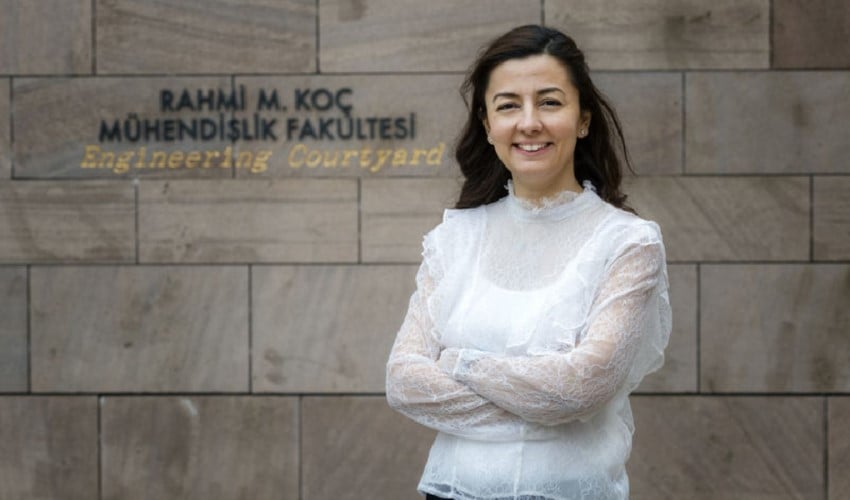
Koç University Department of Chemical and Biological Engineering faculty member Prof. Dr. Seda Keskin Avcı is conducting atomic-level research on the potential of next-generation nano-porous materials. Prof. Dr. Seda Keskin Avcı’s new TÜBİTAK-supported project, STARLET, which has been awarded a 2 million Euro grant from the European Research Council (ERC), holds promise in critical areas such as the fight against cancer and slowing down global warming.
Koç University became the only university in Turkey this year to be awarded support from the European Research Council (ERC). Hosting 28 of the 50 ERC projects in Turkey, Koç University’s Department of Chemical and Biological Engineering faculty member Prof. Dr. Seda Keskin Avcı is known for her work on metal-organic frameworks, also known as MOFs.
These sponge-like porous structures, discovered approximately 10-15 years ago, are a relatively young technology. Today, scientists continue to develop these molecules, which can be used in many fields ranging from capturing water molecules in the desert to distributing electricity more efficiently in vehicles and trapping carbon dioxide released into the atmosphere, and are increasing their numbers with new combinations.
Prof. Dr. Seda Keskin Avcı, with her first ERC-funded project COSMOS in 2017, developed computer simulations to obtain results faster from these materials, which could take years to test in the laboratory. With COSMOS, Prof. Dr. Seda Keskin Avcı became the first female researcher from Turkey to receive an ERC Starting Grant in the field of engineering, and this time she became the owner of the first consolidator project from Turkey deemed worthy of support by the general engineering panel (PE8).
Prof. Dr. Seda Keskin Avcı’s TÜBİTAK-supported project titled “STARLET: Atomistic Modeling of Advanced Porous Materials for Energy, Environmental and Biomedical Applications,” which received a 2 million Euro grant, aims to discover the most suitable materials for cancer treatments, clean energy storage, capturing toxic gases, and fighting global warming through MOFs.
The project, which is a next step in the previous research conducted at Koç University on the subject, aims to determine the performance of MOFs in different applications by combining atomic calculations, molecular simulations, data science methods, and experimental studies. In this way, the study, which will create a holistic material intelligence ecosystem, aims to use the potential of MOFs in energy, environmental, and biomedical applications more efficiently in a short time. The study will continue for 5 years within Koç University.
Seeking solutions to the world’s fundamental problems, from clean energy to cancer treatment
Prof. Dr. Seda Keskin Avcı shared the following details about her project: “Within the scope of this project, we will focus on 10 critical molecules to address the world’s fundamental social problems: hydrogen and methane for the use of MOFs in clean energy storage; ammonia, carbon monoxide, carbon dioxide, and nitrogen oxide to be effective in capturing toxic gas and fighting global warming; and we will investigate the storage and distribution properties of fluorouracil and methotrexate within MOFs to be evaluated as carriers in anti-cancer drug therapy, and nitrogen and oxygen molecules for biomedical applications.
One of the project’s greatest global achievements will be the establishment of the world’s first database in this field. This database will contain the guest molecule storage and transport properties of millions of MOFs. Within the scope of STARLET, design guidelines for high-performance MOFs will also be created to encourage the discovery of new materials.”
ERC BY THE NUMBERS
STARLET, one of the 308 projects selected from 2130 applications this year, was awarded 2 million Euros in support by the ERC. Of the 50 ERC grants received by Turkey, 28 are conducted by Koç University faculty members. 20 of these received main project support, while 8 received Proof of Concept support, which is additional ERC support for commercialization purposes. To date, 18 of the projects that have received ERC support within Koç University consist of research in engineering, 7 in social sciences, and 3 in molecular biology and genetics.
WHAT IS ERC SUPPORT?
The European Research Council (ERC) is Europe’s most prestigious and recognized institution in the scientific field, providing support for the most original and innovative scientific research. Unlike other funds provided by the European Union, ERC support is given to a single researcher, not to a research group, institution, or consortium. The person who receives the project has the right to move their project to any institution they wish across Europe. ERC projects have three programs aimed at researchers at different stages of their careers. The first of these is for 0-7 years post-PhD (Starting - 1.5 million Euros), the second is for 7-12 years (Consolidator – 2 million Euros), and the third is for those doing advanced research 12 years and beyond (Advanced – 2.5 million Euros). Seven researchers who have received ERC support to date have also been awarded the Nobel Prize in their fields.
REPRESENTING TURKEY
Prof. Dr. Keskin received her PhD in 2009 from the Georgia Institute of Technology, Department of Chemical and Biomolecular Engineering in the USA. Starting her position at Koç University Department of Chemical and Biological Engineering in 2010, Keskin Avcı conducts research on determining the potential of next-generation nano-porous materials in energy applications with detailed simulations at the atomic level. She has been awarded the L’Oréal-UNESCO Young Scientist, Turkish Academy of Sciences (TÜBA) Outstanding Young Scientist, TÜBİTAK Incentive, Science Academy Young Scientist (BAGEP), Prof. Dr. Mustafa Parlar Research Incentive, Prof. Dr. Mustafa Parlar Science, FABED Eser Tümen Outstanding Achievement, and Koç University Outstanding Faculty Member awards. In 2017, Prof. Dr. Keskin Avcı, who was entitled to receive the European Research Council (ERC)-Starting Grant, was selected as our country’s representative member in the field of engineering to the Global Young Academy. In 2022, she was included in the “World’s Top 20 Women Scientists” list by Chemical Engineering Research and Design (ChERD). In 2023, she was selected to represent our country in the Mediterranean Science Team.
News Source: 12punto