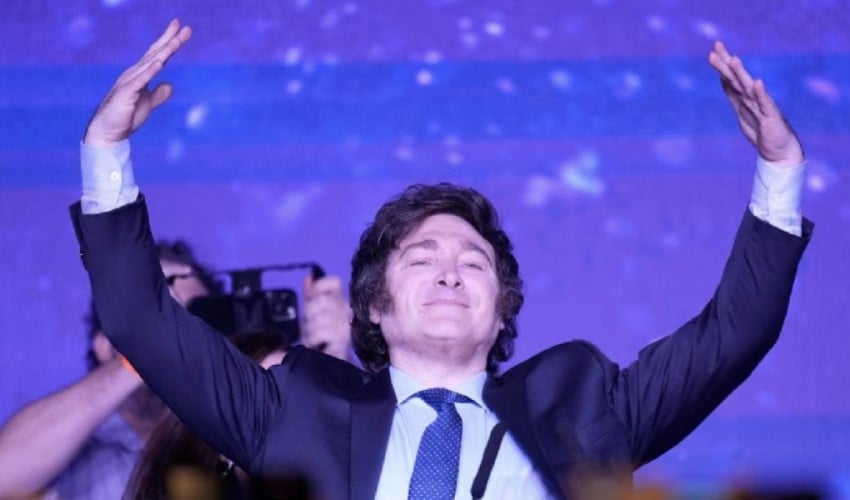
Right-wing candidates won the elections held in the Netherlands and Argentina. Academic Fatih Yaşlı wrote about the election results and the rising right-wing and nationalist movements in the world in an article published today on Sol.org.
Using the term "mad" for Javier Milei in Argentina and Geert Wilders in the Netherlands, Yaşlı attributed the election victories of these figures to the absence of the Left in the world. The article by Yaşlı, titled "Argentina, Netherlands, Turkey: Crisis, madness, hope," is as follows:
Last week, two "madmen" emerged victorious from elections in Argentina and the Netherlands. Javier Milei in Argentina and Geert Wilders in the Netherlands are "mad" in the sense that they are an insult to humanity's thousands of years of accumulation and human reason. It is, of course, no coincidence that these madmen are both pro-market and racist; the crisis of capitalism keeps coming back to haunt humanity with new troubles, bringing "madmen" to power.
Argentina has been struggling with inflation for a long time, the public is becoming increasingly impoverished, and it is experiencing not only an economic but also a political crisis, and this conjuncture of multiple crises was crowned by the hegemony crisis the order is experiencing. If a revolutionary alternative does not emerge, inflation and poverty will rot society; if the anger toward the order is not politicized by revolutionaries, it will be politicized by fascism; if the Left cannot solve the crisis of legitimacy, the Right will. Milei did exactly this; he took the public's anger and came to power by combining it with "mad" promises such as cutting social aid, privatizing all public assets, legalizing organ trade, and closing the central bank. The crisis resulted in a pro-capitalist "madman" taking charge of Argentina to a degree that would disturb the long-term sanity of the capital order itself.
The Netherlands, like all of Europe, continues to suffer from the pains of the 2008 crisis, and this crisis manifests itself in xenophobia and anti-immigrant sentiment. Today, the ground for the political and social strengthening of right-wing populism or neo-fascism in the Western world is formed by the issue of migration and immigrants. As capitalism turns income distribution upside down on a global scale and poor countries become even poorer, the "wretched of the earth" are flocking to the West, much like the great migrations of the past. When this wave of migration combines with the poverty of the Western working classes themselves, the crisis we are experiencing today emerges. In the absence of communist, socialist, and revolutionary movements, while the Western Left has turned its face entirely toward identity politics and forgotten class politics, right-wing populism and neo-fascism are filling the void. Fascism is once again manipulating the public's anger toward the order, directing it elsewhere, and placing it on a plane that is assumed not to pose a danger to the order.
The reason why the crisis experienced on a global scale, as we have seen in the latest examples in Argentina and the Netherlands, is evolving toward a global madness is the absence of the Left. While global capitalism is experiencing a conjuncture of multiple crises emerging in countless areas such as poverty, inflation, climate, migration, representation, and legitimacy, the absence of the Left and the working class from the political stage is driving the world into a state of madness. Regarding the rise of Nazism to power, Trotsky had said something to the effect that "if the communist party organizes revolutionary hope, fascism organizes counter-revolutionary hopelessness." Today, in the absence of a communist movement in the world, fascism is organizing the hopelessness and anger of societies; the absence of the Left forms the basis of the world's counter-revolutionary madness.
Turkey is, of course, not outside this global picture; behind Turkey's counter-revolution and its state of madness, which manifests in different ways, lies the crisis of Turkey's capital order. The symbolic name of this order, Rahmi Koç, said in an interview he gave recently that there are 5.5 million civil servants in Turkey, whereas the state could function with 2 million people. Koç's words show that the Turkish capitalist class has been standing in the same place since September 12.
Because, first with the January 24 Decisions and then with September 12, Turkey was opened to neoliberal plunder, and the ideology of privatization was instilled in broad segments of society. The ground for public ownership was eroded on an ideological plane with claims that state-owned economic institutions were inefficient, that these places had become sources of unearned income, that civil servants were actually not working and were getting paid for nothing, and that everything should be privatized. In other words, capital did not just seize factories, coasts, and mines; it also seized the minds of our people, and the seizure of the mind paved the way for the seizure of the public, the theft of public property by private property.
However, when we compare the number of public employees, which Koç and liberal stupidity see as a "problem," with developed capitalist countries, we reach a completely different conclusion. According to the DİSK-AR report, while the share of the public sector in total employment in Turkey is 13.4 percent, this rate is 15 percent even in the USA, the stronghold of liberalism. When we look at OECD countries, we see that this rate is 18.4 percent on average. In other words, contrary to the claims of the pro-market mind, the number of public employees in Turkey is not excessive at all.
Let us continue from here; the claim that the state's share in the economy is high, which is one of the biggest pillars of the discourse on shrinking the state in Turkey, is also nothing but a lie. Because we learn from the same DİSK-AR report that while the share of public expenditures in Gross Domestic Product (GDP) is 35.8 percent in our country, this rate is 46.5 percent in the UK, 58.1 percent in France, 49.7 percent in Germany, and 56.7 percent in Italy. In other words, in these four developed capitalist countries, the state is "larger" than ours, and therefore the claim of liberal stupidity that the state in Turkey is too large and needs to be shrunk is nothing but a fairy tale invented on behalf of the capital order.
While it is clearly evident that public expenditures are low compared to Western countries, the insufficiency of the share allocated to social expenditures must also be added to this. While the share of social expenditures in GDP is over 20 percent in almost all European countries, this rate in Turkey has declined from 17.6 percent in 2020 to 14.5 percent today. Therefore, a charity state has been built in Turkey for the management of the poverty of millions of people, but there is no social state.
This situation, namely the neoliberal plunder that the Turkish economy fell into after January 24, the ideology of shrinking the state and privatization, has caused capital to deepen the counter-revolution, Turkey to be surrendered to Islamist cadres, and the Republic to be collapsed. The capital order is in need of religious reactionism in order to postpone its own crisis. The export-based accumulation regime built on a cheap Turkish Lira, cheap labor, and precarious work has given the task of controlling labor and managing poverty to political Islam, and it has been performing this task successfully for 21 years, trying to make the counter-revolution permanent.
On the other hand, the counter-revolution cannot seem to solve its own crisis. At least half of society is against the social engineering project of religious reactionism, and this deepens the crisis of legitimacy. Broad masses of the people have been impoverished, first to keep the wheels turning and then to fight inflation, and a terrible distribution crisis has emerged. As seen in the discussions on the Constitutional Court (AYM), the Court of Cassation, the 50+1 rule, and the new constitution, the regime is experiencing its own crisis. The refugee/immigrant issue has become widespread by gaining a character above parties and has become a bomb ready to explode along with rising nationalism. Illegal betting, money laundering, match-fixing, bribery, internet phenomena, money lost by footballers, drugs... The pus oozing from all of this, when combined with the great poverty experienced, leads to both decay and great anger in society. In other words, both the order and the regime in Turkey are in the midst of a multiple crisis that is highly likely to deepen.
This multiple crisis will undoubtedly create its own "madmen," but Turkey's difference is that the government already in power is one of the early examples of right-wing populist movements in the world, albeit with varying degrees. Therefore, the Islamic populism in power is still able to absorb and neutralize the anger toward the order. Despite this, a movement similar to the right-wing populist, neo-fascist movements in Europe is increasing its strength and influence under the surface, and it is attracting great interest, especially among the younger generations. If this movement, which we currently call secular nationalism, can find its own true "madman," that is, a figure who can lead the masses, it will become one of the most influential actors in Turkish politics in the near future.
In short, Turkey, just like the whole world, is facing the multiple crisis of the order, and Turkey is also a part of the global state of madness and humanity's headlong rush toward a dark age; the absence of the Left is the main reason for the madness of Turkey, just as it is for the world. If the working class in the world and in Turkey does not appear on the political stage and intervene in the situation, this course will not be stopped. Revolution is the organization of hope, while counter-revolution is the organization of hopelessness. It is up to us to organize hope in order to stop this course.
News Source: 12punto