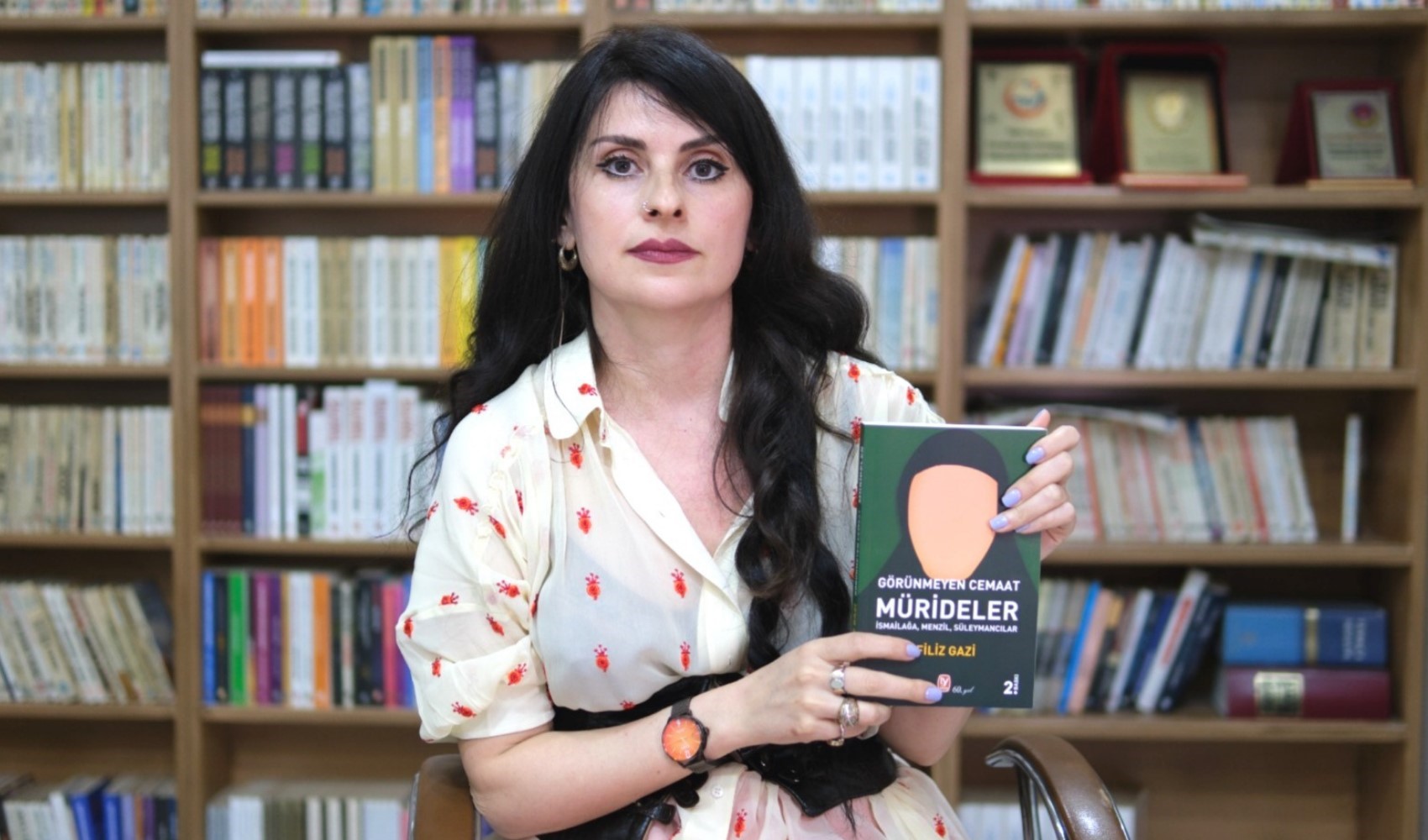
Journalist and author Filiz Gazi, focusing on the lives of women in sects and communities, in her book titled 'The Invisible Community: Female Disciples' also addresses the relationship between political Islam and the state. In this work published by Tekin Yayınevi, Gazi combines anthropology and journalism to reveal the inner workings of structures that usually remain invisible. We spoke with Gazi about the process of creating the book, her challenging fieldwork experiences, the position of women and children in sects, and the functioning and social impacts of these structures.
Women are not discussed much within sects. What did you encounter when you started to take an interest in this subject?
I started working on this topic 6-7 years ago. I first did a report for Gazete Duvar... I spoke with three women. One was a woman belonging to the Süleymancılar, one to the İsmailağa... They were young women. I thought I knew what I would encounter because I had heard things from a young woman during a conversation beforehand. However, after talking to those three women, I realized that it was an area left in the dark and in the shadows. We talk about sects and communities, but how the lives of the women and children there are shaped is not discussed in an explanatory way. The women are the victims, the ones whose lives are ground down, but as I said, it just remains a scandal, a sensation; we talk about it and it ends. It is impossible to look at a community and see only half of it while ignoring the other half. I realized that the women's side was never discussed, never thought about. The idea for the book took root in my mind after talking to those three women, and over the years, I gradually infiltrated these types of communities.
How did you enter these communities? Did you first attend the Monday gatherings of the İsmailağa in Fatih Çarşamba?
Yes, I started attending the gatherings in Fatih Çarşamba on Mondays... From 9:30 to 12:30, that is, for nearly 3 hours, sometimes even exceeding 3 hours. I attended the gatherings inside the Yavuz Sultan Selim Mosque. It is quite crowded. Girls aged 13 to 17 are brought to the mosque in groups. These are students from the outskirts of the city, what we call the economically weaker segments of the city. Of course, there were also women over 40. I wanted to observe without adding any of my own opinions or judgments. In the İsmailağa, the form of hijab is the chador. I had a long, black coat and a headscarf. Of course, I was not wearing makeup. I entered the gatherings in this manner. I generally participated in the gatherings by approaching aunts in their 50s and sitting next to them inside the mosque.
How do those gatherings go?
There is a preacher giving a sermon. The crowd is so dense you couldn't drop a pin, and the preacher is telling the women things in a didactic way. Because you are in a quiet position, you don't really draw much attention to yourself. I attended those gatherings for three weeks. There was more to come. However, in the second week, a woman came up to me. I thought I would draw attention if I said where I came from, so I stopped. After the report I published, I received many emails and messages; they were calling me an 'agent' and so on. This kind of 'taqiya' (dissimulation) also exists among the followers of Fethullah Gülen. What I did was nothing like that.
What was it like?
I have been a journalist for 17-18 years, and I am also an anthropology graduate. Of course, I had field research experience. Like entering a culture to get to know it and living among them for a while. I entered quietly and listened. I tried not to include any of my previous opinions, judgments, or preconceived notions there.
There are striking anecdotes told to you. For example, one woman says regarding their experiences, 'Like the surrender of a corpse to the mortician.'
One woman said something like this to me: 'Filiz, they don't want us to think about anything. Think of it this way, they want us to surrender just as a corpse surrenders to the person washing it.' Later, I heard the phrase, 'He who has no spiritual guide, his guide is the devil,' from another woman. When I first heard these sentences, I didn't know I would hear the exact same sentences in the following years. When I went to Adana for the Süleymancılar, and when I went to the Kahta district of Adıyaman for the Menzil, I heard the same expressions every time.
İsmailağa, Menzil, Süleymancılar... What do you think about these sects?
This might sound like a very sharp judgment, because sects and communities were once viewed as non-governmental organizations and evaluated within the scope of freedom of thought. The issue of whether they should be closed or not... After doing this work, I am of the very clear opinion that sects and communities must be shut down. I mean, I am not adding any extra caveats here. I am not touching upon issues like freedom of speech or anything of that sort. First of all, the women here have no agency whatsoever. I say the same thing for the İsmailağa, the Süleymancılar, and the Menzil communities... I believe women and children have no life of their own in these places.
What is the role of women and children in these structures? We learned about this during the process involving the Adnan Oktar sect, for example. What is the situation regarding the sects you have observed?
You can think of it like a political organization. They are viewed as religious structures, but there is a hierarchy there as well. However, the most invisible side of that hierarchy—which is where the book's title comes from—is the women's side. They are invisible, but they are definitely inside the structure, and they enter spaces where men cannot. For instance, in economically disadvantaged parts of the city like Zeytinburnu... There are Quran study groups held once or twice a week there. A form of socialization takes place. People like 'Mother Sheikh' or 'Mother Deputy' take on roles in these study groups. Much like the 'Big Sisters' among the followers of Fethullah Gülen... They have their own students, and as I said, imagine a network like this existing all over Istanbul and all over Anatolia... When they encounter something they cannot handle or feel they cannot comprehend, they go to a higher-ranking man to ask questions. But they do not have living spaces of their own.
Some individuals from these structures do come forward to tell journalists about certain disgraces and scandals, bringing them to the public's attention, don't they?
What you say is very true... Sometimes a woman finds the courage. Sometimes, a person within a sect or community holds a grudge against another and leaks information. But the news the public knows is just the tip of the iceberg. I don't think many of the horrific incidents ever reach us. That is why... I have been scanning very randomly since 2012 for the book. Furthermore, it is very difficult for a woman to talk about what happened to her in such a matter. Most of the women I spoke to have no economic independence. Imagine growing up in such a family and entering such a community. When something happens to you, it is very difficult to talk about it. It is a process that involves abandoning your family, standing up against a very powerful structure, and knowing that the decision you make will stay with you for the rest of your life... There is also the risk of death involved.
In fact, a consensus had formed in society against sects after the coup attempt on July 15. However, the AKP government divided power among different sects rather than just one. The issue has evolved into a coalition of sects, in a way. How do you evaluate the Erdoğan government's relationship with sects and communities?
There is a symbiotic bond there. There is a mutual win-win situation. At times, these communities act as a voter base. At other times, they act as a braking mechanism on social issues. Because something happens in the media, they don't like it, and the next day, İsmailağa issues a statement. They don't like a TV series, and the next day, they issue a statement. It doesn't matter if it's İsmailağa or Menzil. They act as a braking mechanism regarding values and sacred matters, and it is said that 'society has reacted.' Recently, people were asked about their loyalty to sects and communities... The figure is around 4-4.5 percent. We can almost call it a minority of a minority. On the other hand, there is a desire for a Sharia regime, and for the last 23-24 years, there has been a very rapid, strategic, and confident progression toward that desired regime. A broader heading for these issues is the Naqshbandi order. The history of the Naqshbandi order in Turkey is not new. In the Ottoman Empire, it was something used to bind the subjects to the sultan and to establish the regime there. It acted as a glue. As for Erdoğan, the place where the gentleman's mother is buried is next to the founder of a community. That already says a lot.
News Source: Sercan Meriç