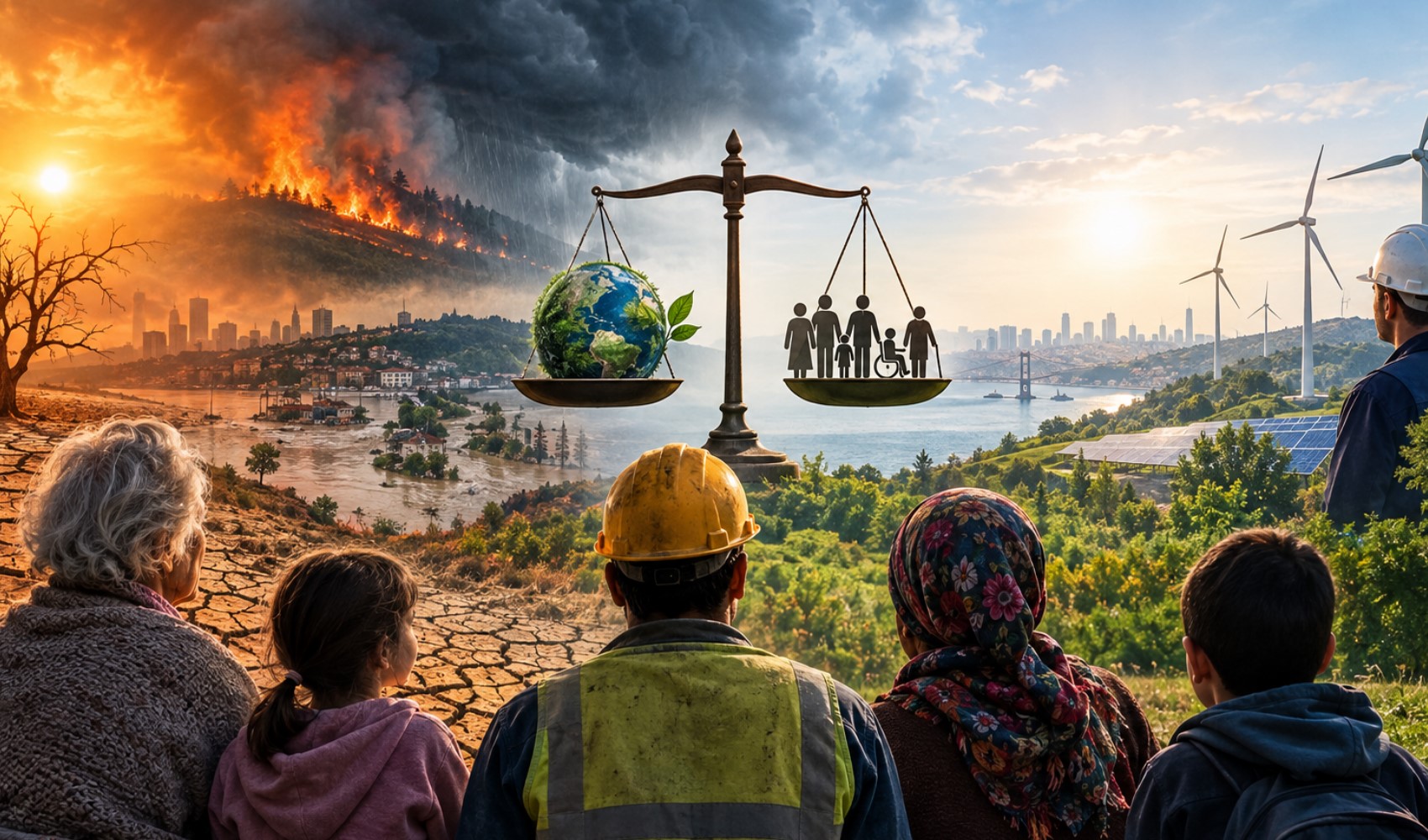
Prof. Dr. Murat Türkeş, a member of the Board of Directors at the Boğaziçi University Center for Climate Change and Policy Studies, stated that the climate crisis does not affect all segments of society in the same way, adding that "climate justice" must be placed at the center of climate policies.
Emphasizing that climate change is as much a social justice issue as it is an environmental one, Türkeş said that disadvantaged groups are hit harder by the crisis. "The negative consequences of climate change do not affect everyone equally," Türkeş said, noting that inequalities are being deepened by the crisis.
Rising temperatures, prolonged heatwaves, drought, extreme precipitation, and forest fires in Turkey are increasing the importance of adaptation policies. The social and economic consequences of the crisis are intensifying the pressure on vulnerable groups.
Türkeş said, "The level of impact on an elderly citizen living in a home without air conditioning is not the same as that of a person in a high-income group. Laborers working in open areas, the poor, children, and individuals with chronic illnesses are at a much higher risk."
1.1 BILLION CHILDREN FACE AT LEAST THREE CLIMATE THREATS
Türkeş stated that food prices, driven up by drought and extreme weather events, hit poor households particularly hard.
Noting that laborers working in open and unprotected conditions are the segment most exposed to heat stress, Türkeş stated that children and the elderly are also among the most vulnerable groups.
According to the UNICEF Children's Climate Risk Report published in June 2026, 1.1 billion children worldwide are exposed to at least three overlapping climate hazards; more than 296 million live in regions where drought, extreme heat, and heatwaves occur simultaneously. According to UNICEF's September 2026 analysis, "Education Interrupted," the education of more than 171 million students—or one in every 10 students—was disrupted in 2025 due to climate-related hazards. The elderly are also among the most vulnerable groups during heatwaves and disasters due to chronic illnesses and limited mobility.
''CLIMATE POLICIES CANNOT BE SUCCESSFUL WITHOUT A JUST TRANSITION''
Stating that the fight against climate change is not limited to reducing greenhouse gas emissions, Prof. Dr. Murat Türkeş said that the social dimension of the energy transition must also be taken into account.
Pointing out that the phase-out of coal must be managed correctly, Türkeş said, "Leaving a coal worker unemployed when a plant closes is not climate justice. Retraining and employing that same person in the fields of solar and wind energy, energy efficiency, or clean technology is the foundation of a just transition."
CAN Europe Turkey Climate and Energy Policy Coordinator Özlem Katısöz also states that a just transition should not be viewed merely as a future coal phase-out plan. As the coal sector in Turkey is already shrinking, workers and coal-dependent regions are paying the price for this unplanned decline. Meanwhile, incentives provided to companies owning thermal power plants to keep the coal sector afloat do not ensure the security of employees' wages, severance pay, or their future.
Katısöz considers developments ranging from the struggle of Doruk Mining workers for their unpaid wages to the inability to find a buyer for the Soma Thermal Power Plant as indicators of this unplanned process. She states that public administration can implement just transition policies that protect workers and local economies in coal regions by anticipating the transformation.
Katısöz also emphasizes that the National Just Transition Strategy, currently being worked on by the Ministry of Labor and Social Security, must take into account the coal regions where economic transformation and job losses are already occurring today. While consultations were held across 17 sectors and 33 themes during the ministry's strategy preparations in 2026, mining is among the sectors being addressed. Katısöz draws attention to the importance of planning the transition together with workers and households in coal regions.

The assessments of both experts show that a just transition must encompass not only changing the method of energy production but also protecting the rights and incomes of workers and the local economies of coal regions.
THE SOLUTION: POLICIES BASED ON CLIMATE JUSTICE
According to Türkeş, public policies against the climate crisis must be shaped from a social justice perspective.
Energy efficiency, renewable energy investments, a just coal phase-out, effective management of water resources, increasing green spaces in cities, heatwave action plans, early warning systems, and disaster-resilient cities constitute the main pillars of climate change adaptation.
Pointing out that individual steps by citizens—such as energy conservation, the use of public transport, efficient water use, and reducing food waste—are also an important part of the transformation, Türkeş said it is critical that climate policies be designed to strengthen social justice. Katısöz's assessments reveal that this approach must be supported by concrete social and economic policies for workers, households, and coal regions during the energy transition.
News Source: 12punto