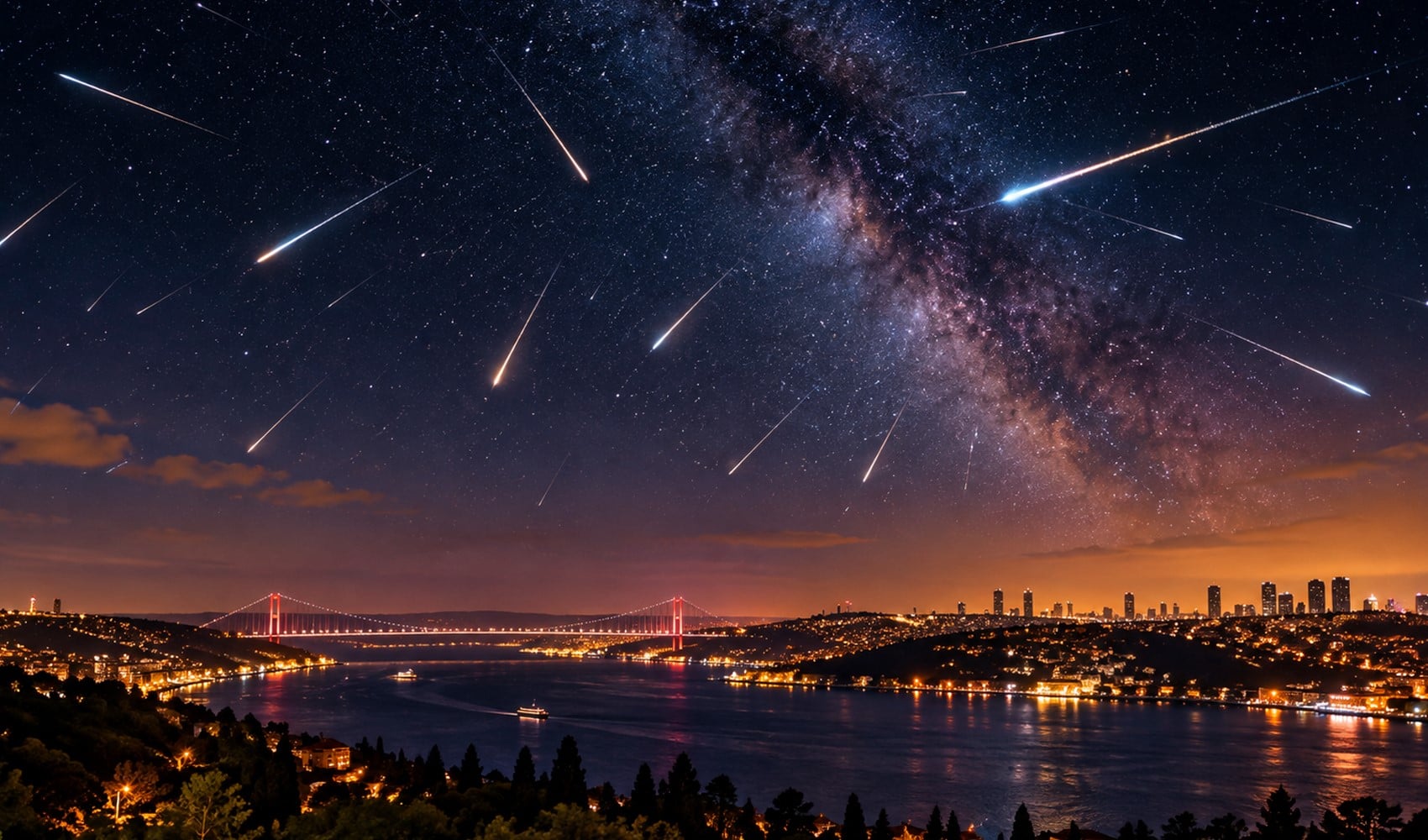
As is known, space exploration accelerated particularly after the Second World War, and these efforts were attributed the status of a strategic key role in the context of gaining prestige and global leadership.
Space exploration, which continued as a fierce competition especially between the Soviet Union and the United States, proceeded in a race-like atmosphere, marked by milestones such as the first living creature in space, the first human, the first woman, the first human to walk in space, the first crew to go to space, and the journey to the Moon, as well as the first human to set foot on the Moon. With technological advancements, scientific satellites entered our lives, and the space age truly began. In this context, space stations hold an important place. The International Space Station (ISS) has been continuously developed since it was placed into orbit in 1998 and has reached its current size, which is almost that of a football field.
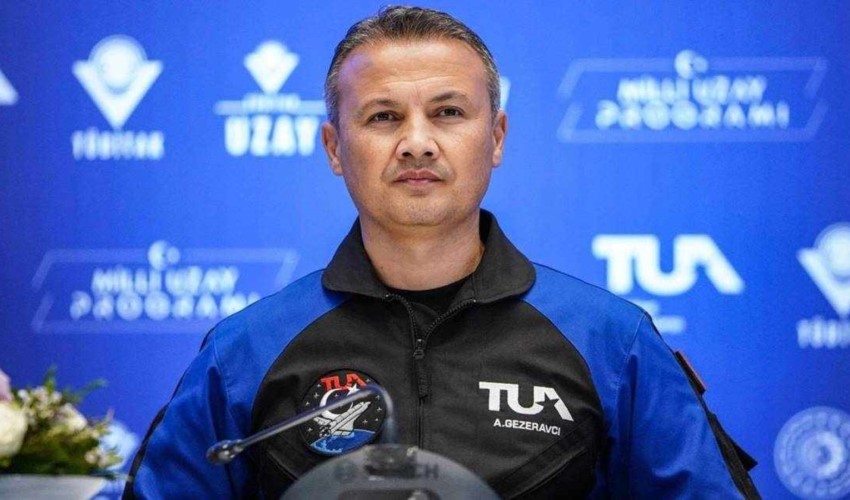
Countless scientific experiments have been conducted on the ISS, where numerous astronauts have stayed over the course of countless flights to date. Among the latest guests of the ISS, which will soon complete its operational life, is an astronaut who is a citizen of the Republic of Turkey: Alper Gezeravcı.
The journey of Alper Gezeravcı, the first astronaut of the Republic of Turkey, began on January 19, 2024, with the SpaceX Falcon 9 rocket, which launched at 00:49 Turkey local time. The mission crew consists of four astronauts who are Spanish, Italian, Turkish, and Swedish citizens. Within the scope of the mission named Axiom Mission 3 (Ax-3), the astronauts will dock with the ISS approximately 36 hours after being launched with the capsule named Dragon, located at the tip of the Falcon 9, and will spend 14 days on the ISS.
Colonel Alper Gezeravcı, a fighter pilot in the Air Force, will conduct 13 different experiments designed by Turkish scientists in the microgravity environment of the ISS during this period.
Of course, neither the launch vehicle nor the ISS itself belongs to us, but Alper Gezeravcı is one of the most valuable and competent officers of the Turkish military, capable of successfully carrying out these challenging tasks.
On the other hand, the experiments, which are the actual purpose of the mission, are also our own experiments designed by Turkish scientists. For this reason, our scientists who own these experiments, which give meaning to our journey into space, are waiting for the result of the mission with at least as much excitement as Gezeravcı.
Astronomy and Space Sciences studies, which gained momentum with the start of operations of the TÜBİTAK National Observatory (TUG) on September 5, 1997, accelerated with the Eastern Anatolia Observatory (DAG), whose construction was completed in 2022 and where scientific observations will soon begin. With the Turkish Space Agency (TUA), established by the law accepted on December 13, 2018, space exploration turned into a state policy and began to be planned from a single source. In this context, our country's “National Space Program” was announced on February 15, 2021.
There were a total of 10 goals in the National Space Program. Sending the first Republic of Turkey astronaut to space was also among these goals. I believe that achieving this goal on January 19, 2024, will also have a positive impact on other goals. For this reason, January 19, 2024, is a turning point in the scope of our country's space exploration. Of course, the fact that some of the National Space Program goals (for example, the goal of a hard landing on the Moon on the 100th anniversary of our Republic) could not be reached on the dates specified in the program shows that the feasibility reports during the creation of the goals were not prepared soundly, but these goals are within the limits of feasibility.
Our country's science and technology potential is strong enough to achieve this. The rest is a matter of time, will, and budget.
As Gezeravcı stated in his message from space, The future is in the skies. This motto, expressed 87 years ago in 1937 by our great leader Gazi Mustafa Kemal Atatürk, actually expresses the goal set before the Turkish Nation.
Although we are late as a country in space exploration, it is extremely important that work on this subject has begun today.
The biggest reason for the delay is that space exploration is extremely expensive. However, when viewed in the long term, I think that the prestige and economic returns that space exploration will bring to our country will consolidate the high-amount expenditures to be made in this field.
In closing, I wholeheartedly congratulate our first astronaut Alper Gezeravcı, our scientists who designed the experiments to be conducted within the scope of the AX-3 mission, and finally, the Turkish Space Agency, which managed the process in achieving this goal. Of course, the successful completion of the experiments and Gezeravcı's safe return are also among my wishes.
Prof. Dr. Ömer Lütfi Değirmenci
News Source: 12punto