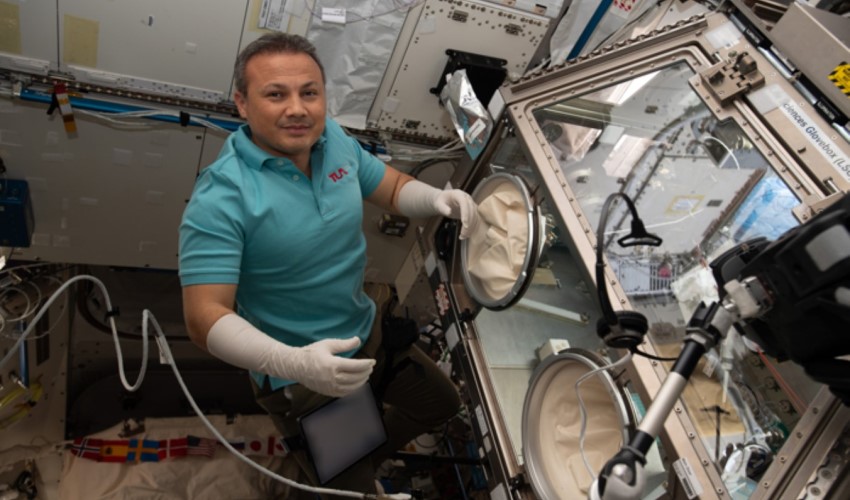
Gezeravcı continued his work on the International Space Station (ISS) with his 7th experiment.
Today, Gezeravcı began the "gMetal" experiment, for which Prof. Dr. İskender Gökalp from TÜBİTAK MAM and Deputy Minister Yozgatlıgil serve as project managers.
The experiment will investigate the effect of gravity on creating a homogeneous mixture between solid particles and a fluid medium under non-chemical reaction conditions. This will enable spacecraft propulsion systems to be made more efficient.
EXPERIMENTS CONDUCTED BY GEZERAVCI
Gezeravcı has carried out 6 experiments since the day he arrived at the ISS.
Astronaut Gezeravcı is continuing the "EXTREMOPHYTE" experiment, which investigates the physiological and molecular responses of the endemic halophyte plant Schrenkiella Parvula, which grows in Lake Tuz, to the space environment; the "CRISPR-GEM" experiment, which is the first step toward developing new plants to provide the nutrients that a large number of people living in space in the future will need and to support environmental controls in closed living environments; and the "UzMAn" experiments, which investigate whether it is possible to use microalgae species in space life support systems.
Gezeravcı is also continuing the "ALGALSPACE" experiment, which investigates the use of algae in space environments for oxygen regeneration from carbon dioxide, supplemental food supply, water improvement, and life support, as well as the "VOKALKORD" experiment, which will enable the detection of vital reactions to living in space through "vocal cord"-related changes and the identification of discomforts caused by low gravity through sound frequencies.
The "OXYGEN SATURATION" experiment also aims to identify differences and discomforts caused by low gravity by calculating the oxygen level of the air provided with the support of artificial intelligence.
News Source: AA