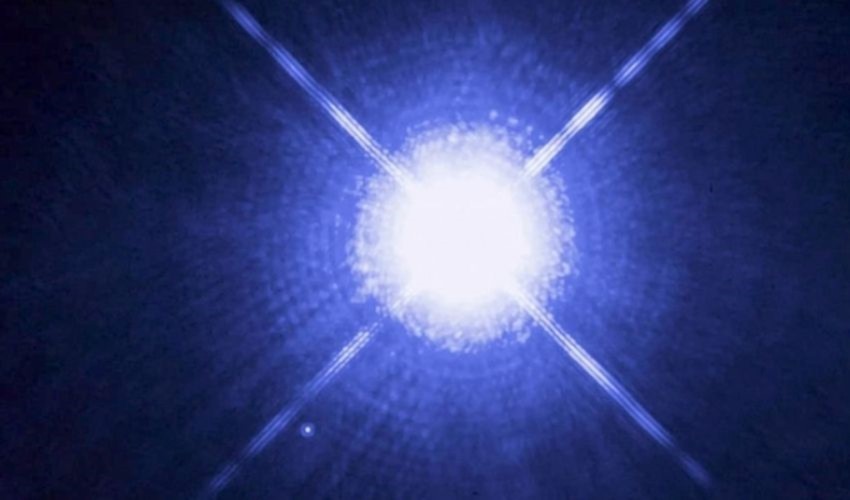
According to a CNN report, astronomers have detected short, bright flashes from the "Tasmanian Devil" that are as powerful as the explosion that caused the star's death, following its initial eruption detected in September 2020.
It was stated that the initial explosion that caused the star's death was not a typical "supernova," which refers to a star becoming increasingly bright and then exploding to eject most of its mass, but rather a rare type of explosion called a "Luminous Fast Blue Optical Transient (LFBOT)."
It was noted that LFBOTs, first discovered in 2018, reach maximum brightness and fade within a few days, whereas a supernova glow can last for weeks or months.
MONITORED FOR 120 DAYS
The research included information that the LFBOT belonging to the "Tasmanian Devil" was named AT2022tsd and was observed by 15 telescopes around the world.
The lead author of the study, Anna Ho, a faculty member in the Department of Astronomy at Cornell University, stated: "Surprisingly, instead of fading steadily as expected, the source (Tasmanian Devil) flared up repeatedly for a short time. LFBOTs are already strange, exotic events, but this was even stranger. We had never seen such fast light in any supernova or 'Fast Blue Optical Transient' that was as powerful as the initial explosion months later."
Ho noted that 15 observatories, including the high-speed camera (ULTRASPEC) mounted on the 2.4-meter Thai National Telescope, monitored 14 irregular light pulses over 120 days, and that this might only be a fraction of what is being emitted by the LFBOT.
Emphasizing that some flashes lasted only tens of seconds and that these could be caused by a stellar remnant created by the initial explosion—namely a dense neutron star or a black hole—Ho stressed that studying LFBOTs could provide more information about formations after a star's death, rather than just its life cycle ending with an explosion and remnant.
INITIAL EXPLOSION MAY HAVE BEEN A BLACK HOLE MERGER, SUBSEQUENT FLASHES MAY BE BLACK HOLE JETS
Ho pointed out that the initial explosion might have been triggered by an unusual event, such as a star merging with a black hole, which is "a completely different path for cosmic catastrophes."
Prof. Dr. Jeff Cooke, a faculty member at Swinburne University of Technology in Australia and one of the authors of the study, also stated: "(LFBOTs) emit more energy than an entire galaxy of hundreds of billions of Sun-like stars. The mechanism behind this massive amount of energy is not yet known. But in this instance, powerful explosions continued after the initial blast and fading. These happened very quickly, in minutes, rather than the weeks or months seen in supernovae."
Stating that the limits of physics are being pushed due to the high energy production and short-duration bursts, Cooke noted that the rapid flaring and fading indicate that all this energy is produced from a relatively small source, and if this is a black hole, matter is being ejected into space at speeds close to the speed of light.
The research was published in the journal Nature.
News Source: AA