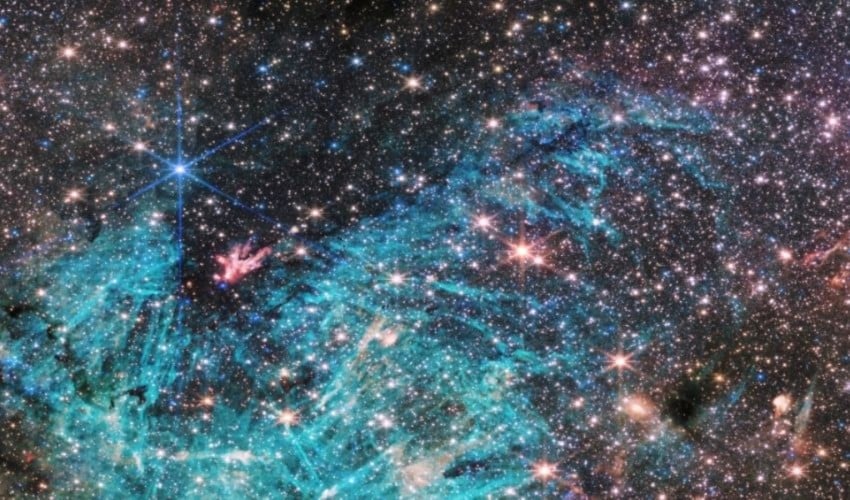
The James Webb Space Telescope (JWST) is allowing astronomers to examine the gas and dust covering the center of the Milky Way, revealing features never seen before. The recent observation made with the space observatory, and its ability to image the universe in infrared light invisible to the human eye, has enabled the capture of unprecedented details.
According to the report by Donanımhaber, one of the greatest mysteries of our galaxy is the star-forming region called Sagittarius C, located approximately 300 light-years away from the Milky Way's supermassive black hole.
The image contains an estimated 500,000 stars of varying sizes and ages that are shining. Among these are a cluster of protostars or dense masses of dust and gas that are still developing and turning into full-fledged stars. It is also known that there is a massive protostar at the center of the cluster with a mass more than 30 times that of the Sun.
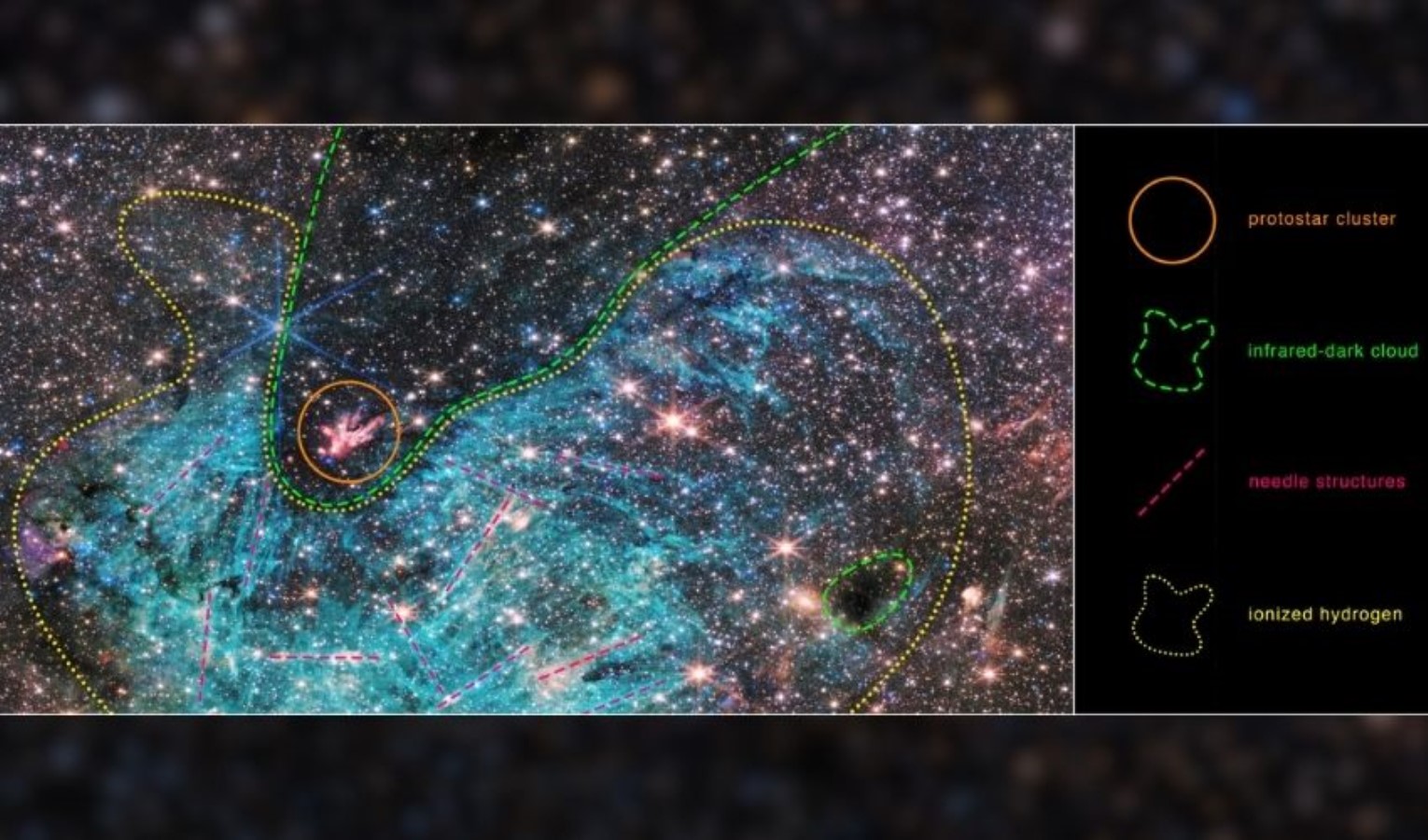
Researchers emphasize that there has never been infrared data at the level of resolution and sensitivity obtained with Webb until now, and that thanks to this, they have the chance to see many new details. The area shown in this image is approximately 50 light-years wide and is located about 25,000 light-years (1 light-year = 9.46 trillion kilometers) away from Earth.
The research team says the galactic center is close enough for JWST to study individual stars. This allows for the collection of unprecedented information about how stars might form in this region compared to other parts of the galaxy. Studying the center of the Milky Way with Webb could provide information about how many stars form there and whether massive stars are more likely to form near the galactic center rather than in the galaxy's spiral arms. The research team is also interested in structures resembling needles arranged without any order within ionized hydrogen.
News Source: 12punto