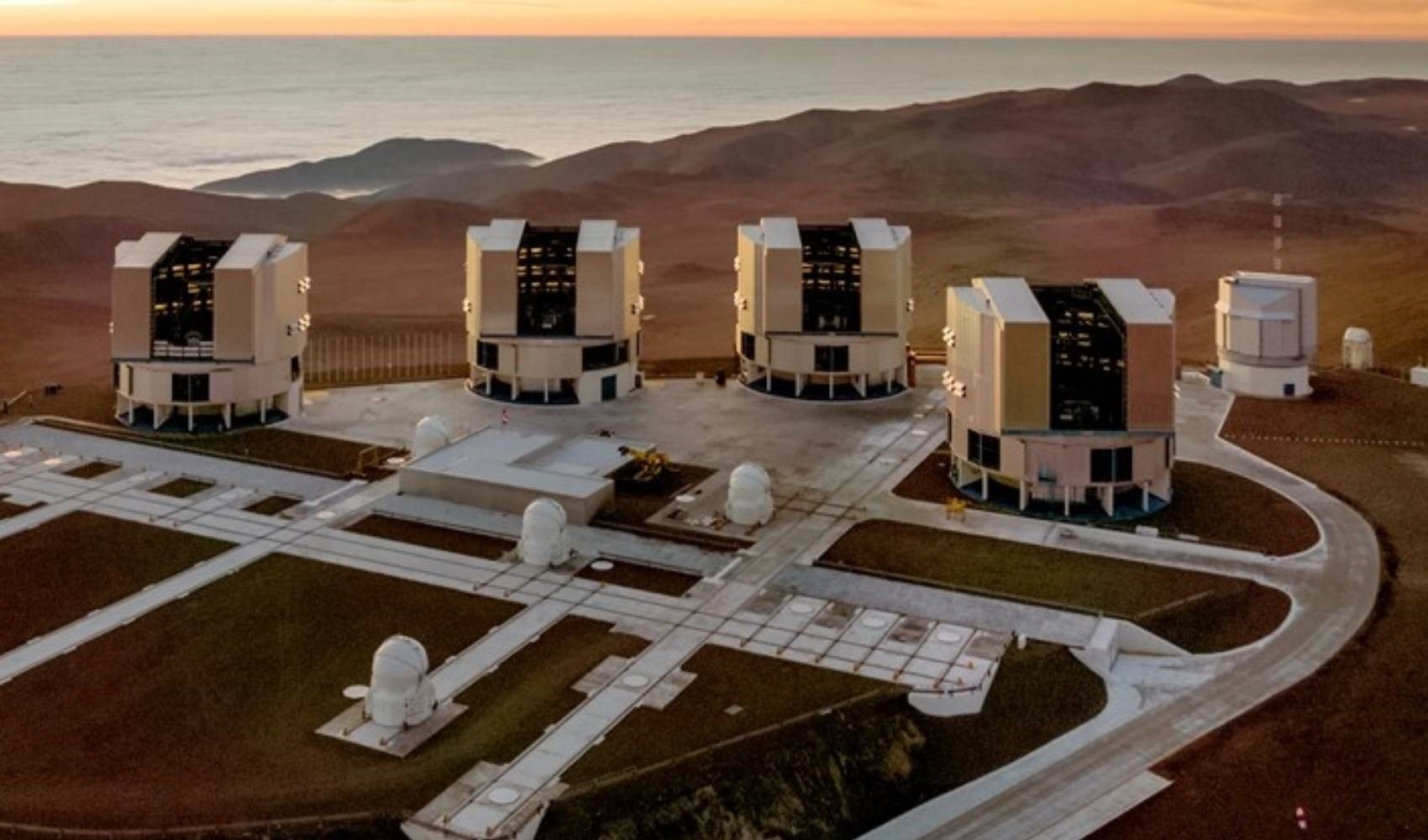
The VLT is at great risk due to the 10 billion dollar INNA Renewable Energy Park, which is planned to be built just a few kilometers away. This project is intended to be carried out in the Atacama Desert by the US-based energy company AES and covers a 7,400-acre area including solar power plants, wind turbines, and hydrogen production facilities. According to calculations by ESO, this facility will create as much light as a small city emits into the sky.
ESO Director General Xavier Barcons announced that the sky around the observatory is expected to become 10 percent brighter due to this project. This increase in brightness could cause the VLT to lose its current prestigious status and reduce the telescope to the level of a more ordinary observatory.
CRITICAL ASTRONOMICAL OBSERVATIONS AT RISK
It is emphasized that a 10 percent increase in light pollution could create more serious consequences than thought. Barcons states that this situation could result in 30 percent of the faintest galaxies currently visible no longer being observable. Yet, the VLT has achieved many groundbreaking discoveries to date, such as capturing the first direct image of an exoplanet and revealing the cosmic web structure in the universe. However, the increasing brightness could make such discoveries impossible.
NEW TELESCOPE ALSO IN DANGER
The INNA Renewable Energy Park could negatively affect not only the VLT but also ESO's 1.5 billion dollar new telescope, the Extremely Large Telescope (ELT). Both telescopes were specifically placed in remote regions of the Atacama, which offers the world's darkest night skies. ESO had conducted extensive global research in site selection to ensure these ideal observation conditions. Barcons stated that they are not completely against the energy facility, but that building it so close creates a major problem. According to him, it is stated that this problem could be solved if the facility were moved at least 50 kilometers away.
SATELLITES IN ORBIT ALSO CAUSE PROBLEMS
Light pollution is not limited to local projects; the density of satellites in orbit also negatively affects observations. It is known that the satellites placed in orbit as part of SpaceX's Starlink project make astronomical observations difficult due to their brightness. These rapidly increasing satellite constellations have become a growing problem for ground-based observatories.
News Source: 12punto