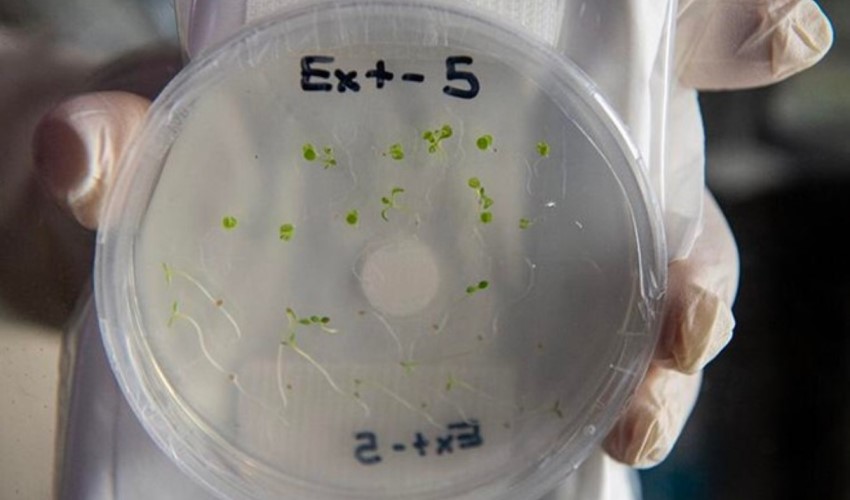
Ege University (EÜ) has shared the results of the experiment conducted in space by astronaut Alper Gezeravcı, who recently returned successfully from Turkey's first manned space science mission, regarding the "Schrenkiella parvula" plant, which is endemic to Tuz Gölü.
In a statement released by the university, it was recalled that one of the 13 experiments Gezeravcı performed in the space environment was titled "Investigation of the Responses of Schrenkiella parvula to Salt Stress in Space Environment-Extremophyte," led by Assoc. Prof. Dr. Rengin Özgür Uzilday of the EÜ Faculty of Science, Department of Biology, with Assoc. Prof. Dr. Barış Uzilday and Prof. Dr. İsmail Türkan participating as researchers.
It was noted that during the experiment, which examined whether the plant, resistant to high-salt environments, could maintain its tolerance to high salinity in very weak gravity, photographs of the plant were sent to the project team on a daily basis.
POSSESSES FEATURES THAT COULD RECLAIM MARS
Assoc. Prof. Dr. Barış Uzilday, whose views were included in the statement, provided the following information:
"We observed that the plants germinated on the second and third days of the experiment. This was very important for us. We saw that they reached the growth levels we expected, but that the leaf and stem shapes of the plants differed due to microgravity.
The Schrenkiella parvula plant is a plant that is tolerant to high salt, heavy metals, and low and high temperatures around Tuz Gölü, and is capable of adapting to harsh conditions. It possesses pioneering features that could enable the reclamation of places like Mars, where humans aim to go and practice agriculture in the future."
Stating that the experimental process is ongoing, Assoc. Prof. Dr. Uzilday added:
"The plants were harvested by our astronaut Alper Gezeravcı at the end of the experiment. Metabolic processes were completely halted using a solution. They were then transferred to a deep freezer at -80 degrees Celsius on the International Space Station. They were brought to Earth in a capsule at the same temperature. From there, they will come to our country. Following this, we will attempt to investigate both the growth performance of the plants and, using next-generation RNA sequencing methods, which genes were activated and how the plant responded to salt under microgravity."
News Source: AA