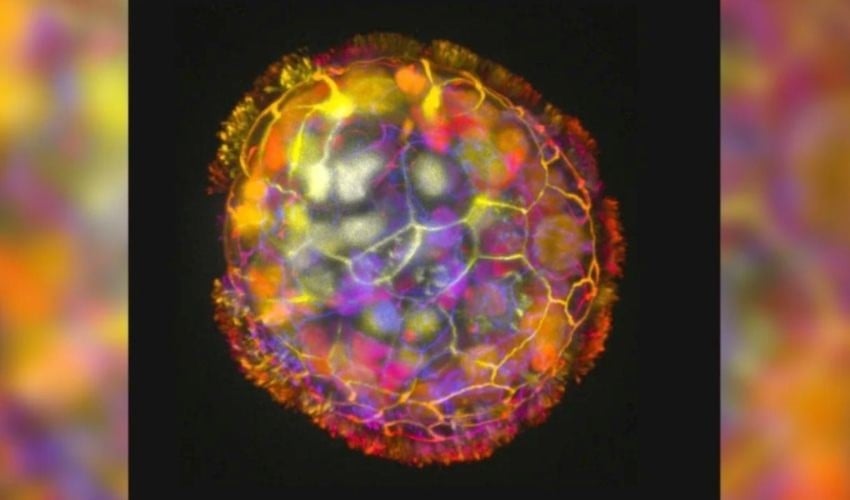
Gizem Gümüşkaya, who became interested in synthetic biology while in the US for a master's degree in architecture, aims to develop eco-friendly new construction methods by using these small living robots—produced from human cells—not only to help heal damaged tissues but also as building materials in the field of architecture.
ROBOT CREATED FROM HUMAN CELLS: ANTHROBOT
Gümüşkaya, who completed her doctorate at Tufts and Harvard universities, provided information about her research in which they produced small living robots from human cells, which they named "anthrobots."
Gümüşkaya, who was born and raised in Turkey and completed her undergraduate education at Istanbul Technical University Faculty of Architecture, said that she came to the US after her undergraduate studies to pursue a master's degree in architecture at the Massachusetts Institute of Technology. Gümüşkaya stated that she was introduced to synthetic biology while pursuing her master's degree, noting that design can also be done in this field and that new biological structures can be produced by manipulating the DNA of cells.
Stating that she started her master's degree in synthetic biology simultaneously while pursuing her master's in architecture, Gümüşkaya said, "As a designer, this really interested me, and I dove completely into the field of biology."
Gümüşkaya explained that after her master's degree, she began her doctoral studies with biologist Michael Levin, who has laboratories at Tufts and Harvard universities, and that she had the opportunity to work more deeply in the field of synthetic biology for 5 years, finishing her doctorate last week.
SELF-CONSTRUCTING SYNTHETIC LIFE ARCHITECTURES
Stating that her starting point was architecture, Gümüşkaya said that "anthrobots" are synthetic life architectures that construct themselves by design.
Gümüşkaya expressed that she set out from the idea of applying the process of biological structures, such as plants, growing from a single seed into a multicellular structure to the construction sector, saying, "An anthrobot is a multicellular, self-moving robot that can derive from a single human cell in 2 weeks."
Stating that the only thing that needs to be done is to feed the "anthrobots" with a glucose-containing liquid, Gümüşkaya noted that they turn into self-moving living beings at the end of 2 weeks and can do everything else on their own besides feeding.
Gümüşkaya emphasized that her ultimate goal is for "anthrobots" to be used in the field of architecture, saying, "More than 40 percent of the carbon released into nature due to global warming comes from the construction sector, and when we look at biology, there is a construction method that grows by absorbing carbon from nature, let alone releasing it. If we can bring this feature to architecture, we will have developed new methods that could have very positive results in terms of global warming. Therefore, the ultimate goal in my heart is to make larger versions of these and use them as building materials."
ENABLES HEALING OF DAMAGED TISSUES
Pointing out that "anthrobots" have many application areas in medicine because they are biologically based living beings, Gümüşkaya said that they can heal damaged nerve cells.
Gümüşkaya said, "These robots can come together and hold onto each other to produce larger structures. These structures they produce act like a bridge; if there is a tear in a nerve tissue, they settle over that tear and allow the nerves to heal under that bridge, and they do this in a very short time, such as 3 days."
Drawing attention to the fact that nerve tissues are not tissues that heal easily, Gümüşkaya expressed that they were excited to see healing within 3 days as part of their research.
Gümüşkaya stated that these robots could be used in the treatment of neurodegenerative diseases such as nerve damage, Alzheimer's, and Parkinson's, and that they will continue their research in this field.
Stating that their research has had very positive reflections in the US, Gümüşkaya said that although it is a small step for the field of architecture, they are relatively closer to application in the field of medicine at the moment and that they have received positive reactions, especially from the medical community.
Gümüşkaya stated that they will conduct experiments in the next stage and that they will contact the US Food and Drug Administration (FDA) after the experiments on damaged tissues in the human body are completed.
Emphasizing that these robots are not produced by manipulating genetics, Gümüşkaya said, "In other words, we will be able to make robots from a person's, a patient's own cells. Therefore, when we put those robots back into that patient's body, we think that the body will not perceive it as a foreign substance and there will be no tissue rejection. It will be a robot that carries the patient's own DNA entirely."

Gümüşkaya stated that the robots in question were produced using the cells' own biological intelligence, but that they could be taken to more interesting points in the future by using artificial intelligence as well.
Noting that she still defines herself as an architect, Gümüşkaya said, "I am just doing architecture with biological cells instead of stone and cement."
Addressing students in Turkey, Gümüşkaya said, "I was able to come to America and expand my research by attending an Anatolian high school and studying at a public university in Turkey. If I could do it, anyone can. You just have to dream and work very hard."
News Source: AA