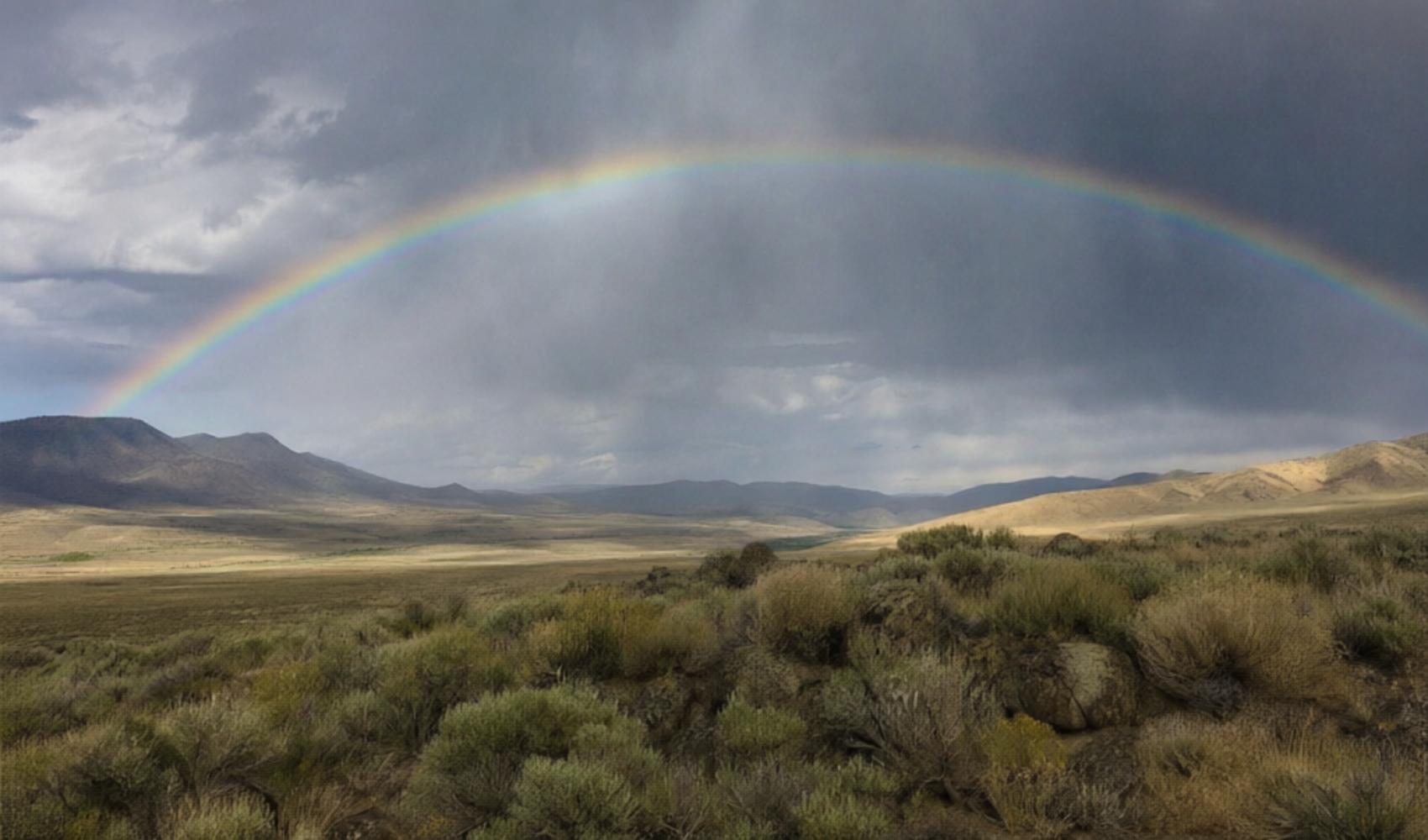
When the rain stops and the Sun emerges from behind the clouds, the rainbow that appears in the sky might seem like a shared view for everyone looking at the same place. However, physically, the situation is more complex than that: even two people standing side by side do not actually see the same rainbow.
The reason for this is that a rainbow is not a concrete object hanging in the sky. A rainbow is an optical pattern created by the path sunlight follows through millions of raindrops, relative to the observer's position. The location of your eyes determines which droplets the light reaches you from and at what angle.
THE JOURNEY OF LIGHT THROUGH THE DROPLET
To see a rainbow, basic conditions must be met simultaneously: the Sun must be behind you, the raindrops must be in front of you, and sunlight must reach the rain without being blocked by clouds. When these conditions are met, light slows down and changes direction as it enters a raindrop. In physics, this is called refraction.
White light is not monochromatic; it consists of different wavelengths. When light enters the droplet, these wavelengths bend by different amounts, and the colors separate. Then, the rays reflect internally on the back surface of the droplet and refract once more as they exit from the front edge.
Rainbow researcher Philip Laven describes this process as "a pattern formed by sunlight reflecting and refracting through millions of raindrops in the sky." Red light exits the droplet at an angle of approximately 42 degrees, while light closer to blue and violet exits at an angle of approximately 40 degrees.
This small difference in angle determines the order of colors in the rainbow. While some droplets higher in the sky send red light toward your eyes, droplets lower down deliver blue and violet light to you. This is why red tones are usually seen on the outer edge of the primary rainbow, and blue and violet tones on the inner edge.
EVERY OBSERVER'S RAINBOW IS UNIQUE
Even if the person next to you looks at the rainbow at the same time as you, the light reaching their eyes comes from different raindrops. When your friend shifts a few steps to the right or left, or even if their height is slightly different from yours, the angle at which the light reaches their eyes changes. For someone passing by the same spot later, the conditions are no longer exactly the same due to the Earth's movement relative to the Sun.
A rainbow is actually more of a circle formed around the "antisolar point," where the observer's head shadow is located, rather than an arc. When viewed from the ground, the lower part of this circle often remains below the horizon, so only the arch-shaped section is visible. When viewed from a high point, such as an airplane, the full circle of the rainbow can sometimes be seen.
The position of the Sun is also one of the main factors determining the image. If the Sun is close to the horizon, a larger portion of the rainbow can be seen. When the Sun rises higher than 42 degrees above the horizon, even the peak of the arc may remain below ground level. For this reason, rainbows are more rarely noticed in the middle of the day.
Sometimes, a fainter second arc forms outside the primary rainbow. According to physicist Ping Wah Li from the Chinese University of Hong Kong, the secondary rainbow can be seen if the sky between the observer and the rainbow is clear enough. This second arc emerges as a result of light reflecting twice inside the raindrop.
In the secondary rainbow, the order of colors is reversed: red is on the inside, and violet is on the outside. However, because the light follows a longer path inside the droplet and weakens more, this second arc appears fainter than the primary rainbow.
An optical illusion can also come into play regarding the "size" of the rainbow. According to meteorologist Raymond Lee from the U.S. Naval Academy, a rainbow has no linear dimension because it is not an object. What defines it is its angular size. The radius of the primary rainbow is approximately 42 degrees, and its diameter is approximately 84 degrees. Although a rainbow rising over a distant mountain may look larger, this is often an interpretation made by the brain based on surrounding objects.
News Source: 12punto