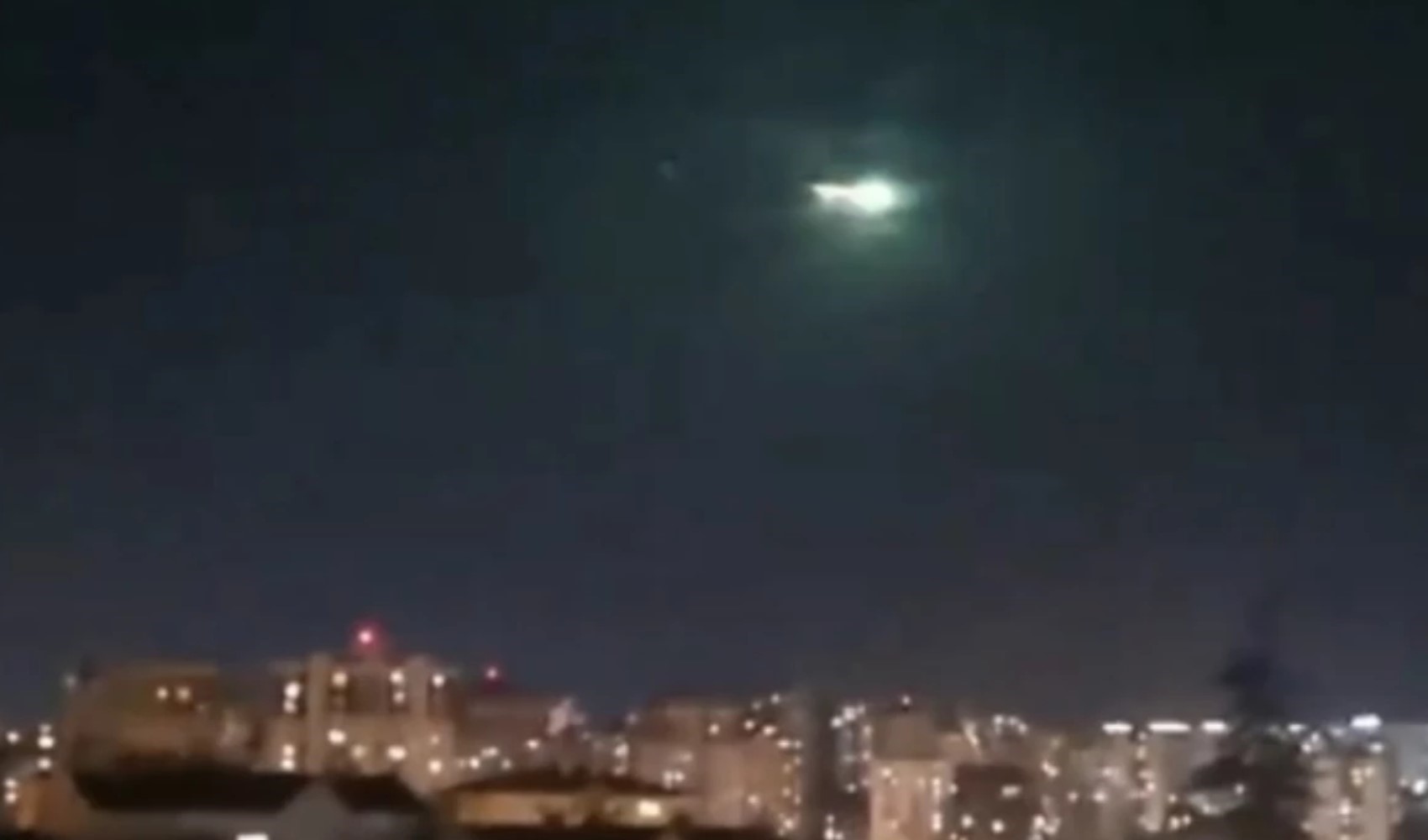
The bright cluster of lights seen in the sky over the city yesterday evening descended and disappeared. Some citizens who watched the cluster of lights in astonishment recorded those moments with their mobile phone cameras.
"IT COULD EVEN BE A SCREW"
Assoc. Prof. Dr. Hasan Hüseyin Esenoğlu, a faculty member at Istanbul University's Faculty of Science, Department of Astronomy and Space Sciences, stated that the descent of the light cluster seen in the sky lasted a long time and that it might have a metallic structure because it remained visible for a sustained period.
Esenoğlu said, "The one in the front is larger and appears bright because it acts as a shield. This is not a natural meteorite; it could be space junk. It could be debris left over from space collisions, rocket fuel, or even a screw."
"IT WAS NOT AT METEOR SPEED"
Emphasizing that the exact nature of the object could be determined if it is found, Esenoğlu continued:
"A natural meteorite carries information about the place it was made and the country it belongs to, just as it brings information about the solar system.
Normally, a meteorite has a faster transit, but the bright mass of light seen last night came down in a swirling motion.
This did not suddenly come from space and arrive on Earth. It had a transit as if it were gradually descending. It was not at meteor speed.
The reason it looked colorful is most likely because there is chemistry on it; there can be coatings or paint. That is why it looked bright. I have also seen something like this for the first time."
"A METEORITE IS EXPECTED TO BURN AND CONTINUE ITS PATH RAPIDLY"
Astronomer Duygu Esendemir, a member of the Turkish Astronomical Society, reported that they had received footage of the light cluster seen in many provinces of Turkey, especially Istanbul, last night.
Stating that they conducted some analyses by examining the footage from different locations following the event, Esendemir continued:
"When a meteorite enters the atmosphere, it is expected to burn and continue its path rapidly due to reasons such as friction, chemical interaction with atmospheric gases, and pressure. This causes it to heat up and radiate energy into its surroundings.
If a meteorite had entered the atmosphere in this way, we would expect a sudden flash, but in the event observed yesterday, it is seen in the videos that the object moving in the air did not move as fast as a meteorite and moved in pieces and in succession, slower compared to a meteorite."
RUSSIAN OBSERVATION SATELLITE HAD DISINTEGRATED
We think this object could be space junk or parts of a satellite orbiting in space. Information was shared on June 26 that the Russian observation satellite RESURS-P1 had disintegrated.
In fact, the International Space Station crew stayed in special shelters for a short time. This disintegration created more than 100 pieces of debris.
The point where this debris entered the atmosphere could be the skies over Turkey, and due to the altitude of atmospheric entry, it could have caused it to be seen in different provinces over an area spreading hundreds of kilometers."
LOW PROBABILITY OF BEING A METEOR
Ankara University Kreiken Observatory Director Assoc. Prof. Dr. Mesut Yılmaz stated that the bright mass of light gliding through the sky yesterday resembled "space junk" more than a meteor due to its speed.
Expressing that he watched the footage published on this subject and that it is difficult to say anything definitive based on the existing footage, Yılmaz said:
"As a first impression, when we look at the footage, that object does not look like a meteor. Because the speed of the object entering the atmosphere seems a bit low.
Meteors enter the atmosphere much faster. The speed of the slowest one is 40 thousand kilometers per hour, and this can go up to 260 thousand kilometers, but when we look at the footage there, it looks like a low-speed object.
There is a possibility that it is space junk. It could be a piece that broke off from these satellites, the space station, or rockets that appeared in the sky."
"THE EFFECT OF THE EXPLOSION WOULD HAVE BEEN FELT"
Evaluating the impact of the falling object, Yılmaz said:
"If it were a meteor, its impact would definitely have been felt. In other words, a serious crater would have formed where it fell, an explosion would have occurred, a fire would have started if it fell into a forested area, and a small-scale tsunami would have occurred if it fell into the sea. In other words, the effect of the explosion would definitely have been felt.
Tons of particles already fall into our atmosphere every year, but most of them melt and disappear in our atmosphere; they do not reach the Earth's surface. Therefore, if it were a meteor, we would definitely have understood it.
If this is artificial, man-made, they also actually break apart and crumble, and they do not have much of a serious effect when they fall to the ground. That is probably why there has been no problem regarding where it fell yet."
"IT CAN CAUSE SERIOUS DAMAGE TO EARTH"
Pointing out that meteor falls are natural processes, Yılmaz said, "Thousands of them already fall to Earth every year. Some are small and large like this, some can be a little bit bigger. There is no abnormal situation here. As long as meteors with a diameter larger than 30 meters do not fall. They are our biggest fear. Because they can really cause serious damage and harm to the Earth." he stated.
Yılmaz warned that if a piece falling from the sky is encountered, it should not be touched, saying, "Because these can sometimes contain radiation. They should stay away and notify the authorities immediately."
News Source: 12punto