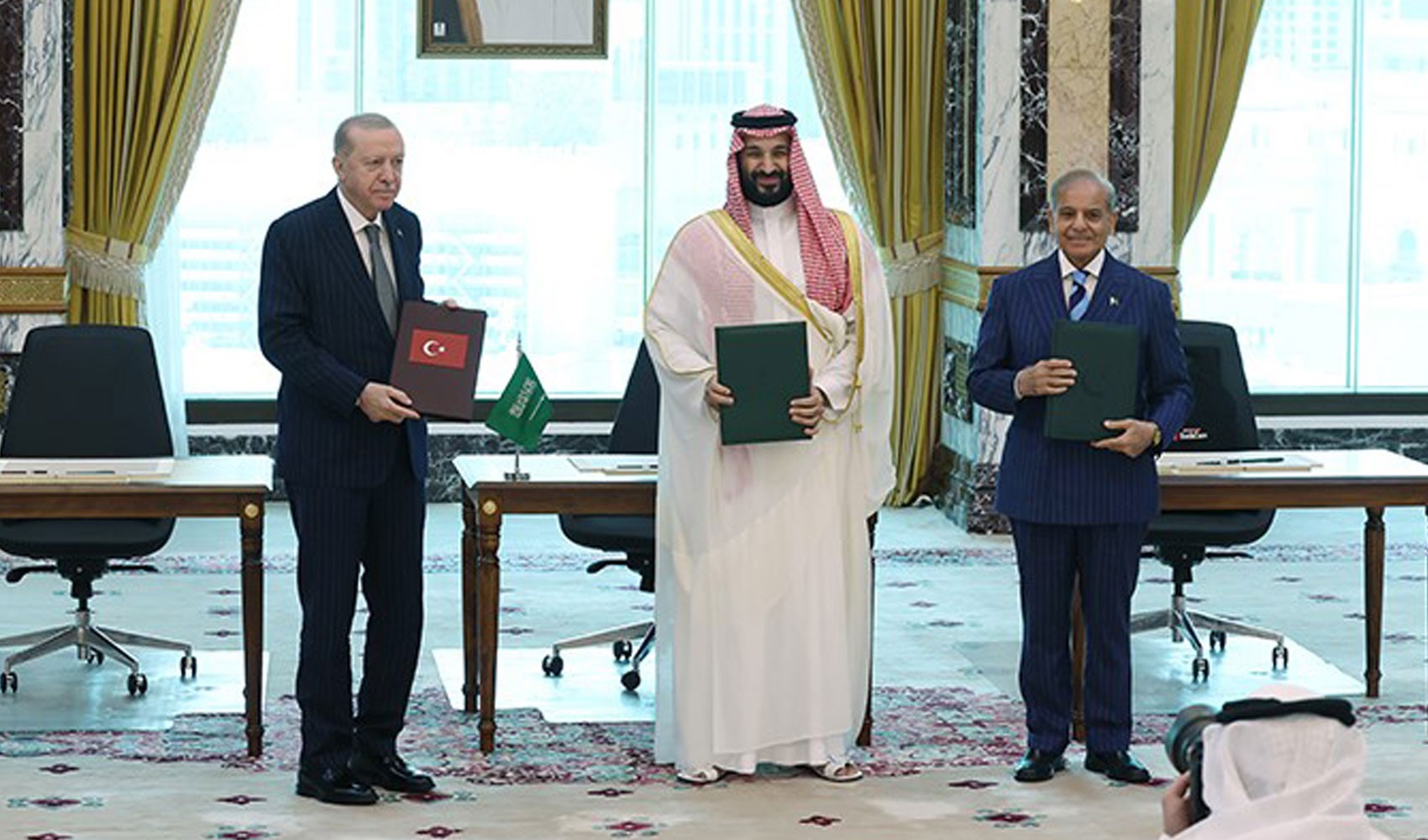
The "Mecca Joint Defense Agreement," signed by AKP Chairman and President Recep Tayyip Erdoğan, Saudi Crown Prince Mohammed bin Salman, and Pakistani Prime Minister Shehbaz Sharif, has been widely covered in the international media.
The British newspaper The Guardian announced the development with the headline, "Saudi Arabia, Pakistan, and Turkey sign NATO-style defense pact as Houthi attacks in Yemen continue."
The report stated that the agreement stipulates that an attack on one of the three countries will be considered an attack on all of them. The report also noted, "By signing a mutual defense agreement, Saudi Arabia, Pakistan, and Turkey have brought together three of the most influential countries in the Islamic world under a NATO-like pact."
Channel 4 draws attention to the agreement being signed in Mecca
The UK-based television channel Channel 4 described the pact as a "Muslim NATO." The report pointed out that the agreement was not signed in one of the participating countries' capitals, but in the holy city of Islam, Mecca, stating, "This agreement brings together the three most powerful Sunni Muslim countries."
The report also noted that the agreement comes at a time when US hegemony in the Middle East is being questioned following attacks on Iran.
DW: "Mecca Agreement is of historical importance"
Germany's Deutsche Welle used the headline "Mecca Agreement is of historical importance" in its report. It was noted that the agreement envisions the development of defense cooperation between the three states in all areas.
CNN: "A NATO-like defense agreement"
The US broadcaster CNN stated that Saudi Arabia has signed a NATO-like defense agreement with Turkey and Pakistan, the two most militarily powerful countries in the Islamic world. Noting that the three countries have transformed their long-standing security relations into a collective defense alliance, the report said, "While Turkey has the second-largest army in NATO after the US, Pakistan is the only country that possesses nuclear weapons." The report also included a statement from a Turkish official suggesting that other countries in the region could join the agreement, highlighting the possibility that the agreement could expand by accepting new members in a manner similar to NATO.
Greek press: "Shame in Athens"
The Greek newspaper Kathimerini addressed the implications of the agreement for Greece in an article by Vasilis Nedos. The assessment noted that the strategic relationship Athens has been trying to build with Saudi Arabia for 5 years has yielded no results, and that despite Greece providing support for the protection of Saudi Arabia, Riyadh preferred to form an alliance with Turkey and Pakistan. The article, titled "Mecca Agreement creates new balances and shame in Athens," pointed out that Athens has not reaped the fruits of its investment in relations with Saudi Arabia. The article also stated that the agreement would increase Turkey's military and political weight and combine the defense capacities of Turkey and Pakistan with Saudi financing. It was also stated that the situation would increase Turkey's defense exports in the Gulf, strengthen its regional influence, and be a source of concern for Athens.
The Greek news portal TVXS interpreted the agreement as "a failure of the Mitsotakis government's Saudi Arabia policy." The article, which also noted that Greece had deployed Patriot air defense systems to Saudi Arabia to support its defense, emphasized that Athens had not achieved any strategic gain despite all its investments.
Cypriot broadcaster AlphaNews addressed the Mecca agreement in terms of Turkey's "casus belli" (cause for war) decision against Greece and the Turkish military presence in Cyprus. The analysis published today commented that Turkey forming a collective defense alliance with nuclear-armed Pakistan and financially powerful Saudi Arabia could affect the balance of power in the region.
Israeli press focuses on the agreement's impact on normalization with Saudi Arabia
Reports and commentaries in the Israeli press focused particularly on the agreement's impact on a potential normalization deal between Israel and Saudi Arabia, which has been encouraged by US President Donald Trump. The Times of Israel covered the development with the headline, "Turkey, Saudi Arabia, and Pakistan sign joint defense agreement in the shadow of the Iran War." Stating that the agreement brings together NATO member Turkey, nuclear power Pakistan, and Saudi Arabia, which hosts Islam's holy sites, the report said, "The agreement brings together 3 Sunni-majority countries that are concerned about the spread of war in the region and have close relations with the US."
A commentary published in The Times of Israel stated that the Mecca Joint Defense Agreement does not mean that the three countries are abandoning their existing relations with the US and NATO, but that they are trying to develop alternative options without leaving their security dependent on Washington. The commentary, signed by Raghu Kondori, argued that the agreement is a factor that could increase Saudi Arabia's bargaining power regarding Israel and provide Saudi Arabia with an advantage in the normalization process with Israel. The article stated, "For Washington, this structure shows not that US influence in the region has completely ended, but that partners no longer want to rely solely on US security guarantees."
"The factor driving Saudi Arabia to this alliance is the concern that the US will not stand by it"
In its report titled "Turkey, Saudi Arabia, and Pakistan sign joint defense pact," the Israel-based i24 emphasized that an armed attack on any of these three countries would be considered an attack on all of them. The report noted that the agreement comes at a time when Saudi Arabia's critical infrastructure and oil facilities were subjected to attacks during the Iran war, and the country is seeking to diversify its defense partnerships.
An article published by Ynet stated that the factor driving Saudi Arabia to this alliance was the concern that the US would not stand by Saudi Arabia, and that a lack of confidence in security guarantees was effective. While it was stated that the agreement complicates the normalization process between Israel and Saudi Arabia, it was also noted that the door is not completely closed.
The Jerusalem Post, in an assessment that included the views of retired Israeli Brigadier General and former National Security Council head Yaakov Nagel, stated that the agreement is a "diplomatic maneuver to put pressure on the US administration" from the perspective of Saudi Arabia.
News Source: İHA