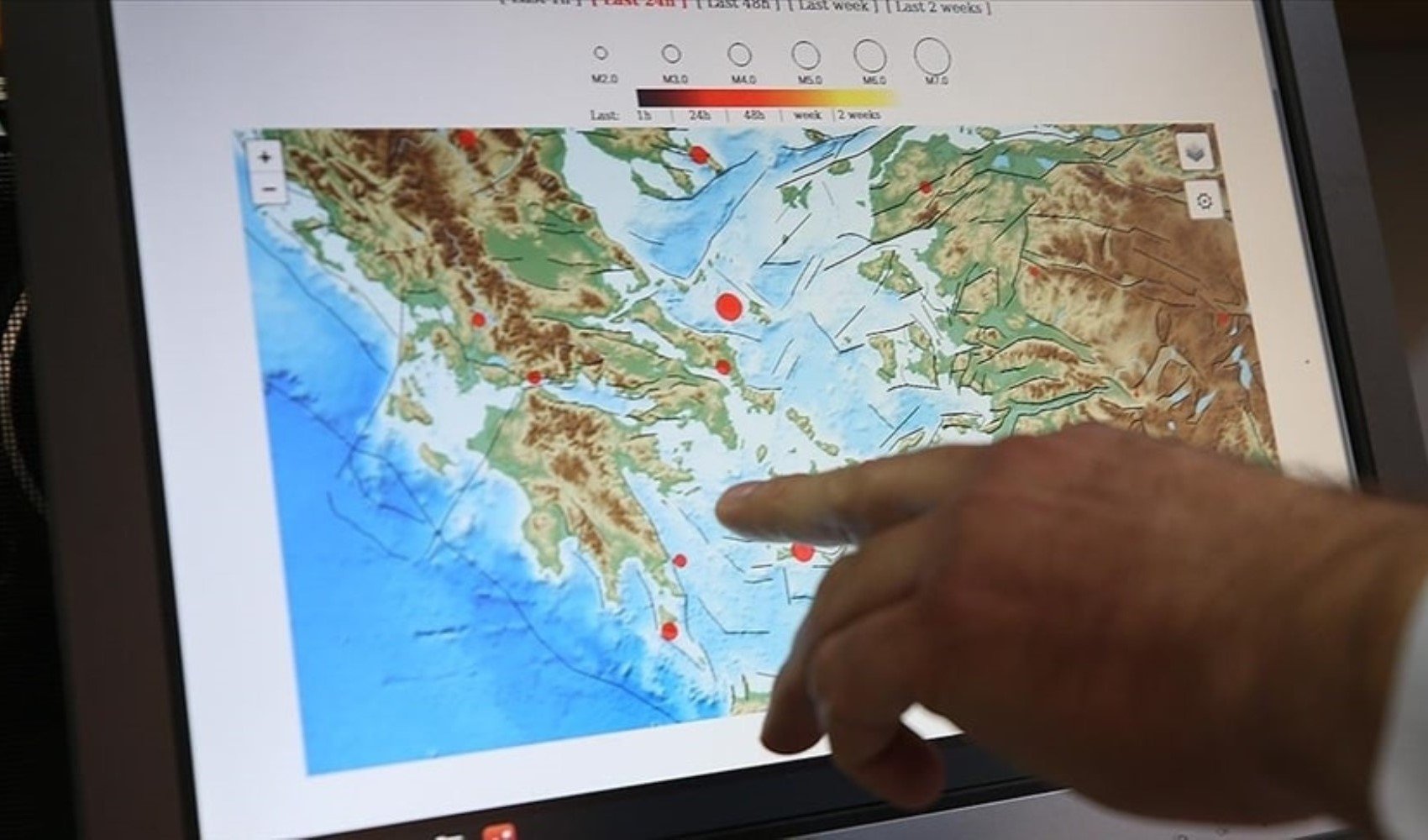
Greek authorities have installed devices in the Aegean Sea for earthquake monitoring and analysis following the recent tremors. Working with the data collected from these devices, Papazachos stated that the possibility of a major earthquake in the Cyclades region cannot yet be ruled out. Addressing the possibility of a volcanic eruption, Papazachos pointed out that there is no scientific evidence that earthquakes trigger volcanic eruptions.
Papazachos stated that the epicenter of the earthquake initially shifted from Santorini towards the northeast, towards Amorgos, but that they have begun to observe seismic activity in the Anydros region again.
Speaking to Kathimerini, Papazachos noted that seismic activity often 'walks' along a fault line, and shared the following information regarding the earthquakes in the region:
''(Seismic activity) began in the area between Kolumbo and Anhydra during the first period from January 26 to February 1, when we experienced earthquakes of magnitude 2 and 3 on the Richter scale. Since February 1, the epicenter of the earthquakes has moved further northeast. From the early hours of February 3, we entered the third phase of the earthquake swarm. We have experienced numerous earthquakes of magnitude 4 and 5 on the Richter scale.''
POSSIBILITY OF A MAJOR EARTHQUAKE
Prof. Papazachos announced that according to the latest data, a section of about 15 kilometers of the 30-kilometer fault has ruptured. However, Papazachos also pointed out that there are still parts of the fault that have not ruptured.
Regarding the possibility of the fault producing a major earthquake, the Greek expert stated the following:
''(On the fault line) There are also unruptured parts, so the possibility of a large fault segment suddenly rupturing and creating a major earthquake remains. (Regarding a major earthquake) We are talking about an earthquake of magnitude 6 on the Richter scale. Just like the earthquakes that occurred in Tirnavos, Arkalochori, and Athens in 1999.''
Papazachos emphasized that the information on whether a major earthquake will occur 'depends on details that seismology almost never possesses.'
Stating that 'even the earthquake itself does not know how big it will be when it starts,' Papazachos provided the following information:
''Imagine you are going to break a piece of wood and there is a knot in the middle of the wood that is blocking you. Whether the knot will be untied all at once or little by little depends on the details. We do not have such detailed information about the internal structure of the Earth. In seismology, we say that even the earthquake itself does not know how big it will be when it starts. Think of a zipper that starts to open but gets stuck at some point. Then the earthquake stops. And then (the zipper) opens violently, meaning a major earthquake occurs.
We have neither scientific nor historical data that an earthquake can lead to a volcanic eruption.''
More than 11 thousand people have left Santorini and the surrounding islands due to the earthquake swarm.
WHAT IS KNOWN ABOUT THE EARTHQUAKES?
Papazachos reported that the earthquake sequence had a smaller spatial extent than they initially thought.
Noting that the earthquakes that occurred in the first week spread over a wide area, Papazachos said:
''We now know more clearly that the epicenters of the earthquake are close to Anhydra, so I can say that the fault we see in Anhydra is most likely the dominant fault. But we know that there is a point that has not yet ruptured. Therefore, we cannot tell the state and the citizens to forget about a major earthquake. Without beating around the bush, we are trying to obtain quantitative data. That is why we are very careful.''
Regarding the research they are conducting in the region, Papazachos said:
''When a fault wakes up, it is often not a single fault, but a fault zone, as we call it, with many branches on the right and left. However, when all these (earthquakes) started, none of the machines we needed were in the region. Our stations were in Santorini, but since the epicenter was far from the island, we could not get a clear image. The data from the first few days were blurry and showed a distribution spread over a very large area. This led to misinterpretations regarding the extent of the fault and, consequently, the magnitude of the earthquake. We installed a machine each in Anydros, Anafi, and today in Amorgos, so we now have seismographs at the central points. Now we will learn more.''
POSSIBILITY OF VOLCANIC ERUPTION
The Greek seismologist recalled that a major earthquake occurred in the region in 1956, which lasted more than 30 seconds and did not lead to a volcanic eruption. Papazachos stated that in 1865, the earthquake that occurred in Falassarna raised the fault line by 15 meters and the island by 9 meters.
The Falassarna earthquake was magnitude 8.2 and lasted 2 minutes. Papazachos used the phrase 'it shook the Aegean Sea to its foundations' for this earthquake. On the other hand, no volcanic eruption occurred after the 8.2 magnitude earthquake.
Regarding the possibility of a volcanic eruption, Papazachos explained:
'...We have neither scientific nor historical data that an earthquake can lead to a volcanic eruption.'
The Greek expert touched upon the following details regarding the future of the earthquake swarm:
''I do not think the duration of the earthquake sequence will change. We have a future ahead of us that requires patience. Fortunately, the season in Santorini and Greece is favorable. These sequences can last a long time. If one of the sequences grows, there will also be an aftershock sequence that will gradually disappear. Its decreasing and disappearing means that the earthquakes will be less frequent, not that their magnitudes will decrease. Unfortunately, there could be a magnitude five earthquake in July.
Earthquakes do not spread energy everywhere in the same way like light bulbs. While an earthquake sends more energy to one point, it may send less energy to another. Therefore, we do not know which regions will be affected and to what extent. However, I spoke with engineers in Santorini; they say that most of the buildings are safe and well-built.''
News Source: 12punto