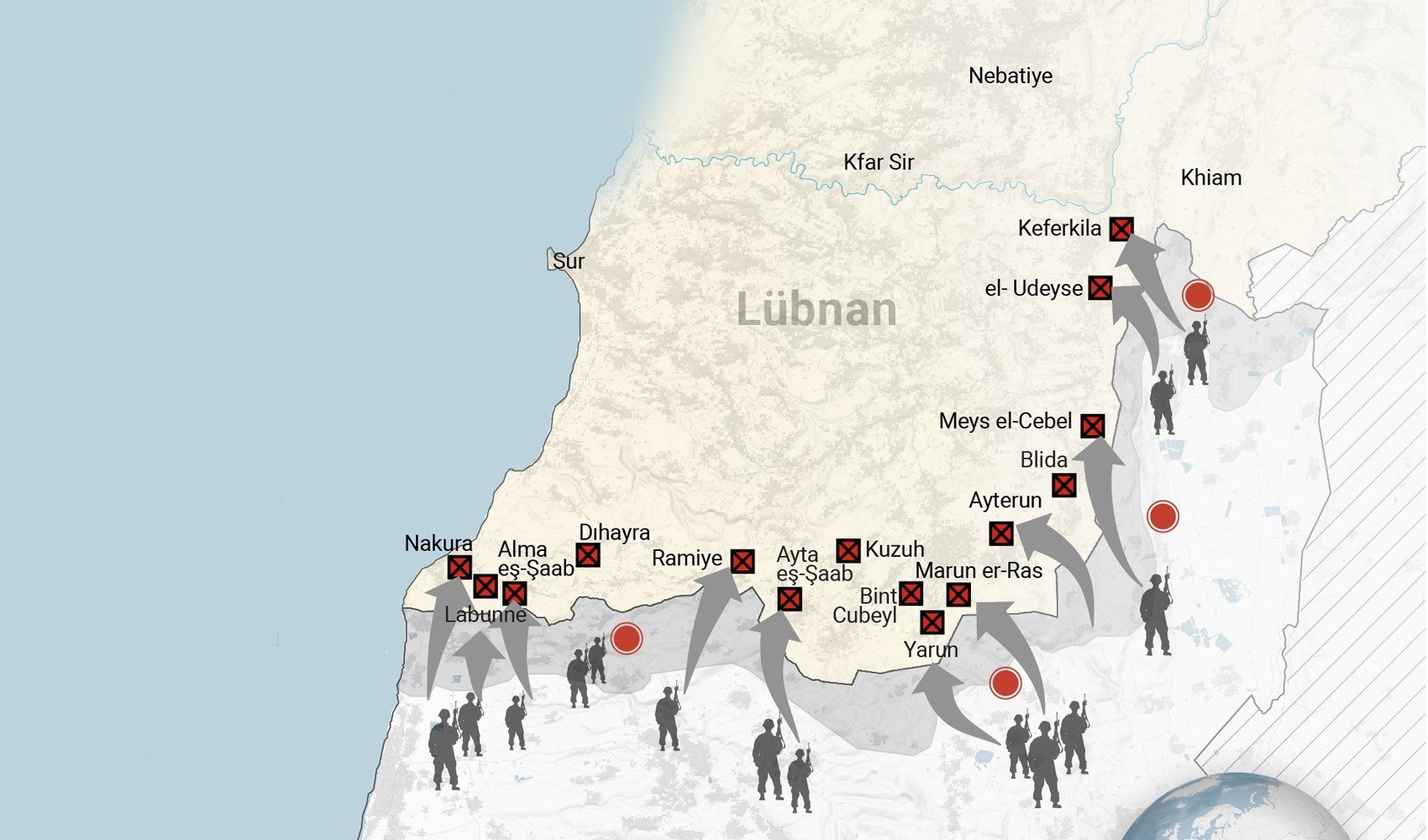
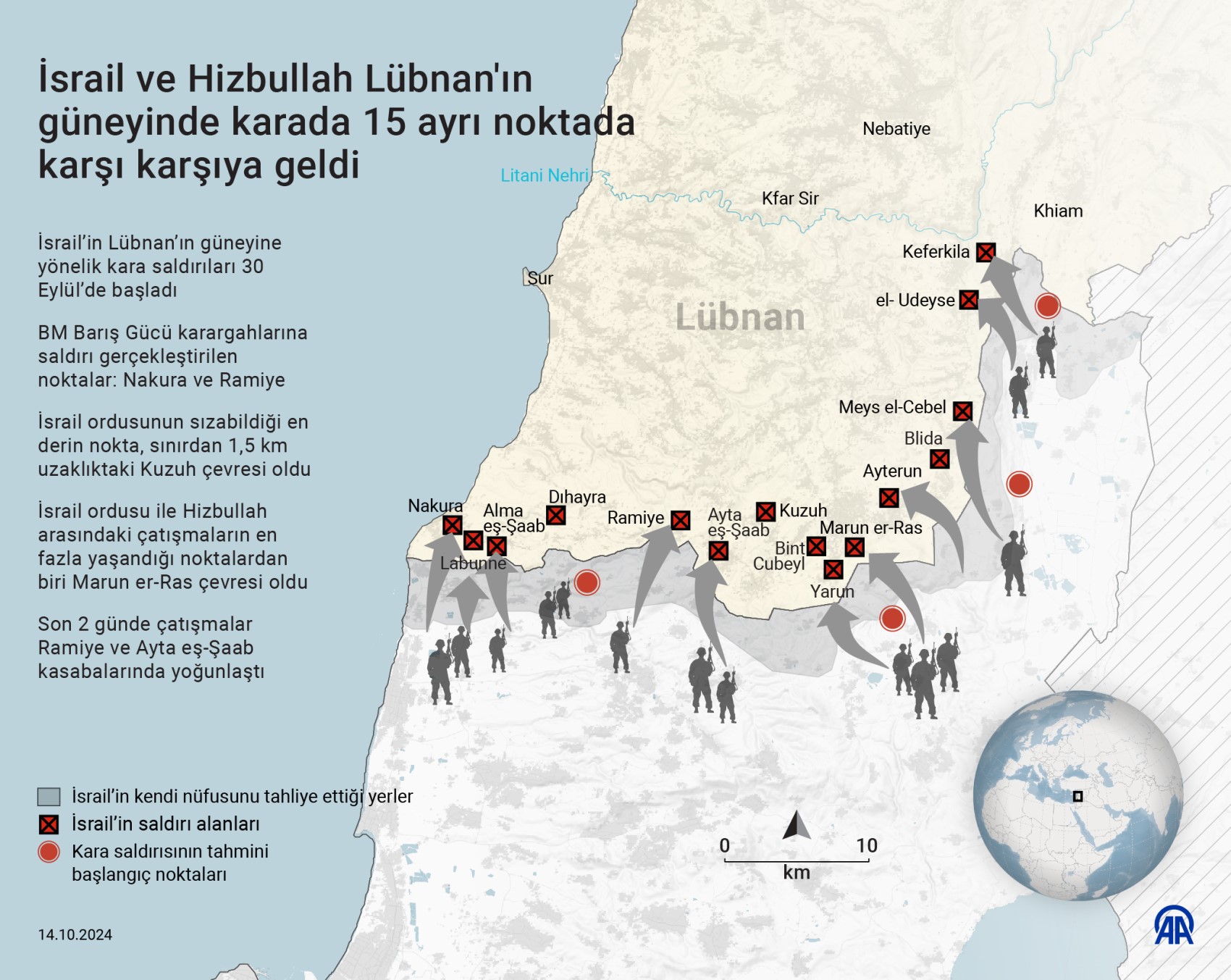
Since September 30, when Israel announced the start of its ground offensive in southern Lebanon, information regarding the areas where Israel has attempted incursions and subsequently withdrawn, as well as the regions where clashes have intensified, is as follows.
- Israel announced the start of "limited and intensive" ground raids in southern Lebanon on September 30
In a written statement issued in the late hours of September 30, Israeli Army Spokesperson Daniel Hagari stated that they had begun "limited and intensive" ground raids targeting Hezbollah infrastructure in southern Lebanon.
Following this announcement, the United Nations Interim Force in Lebanon (UNIFIL) reported that the Israeli army had notified them of its intention to enter Lebanon by land, noting that this constituted a violation of a UN Security Council (UNSC) resolution. The Israeli army released footage claiming it was related to the ground offensive, but Hezbollah denied claims that Israel had entered Lebanese territory.
- Israel declared border towns "closed military zones"
The Israeli army had declared the settlements of Metula, and the surrounding Misgav Am and Kfar Giladi on the Lebanese border, as "closed military zones." Following the start of the ground offensive, it was announced that areas including the settlements of Dovev, Tziv, and Malkia were also declared "closed military zones," and on October 7, the towns of Rosh Hanikra, Shlomi, Hanita, Adamit, and Arab al-Aramshe in the Western Galilee region were also declared "closed military zones."
- First direct ground contact occurred in al-Odaisseh
Hezbollah announced the first direct ground contact on October 2. The statement noted that an Israeli force attempting to infiltrate the town of al-Odaisseh, located in the Marjeyoun district of the Nabatieh Governorate in southern Lebanon, was forced to retreat after suffering losses during the clash.
Hezbollah Spokesperson Mohammad Afif stated, "We have killed a large number of Israeli soldiers in the clashes in the towns of al-Odaisseh and Maroun el-Ras in southern Lebanon," while Israel announced for the first time that one of its soldiers had been killed in the ground offensive against Hezbollah in Lebanon. On the same day, the Israeli army reported that 7 more soldiers, including 2 captains, had been killed and 7 others were seriously injured.
Hezbollah also claimed to have targeted Israeli soldiers attempting to infiltrate the town of Yaroun with explosives and destroyed 3 Israeli tanks advancing toward the town of Maroun el-Ras.
The Lebanese army also reported on the matter, stating that the Israeli army had entered approximately 400 meters into the country's territory from the south. The statement, which identified the towns entered by Israel as al-Odaisseh and Yaroun, noted that the Israeli soldiers withdrew shortly after entering Lebanese territory.
- Israel was able to infiltrate a maximum depth of 1.5 kilometers
Since the day the ground offensive began, the deepest point the Israeli army has been able to reach is the vicinity of Kuzuh, 1.5 kilometers from the border.
One of the locations where clashes between the Israeli army and Hezbollah have been most frequent is the vicinity of Maroun el-Ras, where the first reports of direct contact also originated. On October 8, the Israeli army planted a flag at a point on the road to Maroun el-Ras, approximately 1 kilometer from the border, which had been leveled by airstrikes, before withdrawing.
In the last 2 days, the regions where clashes have been most intense have been the towns of Ramyeh and Ayta ash-Shab.
Apart from this, the infiltrating Israeli army and Hezbollah have clashed in the areas of Bint Jbeil, Labouneh, Blida, Mays al-Jabal, Dhayra, Kfarkila, Aitaroun, Alma ash-Shab, and Naqoura. The Israeli army generally withdrew from the places it entered shortly after.
- Israel also targeted Peacekeeping force elements
As of October 10, the Israeli army also began carrying out attacks in the regions it had infiltrated against the United Nations Interim Force in Lebanon (UNIFIL) soldiers, whom it had requested to withdraw from southern Lebanon.
Israel, which first targeted UNIFIL's headquarters in Naqoura and its surroundings multiple times, struck an observation tower, causing 2 soldiers to fall and sustain injuries. Over the next 2 days, as Israeli soldiers entering the region continued their violations and attacks against the UNIFIL headquarters with Merkava tanks, 3 more Peacekeeping soldiers were injured.
On October 13, while the Israeli army raided UN forces in the town of Ramyeh, a statement from UNIFIL announced that 15 soldiers were treated for skin, stomach, and intestinal complaints due to smoke from fire opened by Israeli soldiers after they had departed.
News Source: AA