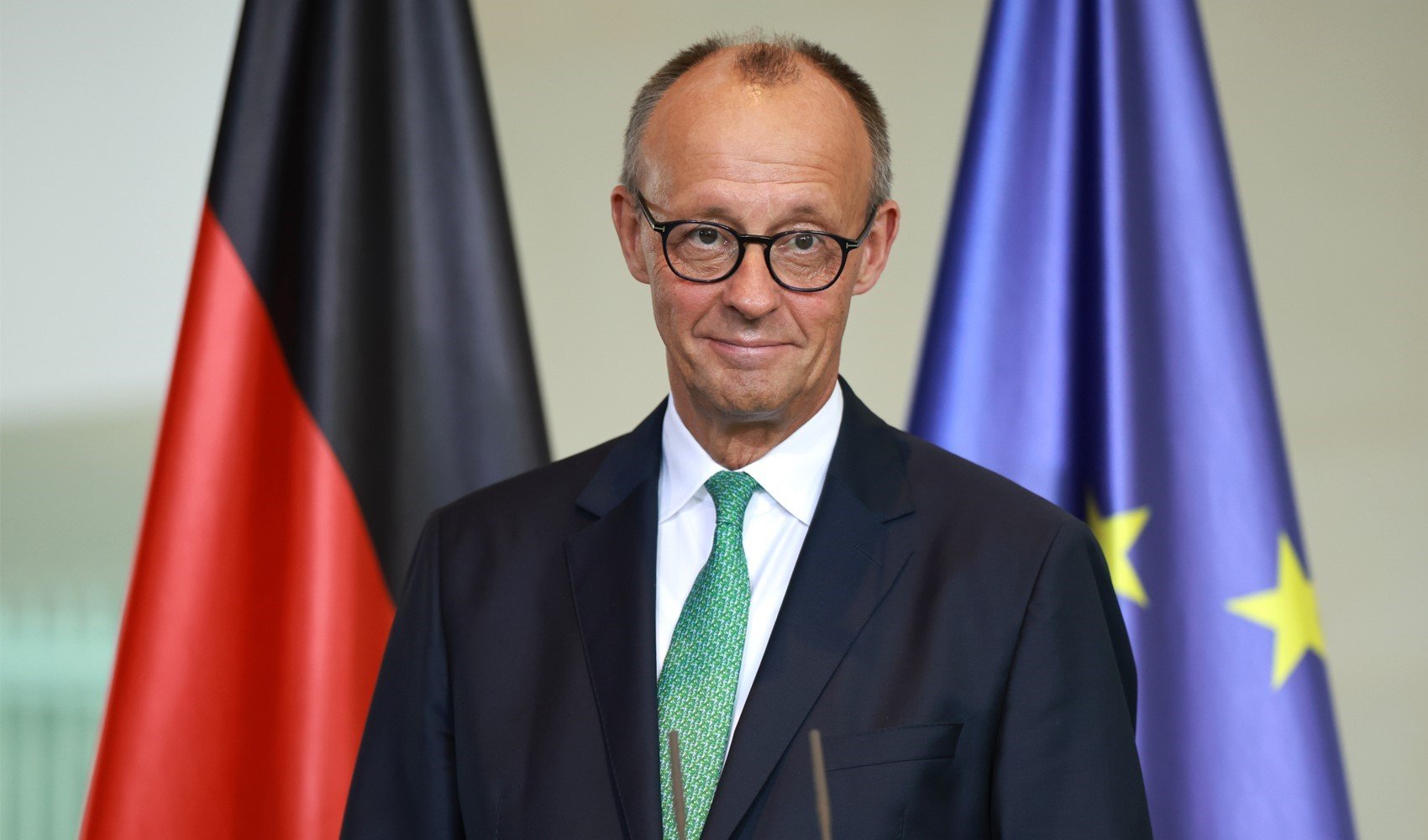
German Chancellor Friedrich Merz reacted to Russia's recent attacks on Ukraine during the Ambassadors' Conference held at the Ministry of Foreign Affairs in Berlin, sending a message that support for Ukraine will continue. Merz, the first Chancellor to speak at the opening of the Ambassadors' Conference in 25 years, recalled Russia's attacks on the European Union (EU) mission and government buildings in the Ukrainian capital, Kyiv, saying, "In recent days, crises and conflicts have been piling up. War has returned to Europe. Therefore, we are facing a very fundamental, even historic task. That is to build a new security architecture."
Pointing out that Germany is making a joint effort with its European partners, especially the UK and France, to lead Ukraine to a just peace, Merz said, "It has never been clearer that we must primarily ensure Europe's security ourselves. Everything shows that (Russian President Vladimir) Putin's imperialist plan will not end with the occupation of Ukraine; on the contrary, this is just the beginning. Every day, we are exposed to Russia's increasingly intense hybrid attacks on our infrastructure. We are watching the provocations in the North Sea and the Baltic Sea."
Merz stated, "We see that Ukraine is also defending our freedom in Europe. Our defense of Ukraine is not just political rhetoric in this respect. It is a reality that we must draw conclusions from, and have drawn, to support and help Ukraine in its struggle for peace in Europe. And this could continue for a very long time."
"WE SHOULD NOT EXPECT IT TO CONTINUE"
Touching on European security, Merz said, "NATO remains the backbone of Europe's new security architecture for us. We will work with all our might to carry this alliance into a good future. We want to continue, and will continue, the task of strengthening the European pillar of NATO in the coming years. This is a long-overdue and strategically more necessary task than ever, because we cannot and should not expect the US to continue to carry the main burden for our security in Europe. We must accept a truth in this regard. Our relations with the US are changing, and the US is also re-evaluating its interests. Therefore, we must also readjust our interests in Europe without falling into false nostalgia. The US remains our most important partner. We are seeking cooperation. We are ready for close coordination and cooperation, but it is becoming clear that this partnership will no longer be as natural as it once was. The partnership will be shaped more around issues and interests; in other words, our stance toward the US will stem from our own strength."
"WE WERE IN A KIND OF ARROGANCE"
Making assessments regarding Germany's foreign policy priorities and the new era, Merz engaged in self-criticism about his country with striking words, saying, "For a long time in Germany, we were in a kind of arrogance in our view of the world, at least an arrogance stemming from our economic power."
Merz added, "We now see it quite clearly. In Germany and Europe, in the coming years, perhaps even decades, we will face some challenges and some unacceptable situations that we do not yet know today, but as with every periodic turning point, this situation will also create opportunities. We must seize these opportunities with courage."
"GERMANY WILL DO ITS PART"
German Foreign Minister Johann Wadephul, in his speech at the Ambassadors' Conference, stated that Russia is using every excuse to continue the war it is waging with Ukraine, saying, "We are experiencing a war in Europe. Russia is attacking our security order. If we do not stop Russia, it will attack more strongly. The future of Europe will be determined in Ukraine. It will be revealed there whether borders on the European continent will be changed by force. Therefore, Germany will do its part for security guarantees for Ukraine."
Recalling Germany's candidacy for a non-permanent seat on the United Nations (UN) Security Council for the 2027-2028 term, Wadephul asked the ambassadors to work on this issue in the countries where they serve. The 'Ambassadors' Conference,' held at the German Foreign Ministry and attended by approximately 230 diplomats, will end on September 11.
News Source: İHA