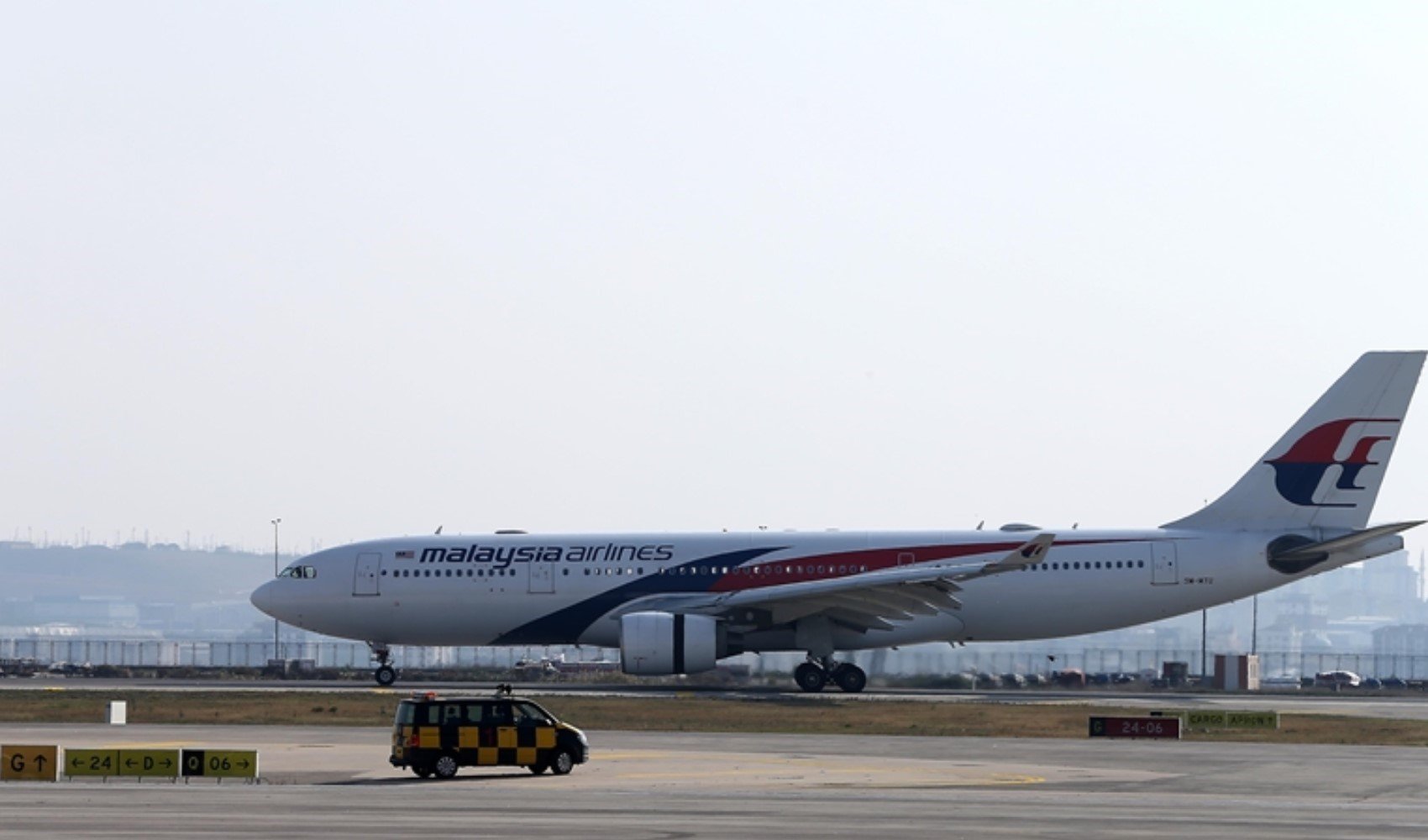
A new development has emerged regarding the Malaysia Airlines flight that crashed in 2014 and has remained missing ever since.
According to a report by the British newspaper The Telegraph, researchers from Cardiff University have discovered certain signals recorded via underwater microphones in the Indian Ocean on March 8, 2014, the day Malaysia Airlines flight MH370, which departed from Malaysia for China, went missing.
Noting that the 6-second sound recorded during the hours the plane is estimated to have crashed could help identify the location of the wreckage, the researchers stated that a 200-ton aircraft falling at 200 meters per second could generate kinetic energy equivalent to a small earthquake.
Stating that this amount of kinetic energy could be recorded by underwater microphones thousands of kilometers away, the researchers pointed to two underwater listening stations located in the region.
The researchers stated that the two stations, established as a monitoring center to oversee the United Nations' Comprehensive Nuclear-Test-Ban Treaty, are located on the British overseas territory of Diego Garcia and in the Cape Leeuwin region of Australia.
Dr. Usama Kadri from Cardiff University noted that of the two listening points the signals could reach in a few minutes, Cape Leeuwin recorded data during the specified hours, but no such recording was found at Diego Garcia.
Stating that this situation raises questions about the source of the sound, Kadri expressed that a signal exercise could be conducted in the region using explosions that would produce similar energy.
Kadri stated that if a similar signal measurement is recorded as a result of the exercise, it would pinpoint the exact location of the Malaysian plane, and if the signals are found to be unrelated, the search area and estimated time of the crash could be re-evaluated.
WE HAVE NOT FOUND A DEFINITIVE SIGNAL
Emphasizing that they are working on the use of this technology in responding to accidents occurring in the oceans, Kadri said, "Unfortunately, we have not found a signal with the precision required to launch a new search for the missing plane. However, if the recommendations are followed by the authorities, the relevance of the observed signals can be evaluated, and we could potentially shed light on the location of the missing Malaysia Airlines flight."
Kadri also recalled that an Argentine submarine was found in the past using this technology.
Malaysia Airlines flight MH370 took off from Kuala Lumpur International Airport in Malaysia on March 8, 2014, bound for Beijing, the capital of China, and the last communication with the plane was made 38 minutes after takeoff.
Radar records showed that the plane deviated from its planned route to the west and flew toward the southern Indian Ocean.
The search efforts conducted in the areas where the plane is estimated to have crashed in the southern Indian Ocean with 227 passengers and 12 crew members became the most expensive search and rescue operation in aviation history. However, no trace of the plane was found, other than some aircraft parts confirmed to belong to MH370.
News Source: AA