Arguing that China is behind the development that occurred immediately after the presidential and parliamentary elections held in Taiwan, Tien said, "This is a calculated attack on democracy and a defiance of international norms. While democratic countries around the world were congratulating Taiwan on its elections, Beijing chose to pressure Taiwan."
Tien announced that, following the decision, Taiwan will sever diplomatic relations with Nauru in accordance with the principle of reciprocity, withdraw its diplomatic and technical personnel, terminate bilateral cooperation plans, and request that Nauru close its embassy in Taiwan.
Claiming that Nauru had requested a large amount of economic aid from Taiwan before severing diplomatic ties, but that they had rejected this, Tien implied that the decision was linked to financial benefits provided by the Chinese side.
The Nauru government, in a written statement released today, announced that it had severed diplomatic relations with Taiwan and recognized the People's Republic of China as the sole legitimate representative of China.
In response to a question about the timing of the decision at a daily press conference held in Beijing, Chinese Foreign Ministry Spokesperson Mao Ning stated, "The decision is Nauru's independent choice as a sovereign country. This has shown that the 'one China' principle is the general direction of global opinion and the general trend of history."
NUMBER OF UN MEMBER COUNTRIES DROPS TO 11
As a result of Nauru severing ties, the number of United Nations (UN) member countries that continue to recognize Taiwan diplomatically has dropped to 11.
Most recently, the Central American country of Honduras announced on March 26, 2023, that it had severed diplomatic relations with Taiwan and recognized Beijing as the representative of China.
Currently, the Central American countries of Guatemala and Belize, the South American country of Paraguay, the Caribbean countries of Haiti, Saint Vincent and the Grenadines, Saint Kitts and Nevis, and Saint Lucia, the Pacific countries of Tuvalu, Palau, and the Marshall Islands, and the African country of Eswatini recognize Taiwan as the representative of China.
The Vatican, which is not a UN member, also maintains diplomatic relations with Taiwan.
CHINA, TAIWAN SEPARATION
It is noteworthy that Nauru's severing of diplomatic relations with Taiwan came after the presidential and parliamentary elections held on the island.
The presidential elections held in Taiwan on January 13 were won by the candidate of the ruling Democratic Progressive Party (DPP), incumbent Vice President Lai Ching-te.
Following the Second World War in China, the Communists, who emerged victorious in the civil war between the Chinese Nationalist Party (Kuomintang) forces led by Chiang Kai-shek and the Chinese Communist Party (CCP) forces led by Mao Zedong, declared the establishment of the People's Republic of China on October 1, 1949.
The members of the Kuomintang who lost the civil war settled in Taiwan and established a provisional government there, claiming that the "Republic of China" administration, founded in 1912, continued on the island.
Although this attempt was not accepted by China, Taiwanese representatives represented China in the UN General Assembly until 1971. After many countries shifted their diplomatic preference from the Republic of China to the People's Republic of China in the 1950s and 1960s, Taiwan's position in international organizations became uncertain when the Beijing government was accepted as the sole legitimate representative of China in a vote held at the UN General Assembly in 1971.
Emphasizing the "one China" principle, the Beijing administration opposes Taiwan establishing independent diplomatic relations with world countries and being represented in the United Nations (UN) and other international organizations, and makes it a condition that countries recognizing it sever diplomatic relations with Taiwan.
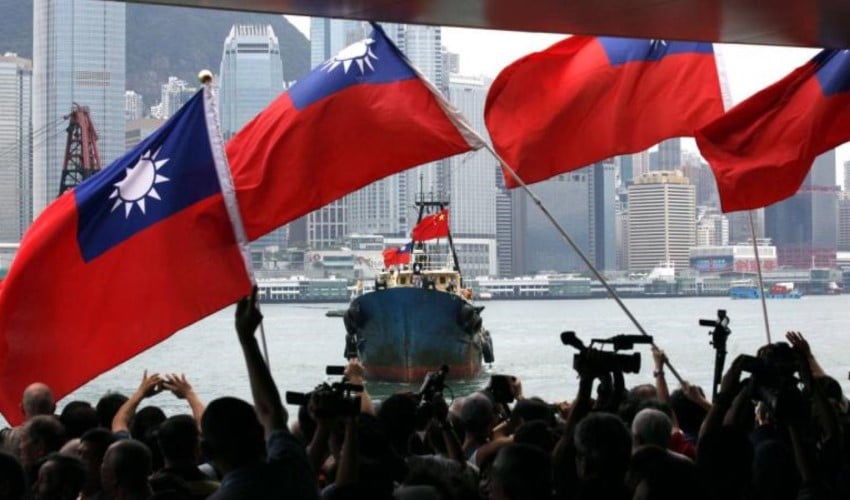
Taiwan, which China claims is part of its own territory, has had de facto independence since 1949. The separation and sovereignty dispute that emerged between mainland China and Taiwan after the civil war still continues.
News Source: AA