



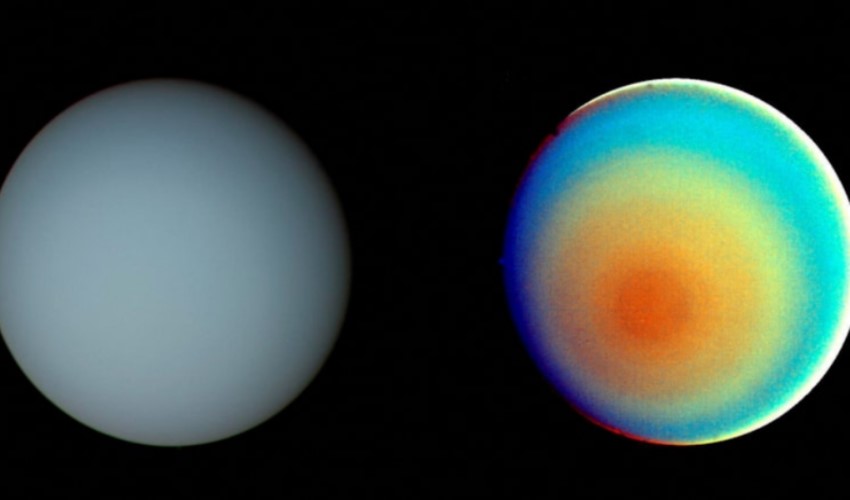
According to a BBC report, British astronomers seeking to reach the "most accurate" description of Neptune and Uranus, whose photographs do not reflect their true colors, re-examined data sets recorded by the US National Aeronautics and Space Administration (NASA) Voyager 2 probe in the 1980s.
In this context, the researchers used the Hubble Space Telescope's Space Telescope Imaging Spectrograph and the Multi Unit Spectroscopic Explorer at the European Southern Observatory's "Very Large Telescope" (VLT).
The spectrographs, which reassembled the pixels of Voyager 2—which had recorded its images in three separate colors—revealed that both planets are actually very similar shades of pale blue-green.
PHOTOS FROM THE PLANETS WERE COMBINED
The researchers stated that the scientists who first processed the images of Neptune and Uranus combined the three photos provided by the probe in a way that made the colors brighter and the contrast higher in order to highlight features of the planets' atmospheres.
Lead researcher Prof. Patrick Irwin emphasized that astronomers have long been aware that the true colors of the two planets did not match those in the photographs.
Irwin stated, "Planetary scientists of that era were aware that the colors were artificially saturated, and the photos were published with that knowledge, but over time, that distinction was lost."
The study also revealed that a thin haze layer on Neptune gives the planet's atmosphere a pale blue tint, and that Uranus appears greener during its summer and winter seasons when one of its poles is pointed toward the Sun. The research was published in the Monthly Notices of the Royal Astronomical Society.
News Source: BBC









