



Suat TEKİN - 12punto.com.tr
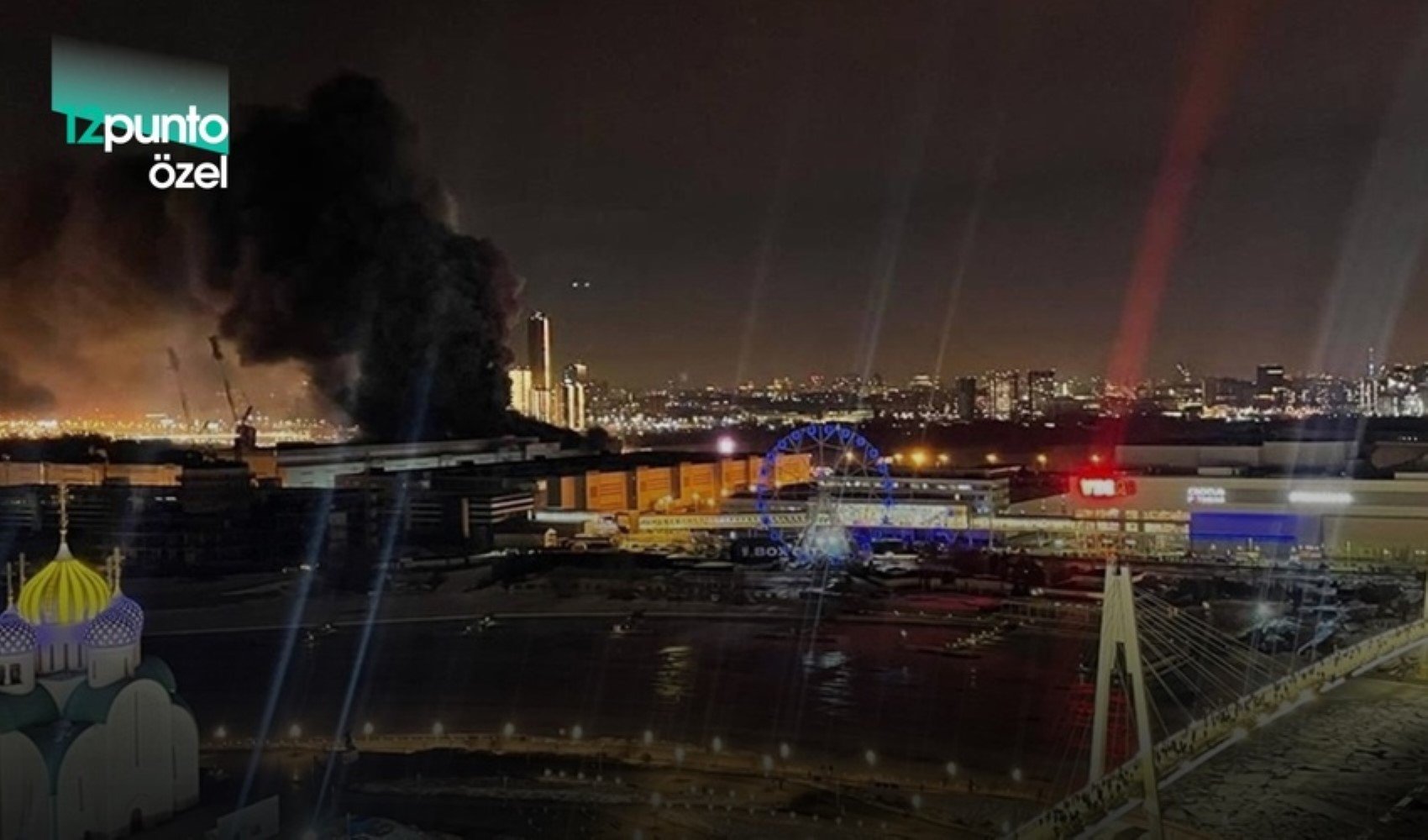
The attack on the Crocus Concert Hall in Russia has raised many questions. While it has been announced that 139 people have lost their lives in the attack so far, Russian officials have sent messages that they will 'make them pay'.
In statements made by Russia, the US, the UK, and Ukraine have been accused of being the 'power behind ISIS' so far. While the US rejected these accusations in the initial moments of the attack, it also argued that Ukraine had no role in the attack.
ISIS, which claimed responsibility for the terror attack, stated that they were targeting 'Christians'. Images of the moments of the attack were shared on ISIS's media outlets.
We discussed the possible consequences of the terror attack in Moscow, how it could affect the war in Ukraine, and what Russia's 'response' will be with CGTN Turk news coordinator Erkin Öncan and harici.com.tr editor Emre Köse.
PREPARATION PHASE OF THE ATTACK
The terrorists' attack in Moscow has resonated throughout the world. One of the most important reasons for this is the question marks regarding how the largest terrorist attack seen in the world in recent years was possible. Stating that the attack was well-planned, Köse also draws attention to the presence of jihadist groups fighting against Russia in Ukraine.
"For this, it would be useful to return to the events that developed in Afghanistan in the summer and autumn of 2021 and the looting of Almaty, Kazakhstan's largest city, in January 2022 (there was a protest movement that initially started due to the removal of LPG subsidies). At that time, Tajik political scientist Parviz Mollayanov mentioned about 8 thousand Salafi jihadist militants who went from Syria and Iraq to Afghanistan. The ISIS-Khorasan organization, which is shown as the perpetrator of the attack today, underwent a serious restructuring during the mentioned period.
In other words, there were too many jihadists to be used, and experts from the Russian Criminology Association also made an assessment saying, "During counter-terrorism operations in Syria and Afghanistan, foreign intelligence agencies, especially MI6 and CIA, had seized data on many sleeper cells, including codes and communication channels. 'Wake up' such a cell, give them a step-by-step scenario, and do it in the name of an anonymous or fake person, that's it, all your tracks disappear." These may sound very speculative, but this dimension of the incident strengthens the conviction that there is no good intention in the West directly finding and pointing out the perpetrator.
And it is obvious that this was a well-planned attack. It is no secret that the attackers fled to the Ukrainian border and that Salafi jihadist organizations also took part in sabotage attacks coming from Ukraine to Russia's border regions of Bryansk, Belgorod, and Kursk. Indeed, Abdulhakim Shishani, the head of the Ajnad al-Kavkaz organization operating in Idlib, is currently on the side of Ukraine."
Öncan emphasizes that the terrorists who were trained in Turkey acted in a 'planned' manner during the preparation phase of the attack. According to Öncan, what happened points to the fact that the attackers were professionals.
"What is known so far about the preparation phase of the attack is limited to what has been reflected in the press from the interrogations of the terrorists. Although those who carried out the attack said they did it 'for money', both the videos regarding the moment of the attack and ISIS officially claiming it show that the attack was a planned act of terror.
As for the preparation phase, the biggest claim reflected in the Russian press is that the attackers received training for two months in a camp near Istanbul, Turkey. In fact, according to some Russian journalists, the MIT (National Intelligence Organization) carried out an operation on these camps yesterday morning upon information provided by Russian intelligence. This claim has not yet been confirmed by either Turkish or Russian authorities. However, it is known from social media posts that at least one of the terrorists was in Istanbul and passed to Russia from Istanbul. In other words, it is certain that there is a Turkey connection, but the details are not yet known.
It is clear that the attackers were very planned. Because, according to the data of the Russian Investigative Committee, the terrorists entered the building at 19:58 and left at 20:11. In other words, whatever happened, it all happened in a total of 13 minutes. Using more than 500 bullets, 28 magazines, killing more than 100 people, starting a fire that resulted in the complete collapse of a part of the building, and escaping. The fact that all of this happened in 13 minutes shows that the attack was carried out by professionals who knew their job completely."
WHY DID ISIS TARGET RUSSIA?
During the 2010s, when it was active, ISIS was making a name for itself with the terrorist acts it carried out, especially in Europe. Why did the organization, which carried out its first worldwide-sounding attack after years, choose Russia as its target this time? Köse thinks that the main reason behind Russia being targeted is to ensure that the Russians hurry in the Ukraine war.
"Let's go back to the proxy war in Syria. The breaking of the 2013 Aleppo siege was a turning point, and the US had been convinced that the goal of overthrowing Bashar al-Assad was unrealistic, and after this, we witnessed the strengthening of Al-Qaeda's Syrian branch, the Nusra Front, and the organizations in its periphery. These developed step by step. Then the Army of Conquest, consisting of Salafi jihadist organizations led by Nusra, captured Idlib. Salafi jihadism functions as a kind of emergency pull for the West. When things went wrong (that is, in the undeclared NATO-Russia war in Ukraine), some of the thousands of jihadists ready to be used were selected and sent to the field. This attack was a move aimed at making Moscow, which has an overwhelming superiority on the field, falter and panic."
Erkin Öncan, in his comment on Russia being targeted, says that jihadist terrorism is Russia's 'internal affair'.
"Jihadist groups have been targeting Russia for a very long time. Russia is both a region that is home to millions of Muslim citizens within it and a country that has carried out intensive operations against jihadist terrorism in various parts of the world, especially in Syria. Today, a very significant portion of the members of radical Islamist terrorist organizations operating, especially in the Middle East, are Russian citizens. Just like from other Central Asian countries, there are many militants recruited from among Muslims in Russia and transported to the Middle East. This situation shows that a long-term conflict between Russian forces and jihadist terror is already ongoing. It is also a long-known fact that Russian intelligence closely monitors its citizens who are Russian citizens and have joined jihadist terrorism, both in the Middle East and in other countries.
Therefore, jihadist terrorism is both an 'internal affair' of Russia in a sense, the primary target in Russia's cross-border operations, and the greatest dynamic force that can be used regarding the destabilization of Russia. It usually does not come to the agenda of the world public because it does not reach success, but the majority of the operations that Russian intelligence organizes in the country are directed at radical Islamist cells."
'RUSSIA IS NOT INTERESTED IN ISIS, BUT IN ITS CLIENT'
Russia holds the US and Ukraine responsible for the attack. In his statements, Putin expressed that the powers behind the attack would be punished. Whether the US and Ukraine are really behind the attack is a question mark. However, it is certain that by holding these countries responsible so far, Russia has given clear messages that its stance in the Ukraine war could change.
Köse evaluates what could happen if Russia holds Ukraine responsible as follows:
"There is no one who denies that Salafi jihadist organizations are in Ukraine. This includes the American public broadcaster Radio Free Europe. Some time ago, they were praising the Salafis on Kiev's side under the headline 'Will ethnic minorities be liberated if Putin loses the war?'. For example, the Chechen Dzhokhar Dudayev Battalion is currently on the side of Ukraine. Even Washington directly finding the perpetrator is enough to cast suspicion on the incident. If Moscow ultimately says that the perpetrator is Ukraine, it could expand the scale of the actual war it coded as a "special military operation" and the mobilization practice."
Öncan's comment is as follows:
"The Russian state and the Russian public blame the West, especially regarding radical Islamist terror. They are not entirely wrong in pinning the bill on the US and Ukraine. Today, it is also a known fact that members of radical armed organizations are simultaneously used as mercenaries or for a specific target in exchange for money. Regarding Ukraine, it has been proven many times that militants from various radical Islamist organizations have come to Ukraine to fight against Russia.
Besides all this, even if it has nothing to do with the Ukrainian administration directly, it is very natural for the militants to choose Ukraine as an escape route because the current situation on the field has made Ukraine an important route for illegal crossings.
Russia, regardless of which organization claims the attack, sees the US as the real perpetrator. Putin also clearly stated in a statement he made on the subject that they are not interested in the organization, but in its 'client'.
Therefore, of course, domestic operations against radical Islamist terror groups will increase, but it is possible to say that the real response Russia will give will be directed at the US and that this will primarily take place in the Ukrainian field."
THE WAR IN UKRAINE MAY INTENSIFY
Russia's initial reactions following the attack show that the Crocus Hall attack will affect the Ukraine war.
Köse, who sees the possibility of the war intensifying as controversial, states that Russia is acting cautiously.
"Frankly, it can be said that Russia is acting extremely cautiously in such an environment. There was a reaction from within (from human rights ombudsman Tatyana Moskalkova) to the torture of the four militants captured after the Crocus massacre. However, while even the existence of Ukraine, where the war continues, as a state has become questionable, and the war has already been won, I am not very sure if Moscow is thinking of shifting gears up."
On the other hand, Öncan's comment on the course of the war is different. According to Öncan, the possibility of the war intensifying is not low.
"In general, I was already expecting the Ukraine conflicts, which have been continuing at a 'low gear' for a while, to intensify somewhere because there are still important problems waiting to be solved on the field. Russia has been waiting for a while, for the internal conflicts of the Ukrainian state to intensify, for the Western aid given to Ukraine to create more debate in the Western public..."
Öncan also draws attention to the possibility of the tension between the West and Russia rising.
"In my opinion, rather than cooperation, the tension will continue to increase. Because the West underlines that the attack was organized by ISIS and says it has nothing to do with Ukraine. The Russian administration, on the other hand, draws attention to the political background of the issue by emphasizing that ISIS and radical Islamist terror mostly 'attack the enemies of the US' in the world. In other words, the West is looking at the gun, while Russia is looking at the hand holding the gun. This means that, specifically for the Moscow attack, the distinction between the West and Russia regarding jihadist terrorism will continue in the coming period."
News Source: Suat Tekin









