


Ahmet Hakan was badly mistaken



Hürriyet columnist Ahmet Hakan's article titled “Bearded, robed MOSSAD agents” was decorated with detention photos of a bearded man and a woman in a headscarf, both walking with their heads bowed by the police.
Ahmet Hakan had written under the photos, “Our MIT had conducted an operation in Turkey against some types identified as working for MOSSAD. One of those operated on was a bearded, robed man.” He concluded his words with the question, “Did we understand, I wonder, that even bearded, robed people could be MOSSAD agents?”
Of course, bearded, robed, and headscarved people can also be MOSSAD agents. But the two people, the bearded man and the woman in a headscarf, whose photos Ahmet Hakan published, were not MOSSAD agents!
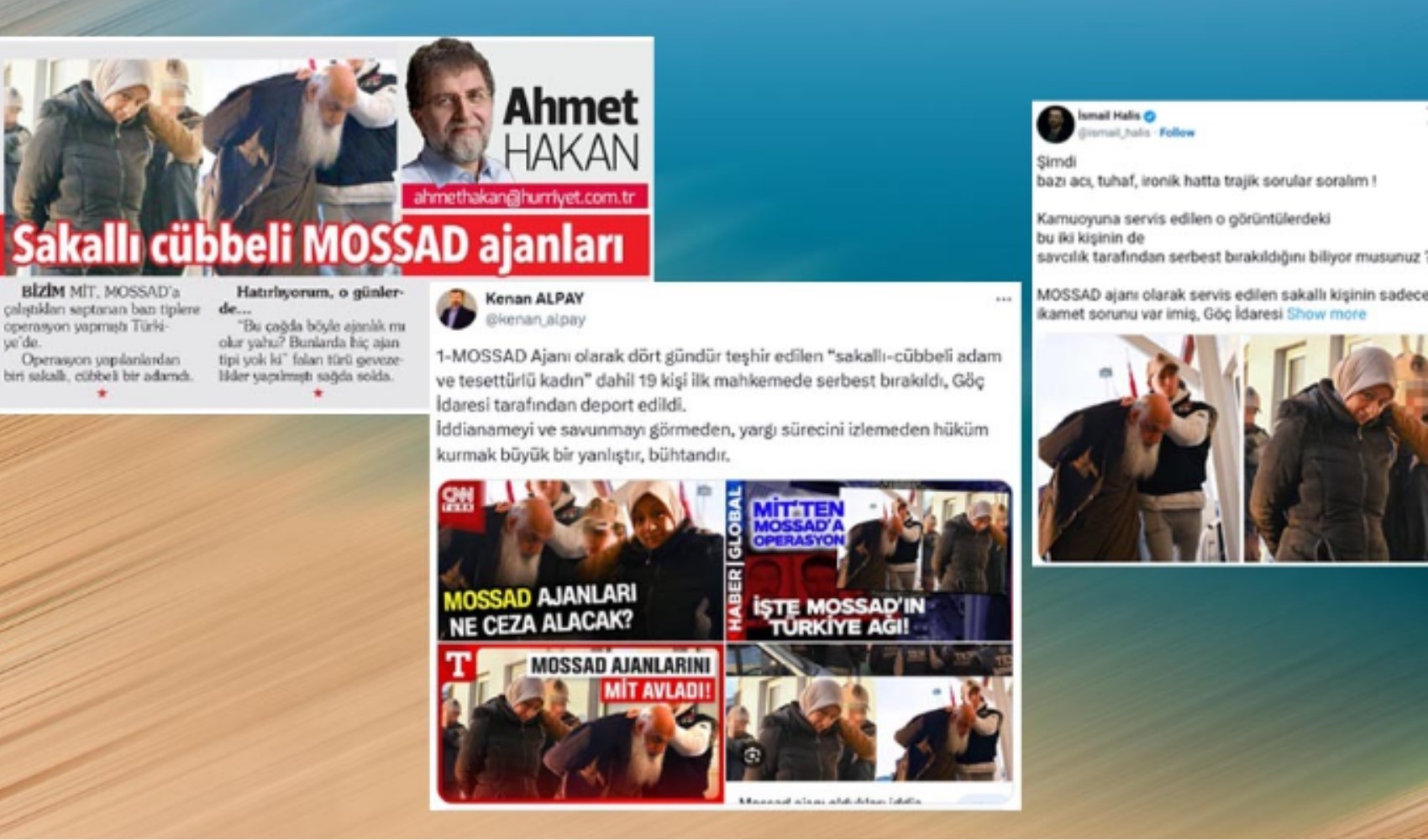
The woman in the headscarf and the robed man in the photo were later released. Unfortunately, newspapers like Hürriyet and Sabah, which reported on their detention, did not announce that they had been released. Yeni Akit newspaper columnist Kenan Alpay also complained about this at the time:
“19 people, including the ‘bearded, robed man and the veiled woman’ who had been paraded as MOSSAD agents for four days, were released at the first court hearing. They were deported by the Migration Administration. It is wrong and slanderous to pass judgment without seeing the indictment and the defense, and without following the judicial process.”
As Alpay emphasized, it was wrong to directly label these people as agents. Ahmet Hakan may not have seen or may have forgotten that these people were released. However, he should have looked at the outcome of the operation from 1.5 years ago. That is how memory sometimes deceives a person.
''YOU SHALL NOT LET DUST SETTLE ON YOURSELF''
Melih Aşık, in his article “The Milliyet Torch” written on the occasion of Milliyet's anniversary, shared an anecdote about Abdi İpekçi that Mete Akyol had told him:
“Abdi İpekçi placed the rule of ‘Primum non nocere’ (First, do no harm), which every physician learns as the A of their profession, at the foundation of the journalism profession. Secondly, I learned this rule of journalism from him: ‘You shall not let dust settle on yourself.’”
The reason Melih Aşık mentioned this anecdote, which I have summarized, was to concretize the contribution of Milliyet's legendary editor-in-chief Abdi İpekçi to the “institutionalization of journalism in Turkey” and the “Press Ethics Law” prepared in 1960.
The Press Ethics Law was the first step taken in line with “principled journalism,” reflecting the accumulation of journalism in Turkey. With this step, the “Press Council of Honor” was established, and when that proved ineffective, the law was transformed into the “Journalists' Press Ethics Rules” in 1972. And then, under the leadership of Umur Talu and with broad participation, the “Declaration of Rights and Responsibilities of Journalists in Turkey” was prepared; it was printed in thousands of copies and put into practice in 2000.
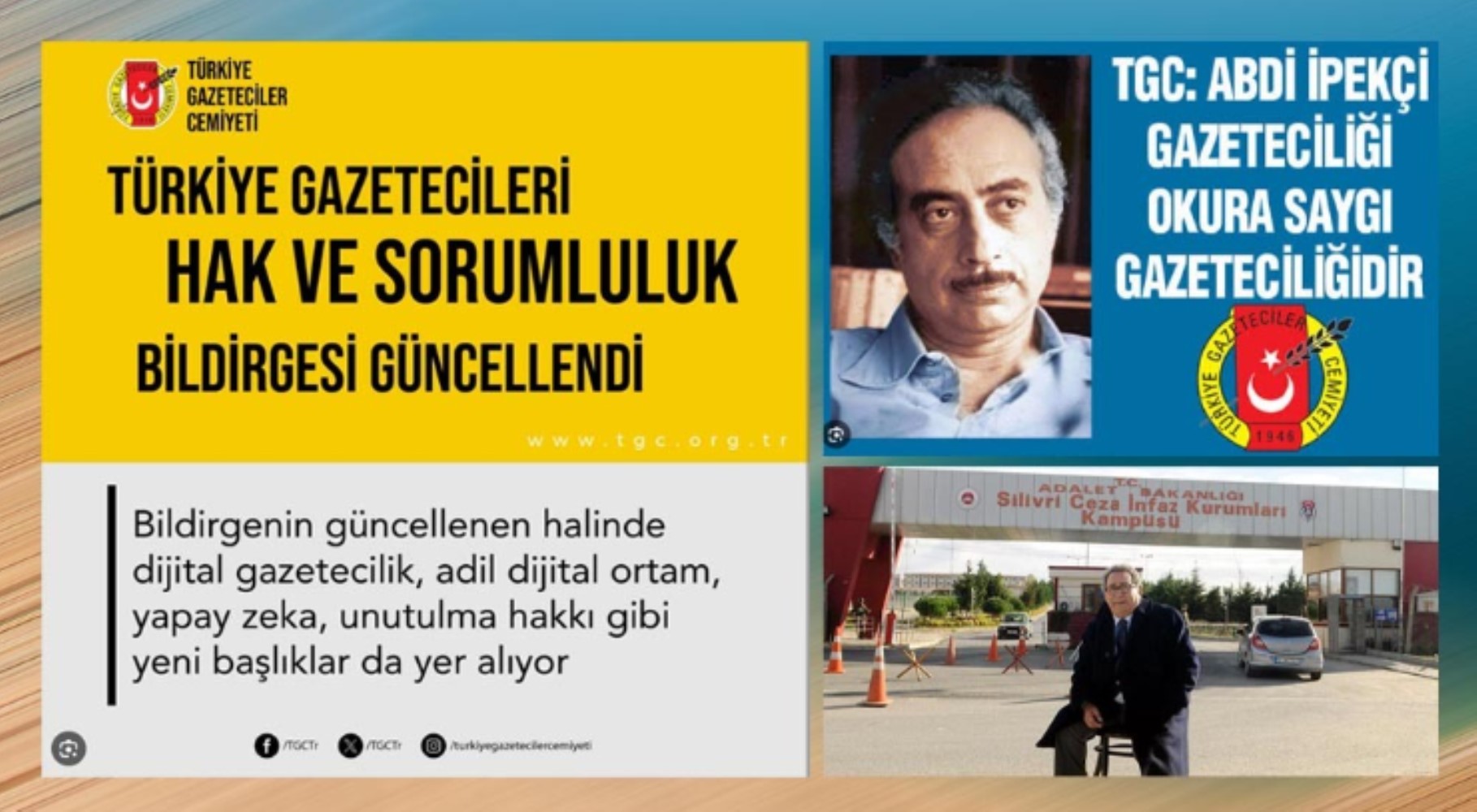
The declaration reflected the ethical accumulation of both our country's journalism and universal journalism at that time; detailed ethical principles were determined in almost every field. Although it was called a declaration, I believe this text was the CONSTITUTION of Turkish journalism.
It still is, but journalism is a dynamic profession. The necessity of updating it arose over time; in 2019, as the Turkish Journalists Association's Professional Principles Monitoring Commission, of which I was also a member, we updated the declaration.
However, the passing years caused new ethical problems, especially in digital media; some gaps emerged. Therefore, as a commission, we worked on the declaration once again. Yasemin İnceoğlu and I took on the primary responsibility for the restructuring of the declaration. We also worked in close cooperation at every stage with commission members Sibel Güneş, Belma Akçura, Ümit Aslanbay, and Tuğrul Eryılmaz to adapt the ethical principles to today's media environments. Ultimately, it is fair to say that the declaration was completely renewed. Its language was also renewed; for example, we made changes such as replacing “press” with “media.”
New solutions were brought to the ethical problems brought about by digitalization under headings such as “Fair digital environment,” “Social Media,” “Digital media,” “Right to be forgotten,” and “Artificial intelligence.” Important and current new expansions, in my opinion, such as “Transparency in media ownership and financing,” “Copyright in digital media,” and “the position of non-journalists regarding the principles” were also included in the declaration.
The Turkish Journalists Association announced the renewed version of the declaration, which was approved by all members at the General Assembly, three days ago and also posted it on its website. Now it is time for our colleagues to give the declaration the necessary importance and internalize it.
As Abdi İpekçi said, we must make the declaration our primary reference source so that we “do not let dust settle on ourselves.” Principled journalism is the only way to improve ourselves.
REGISTRATION OF RELIABILITY IN MEDIA
The international organization Reporters Without Borders (RSF) developed a project with industry experts six years ago to ensure the transparency of news media and their compliance with professional standards. The goal was to support reliable journalism against the spread of false information and the uncontrolled proliferation of artificial intelligence.
The basis of the project, called the “Journalism Trust Initiative” (JTI), is to ensure that quality journalism receives certification. Within the scope of the project, certification is given to media organizations whose journalistic practices and editorial management are confirmed by an international auditor to meet the highest professional and ethical standards.
JTI certification is based on 130 criteria that also cover transparency in the use of artificial intelligence, editorial ethics and responsibility, and the reliability of information in the digital age. This international certification is an important and prestigious tool for strengthening trust between media and audiences.
To date, more than two thousand media organizations from 119 countries have participated in the project. Most recently, last month, Latvijas Radio from Latvia became eligible to receive JTI certification. But unfortunately, although there are those who have contacted JTI, it is sad that there is no media organization from Turkey that has received the certification or even started the certification process. I hope that in the coming days, a media organization from Turkey will emerge that believes it can pass the 130 criteria, and we will be happy on behalf of our profession...
CONTENT CREATION AND JOURNALISM
TUSAŞ taking journalists as guests to the aviation fair in Paris was discussed on social media through journalists Sinan Burhan and Zafer Şahin, but journalists from Anadolu Agency, A Haber, Haber Global, and TRT Haber were also invited...
The most striking aspect of the Paris invitation was that digital content creators also used the “Grey service passport” given to public officials when going abroad. Hakkı Alkan responded to the criticisms in this direction by saying that he received a grey passport because he has a press card.
Upon this, Prof. Dr. Süleyman İrvan tagged Hakkı Alkan and Adem Metan and asked, “As far as I understand, you both went abroad with a grey passport. This means you both have a Press Card. In that case, why don't you call yourself a ‘journalist’ when introducing yourself on your X account, but instead say ‘content publisher’?”
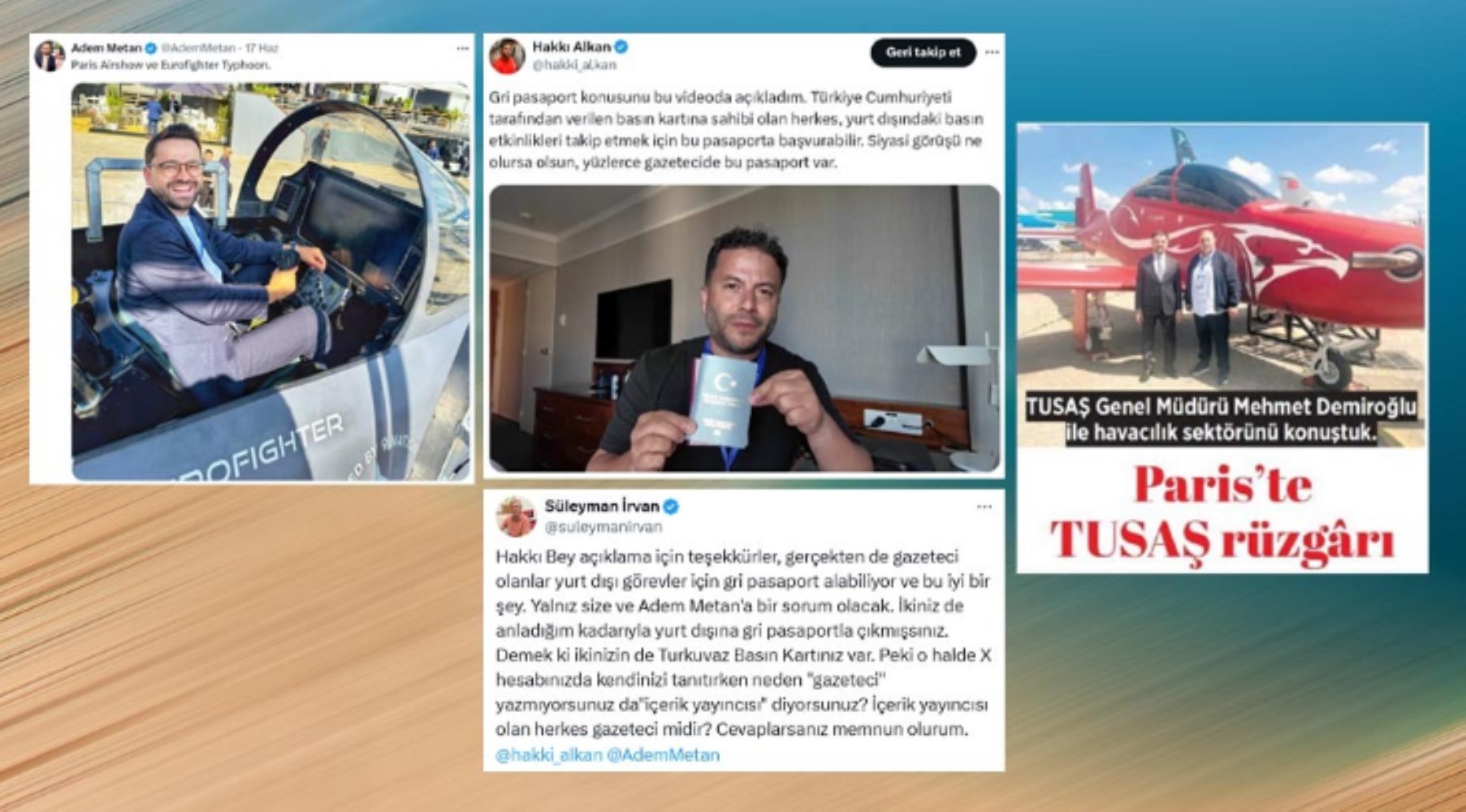
Alkan did not respond to this question, but it is understood that he became a press card holder because he worked first at a magazine and then at a news site; now he defines what he does not as journalism, but as a “content publisher.” Adem Metan, who chose to remain silent, also calls himself a “digital publisher.”
It is very clear; digital content creation, where broadcasting is sometimes done for a fee and through “collaboration,” is a different job from journalism. For this reason, it is a positive development that they distinguish themselves from journalists with these definitions. At least they do not portray themselves as journalists like some “street interviewers” who are not journalists. However, the fact that they carry a “press card,” which should be specific to journalists, is a problem that needs to be solved—and also answered by the Directorate of Communications.
The other side of the problem is that two content creators who are not journalists are seen as equivalent to journalists by an institution like TUSAŞ, and the same function is assigned to news reporting and promotional activities. This is the mistake we need to dwell on and think about.
NO ONE CALLED KAAN A ''RADIATOR''
After the agreement was signed with Indonesia for the sale of KAAN, the pro-government media found material to mock in its own way. There is no shortage of “radiator” headlines there.
Ali Saydam, who wrote “The radiator has grown wings and is flying,” described it as an “expression that will enter the history of shame of the opposition.” Türkiye newspaper ran the headline, “The news that was the subject of ridicule by the Republic is on the agenda once again! Historic success from KAAN, which they called a ‘radiator’.” The Ensonhaber site published a news story titled, “They had compared KAAN to a ‘radiator’: Cumhuriyet newspaper fell into silence.” There is no need to multiply the examples; they are all more or less like this.
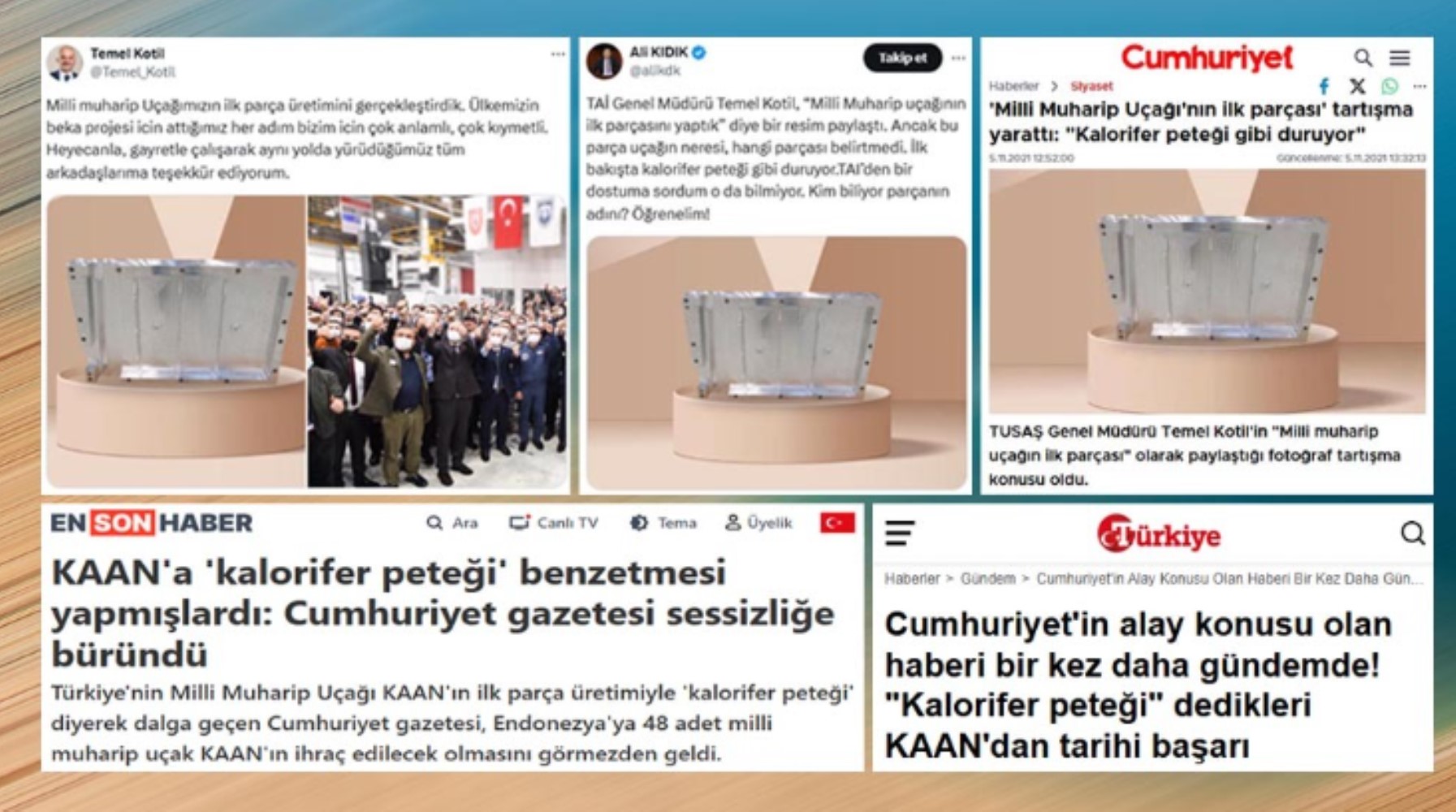
However, these headlines distort the truth. In the phrase frequently used by the pro-government media, it is a complete case of disinformation. Because Cumhuriyet newspaper did not compare the KAAN aircraft to a radiator in its 2021 news; it only compared the first part announced.
Cumhuriyet had reported on the post of İyi Party member and aviation expert Ali Kıdık with the headline, “The first part of the national combat aircraft created controversy. ‘It looks like a radiator’.” In his post, Kıdık was criticizing the statement of TAI General Manager Temel Kotil, saying, “He did not specify where this part is on the aircraft, which part it is. At first glance, it looks like a radiator.”
Kıdık's comparison might be criticized, perhaps, but there was no expression in what he wrote about belittling the aircraft. He was emphasizing the deficiency in Kotil's statement, who did not write the name of the first part.
Now, the pro-government media is distorting the subject by showing the “radiator” comparison regarding the first part, whose name and nature are unknown, as if it were made for KAAN. Although it is stated in some news stories that the comparison was for the first part, the headlines are misleading.
And in most of the news, it is not even explained who made this comparison, and this subject is turned into propaganda material against the opposition. It is being distorted in plain sight…
In a single sentence:
-In the news stories of Cumhuriyet and Hürriyet that “PFDK members' correspondence was leaked,” Türkiye newspaper columnist Tahir Kum, who uncovered the incident, was not cited as a source.
-Akşam, Hürriyet, Sabah, Yeni Şafak, and İHA supported the legal amendment that allows for the expropriation of olive groves in Muğla and the opening of a mine by uprooting them by reporting Prof. Dr. M. Taha Özkaya's words, “Olive trees can be moved.”
-In the news stories of Gazete Pencere and Yeniden Yaşam about the remains of Kurdish artist Ayşe Şan being brought from İzmir to Diyarbakır 29 years later, the reason for waiting so long was missing.
-In Türkiye newspaper's news about the balloon accident, “The pilot sacrificed himself for the passengers,” there was no information about how the pilot made a sacrifice.
-Sabah and Hürriyet ignored the protests held by workers in front of the Ministries of Finance and Labor, and by retirees in Eskişehir.
-Pro-government media newspapers such as Milliyet, Sabah, Akşam, and Yeni Şafak ignored the record-level increase in fuel prices.
-It was wrong for NOW TV to define those who went from Israel to Cyprus due to the war as “refugees”; there is no question of people fleeing their countries seeking asylum.
-The news story “Terrible mother kidnapped her daughter,” which was passed by DHA and İHA and published in dozens of places from Sabah to Posta, was based only on the words of the man making the accusation; it was one-sided.
FOR YOUR CRITICISMS, COMPLAINTS, AND SUGGESTIONS: [email protected]
Would you like to get notifications about new developments and save news?
- NotificationsNew developments and breaking news
- SaveNews is stored in the app
Most Read

Video response to Kim Jong-un claims

Murat Ağırel’s police statement has been revealed
Azerbaijan issues arrest warrants in absentia for 7 people living in Turkey

The Orionid meteor shower will be visible from Turkey!
The penalty for Ronaldo, who left the national team camp, has been announced

Fatoş Seğmen reveals the cause of her daughter's death

Latest status in the race between AKP and YENİ Party revealed

Injury shock at Liverpool: He may miss the Fenerbahçe match

Who authorized the concert held in a parking garage?

From brotherhood to a distant partnership...