


The judiciary that speaks, the media that stigmatizes



According to the government's mouthpieces, the operations to cancel the diploma of Istanbul Metropolitan Municipality (IBB) Mayor Ekrem İmamoğlu and his subsequent arrest are not political, but criminal.
Hürriyet columnist Ahmet Hakan used the phrase, “The judiciary does not explain. The judiciary does not speak. The judiciary does not defend itself.” He argued that the judiciary's silence “leads to the perception of a political operation.”
However, that was in the past; the judiciary used to not speak. Now, the judiciary speaks, accuses, and sometimes even engages in polemics. The statements by the Istanbul Chief Public Prosecutor's Office regarding the operations against İmamoğlu are proof of a “judiciary that speaks.” In these statements, İmamoğlu and the other individuals taken into custody were portrayed as if they had already been convicted of corruption and aiding a terrorist organization, violating the presumption of innocence. The seizure of İmamoğlu’s company and Murat Ongun’s assets before even the interrogation had begun was the result of the verdict being announced in advance.
Another sign of the “judiciary that speaks” was found in an article by Sabah columnist Okan Müderrisoğlu. On January 13, İmamoğlu sent a message to Chief Public Prosecutor Akın Gürlek requesting an appointment, but Gürlek did not even respond. Presumably, he did not learn that the message was sent from İmamoğlu.
One of those who argued that the operations against İmamoğlu were “not political but criminal” was Yeni Şafak columnist Ali Saydam. According to him, the incident was reduced to a political dimension because the relevant parties did not speak enough. He warns the government, saying, “The criminal dimension of the matter should have been explained, even before the crisis began.”
This thesis, defended by many pro-government journalists, does not reflect the truth. First and foremost, President Erdoğan’s iftar speeches are proof that the operation is political. The pro-government media had also started explaining the “criminal dimension” months ago, conducting a campaign to stigmatize İmamoğlu and his team as criminals. Hardly a day went by without headlines such as “The address of the embezzlement is IBB subsidiaries,” “You could only be a gang leader,” “Bales of rent network exposed,” and “Details of the İmamoğlu-DEM-Kandil agreement emerged: 100 million dollars.”
The university diploma was also part of the campaign. Led by Hürriyet columnist Nedim Şener, the pro-government media declared the verdict that İmamoğlu’s diploma was invalid through almost all channels. Indeed, they avoided portraying the diploma cancellation as a political decision. In most reports, there was not even information that the cancellation prevented İmamoğlu’s presidential candidacy.
The pro-government media made an extraordinary effort to portray the operation against İmamoğlu as “not political but criminal.” They continued the campaign with headlines such as “Criminal organization leader” (Akşam), “Eko system” (Sabah), “Billion-lira villa in exchange for tender” (Sabah), “Bribe like a banana” (Takvim), “They robbed in bales” (Akit), and “Tender to his son’s friends” (Yeni Şafak).
Moreover, the “criminalization” campaign in the media was fueled by police operation footage and confidential information from the file; the “judiciary that speaks” showed itself here as well. They produced and continue to produce one-sided reports that ignore reactions, the Saraçhane rallies where hundreds of thousands of people gathered, and the protests spreading across the country, while disregarding the responses given to the accusations.
Of course, the opposition media should also have published the allegations based on the statements of secret witnesses, the responses of the accused, and analyses in detail. It is essential that the investigation be reported in all its aspects so that the political nature of the İmamoğlu operation is sufficiently understood by society.
The fundamental principles of journalism are suspended, and the stigmatizing media is in a rush to assist the “judiciary that speaks”...
The partisanship of AA and TRT Haber
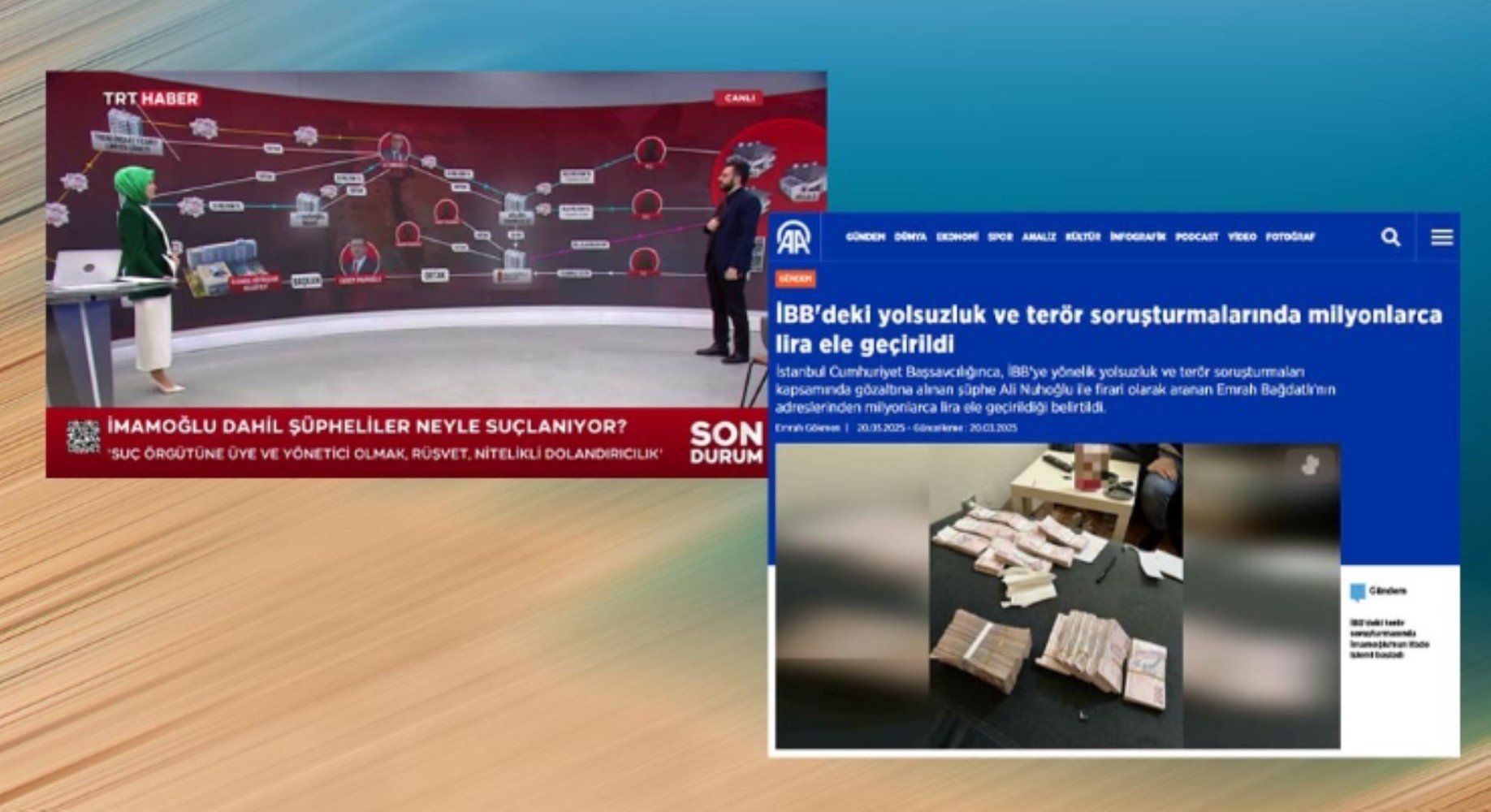
It was reflected in the pro-government media that 40 million liras were found in the home of businessman Ali Nuhoğlu and 1 million 300 thousand dollars in his workplace during the operation in Istanbul, and that “large amounts of money were seized” at the addresses of İmamoğlu’s advisor Murat Ongun and Emrah Bağdatlı. Moreover, police camera footage was added to these reports.
Anadolu Agency published the news with the headline “Millions of liras seized in corruption and terror investigation at IBB,” and TRT Haber published the image of money spread out on a table with the headline “Here is the money seized in the IBB corruption investigation.” Thus, it was presented as if all suspects had large amounts of money in their homes.
AA and TRT, which should be providing public service broadcasting, were also part of the media campaign. From the very first moment, İmamoğlu was defined as a “criminal organization leader” on TRT.
Even morning show host Anda Özmen was describing the accusations as if they were certain, like her guest Murat Yılmaz, saying, “There is a bribe requested from the mall.” Lawyer Aydoğan Ahıakın, who constantly said “İmamoğlu criminal organization” on the program hosted by Diriliş Postası columnist Betül Soysal Bozdoğan on TRT Haber, is also a member of the AKP Central Disciplinary Board. In any case, to appear on a program on TRT, one must be pro-AKP or MHP and pro-government. TRT screens are closed to the opposition.
It was A Haber, along with TRT and AA, that announced the decision to arrest İmamoğlu long before it was officially declared.
Will communism come this winter, or chaos?
During the Cold War years, the greatest propaganda weapon of those who ruled the state was the “communist bogeyman.” Former President Celal Bayar would not stop saying, “Communism will come this winter.” Later, it became a subject of ridicule, like Ahmet Özal’s words, “They killed my father.”
Nowadays, the “communist bogeyman” has been replaced by the “danger of chaos.” In every case, the possibility of chaos is immediately mentioned. The media also uses and spreads the politicians’ chaos rhetoric.
Finally, after the detention of Ekrem İmamoğlu and 87 others, Sabah published the news, “No passage for the chaos plan.” The report stated that after the operations, the Istanbul Governor’s Office banned all kinds of demonstrations in Istanbul for four days and closed some streets to traffic.
In fact, Sabah’s report was incomplete; it was not just demonstrations and streets that were banned. Access to social media was also restricted. By implementing an undeclared state of emergency, the right to information, freedom of expression, and the right to organize demonstrations were blocked; the traffic and daily life of the entire city were turned upside down.
Even after İmamoğlu’s arrest, the ban on meetings and demonstrations in Istanbul was extended; entry and exit to the city were restricted. It was announced that “individuals, groups, and vehicles likely to participate in the actions will not be allowed to enter or exit.”
After the protests spread to Istanbul and the whole country, news of chaos increased in the pro-government media. In the Türkiye newspaper’s report, “The state saw the chaos early,” the danger of chaos was presented with baseless interpretations such as “a 3 billion dollar fund was established” to create chaos!
RTÜK President Ebubekir Şahin also intervened during the hours when the court decision was awaited, threatening TV channels that broadcast the protests and the speeches of CHP members with license cancellation. Some channels, gripped by anxiety, stopped their live broadcasts. Unfortunately, the threat was effective.
Protecting democracy and freedoms is one of the fundamental duties of journalism. Defending the suspension of freedoms under the pretext of chaos does not befit journalism. Protesting this operation is as much a democratic and constitutional right as the Gaza protests in Israel and the US, which are constantly showered with praise in the pro-government media. Of course, without resorting to violence and remaining within democratic boundaries.
Ali İsmail’s killers must be happy
The house arrest of journalist İsmail Saymaz after being held in custody for three days was timed to coincide with the noise of the two major operations in which Ekrem İmamoğlu and 90 people were detained. It was clear from the seizure of his passport at the airport that a storm was coming.
During the Gezi protests, he is accused of “trying to provoke citizens against law enforcement by providing information on social media that does not reflect the truth.” The evidence for the crime consists of news, posts, and phone calls from 12 years ago... İsmail Saymaz’s response to these accusations was very clear:
“I only wrote about human rights violations during these actions, especially the murder of Ali İsmail Korkmaz. This journalistic effort of mine has been awarded by both national and international press organizations. Since no other crime could be attributed to me, they want to throw me into the Gezi Park file.”
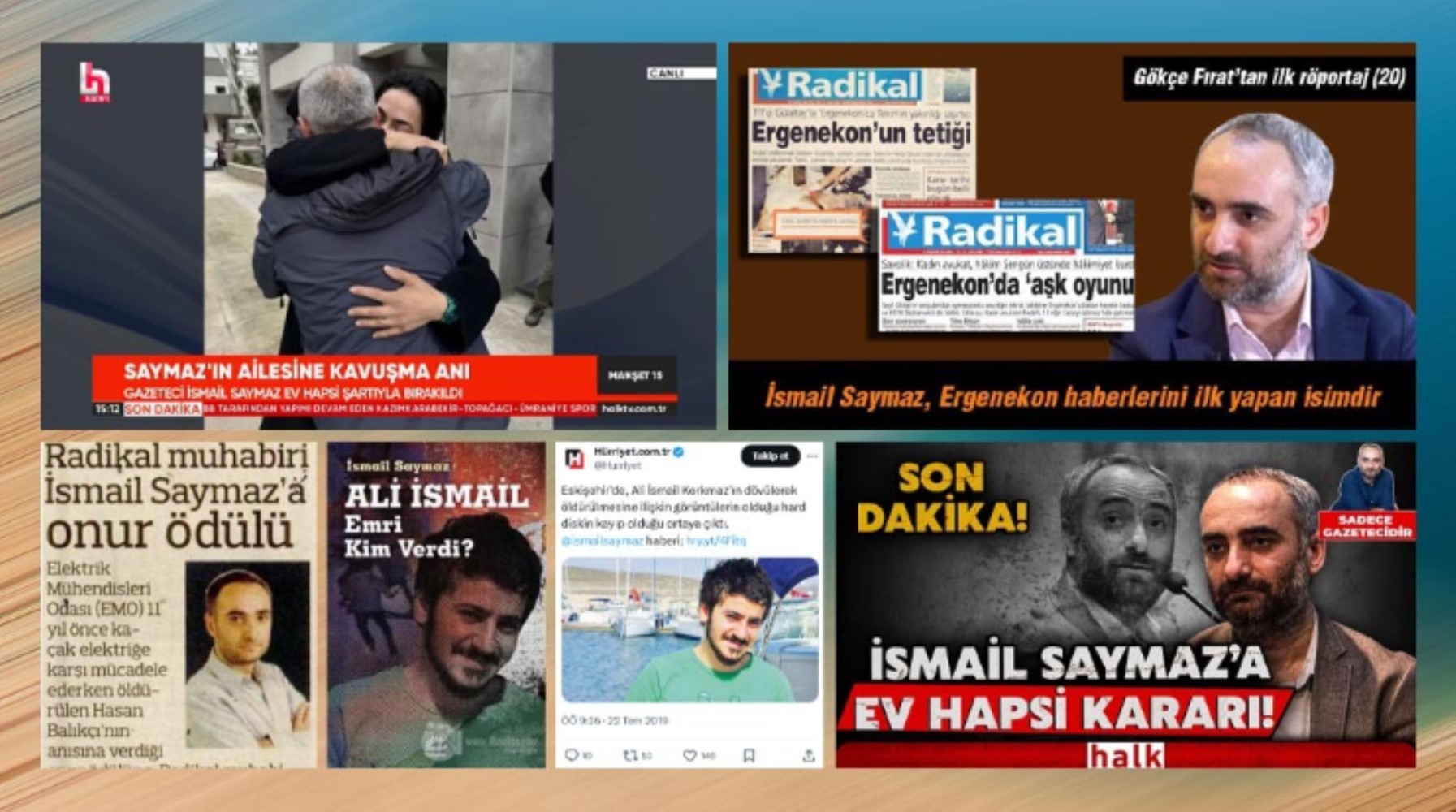
To be honest, when I think of the Gezi protests, I also think of Ali İsmail Korkmaz being beaten to death by police officers. İsmail Saymaz was a reporter for the Radikal newspaper at the time and carried out an effective journalistic activity in uncovering that heinous murder and in the trial of the police officers.
He did not take a step back in the face of the threats and insults of the then-Eskişehir Governor Güngör Azim Tuna, and he even had the governor sentenced to pay compensation. Later, he compiled the information he obtained regarding the murder in a book titled “Who Gave the Order for ALİ İSMAİL?”
If you ask Minister of Justice Yılmaz Tunç, “there is no one imprisoned for journalistic activity,” but İsmail Saymaz was subjected to an investigation solely and exclusively because of his journalistic activity. Journalism was punished, and good journalism at that.
The police officers who were the perpetrators of the Ali İsmail Korkmaz murder and that governor who tried to cover up the murder must be the ones most happy about İsmail Saymaz’s detention and house arrest.
The measure lost in praise of the trustee
A news report titled “Maydonoz Döner, for which TMSF appointed a trustee, opened 10 new branches” was published in the Akşam newspaper. The report emphasized that “Maydonoz Döner,” for which the TMSF (Savings Deposit Insurance Fund) appointed a trustee, continues to grow and contribute to the economy by opening new branches.
However, when I read this news published on March 8, I checked the archives; the Ministry of Interior conducted a “FETÖ operation” on this company on February 21, and the TMSF appointed Meryem Karaköse, Deputy Chair of the AKP Istanbul Women’s Branch and IBB Council member, as a trustee on March 4.
According to Akşam’s report, Meryem Karaköse showed great success in just four days and opened 10 new branches! If they had waited a few more days to praise her, it would have been more believable.
In a single sentence:
- Yeni Şafak’s Ersin Çelik wrote that “it was announced in the report prepared by the Center for American Progress in 2020 that Gazete Duvar, Medyascope, T24, and Bianet were funded by the US,” but in the report, T24 is listed as an “independent news organization,” not one that “receives funding from the West.”
- Sabah and Türkiye wrote, “Increased bonus stuck on CHP,” but the proposal could not be discussed in the Grand National Assembly of Turkey (TBMM) first due to the protests of CHP members, and then because AKP and MHP members did not attend.
- On the day that news of “Broad-defined unemployment (idle labor force) hit a record” was published in the opposition media, news of “Unemployment at a 12-year low” was used in the pro-government media.
- Milliyet published a mall project in İzmir Göztepe, and Akşam published the “covert advertisement” of the AKP-run Konya Metropolitan Municipality as news without adding the “This is an advertisement” warning.
- Karar quoted BirGün’s news, “Turkey is behind the world average in meat consumption,” without citing the source.
- Hürriyet did not write the name of the hotel in Alanya in its news, “142 thousand lira slap to the sexist hotel.”
- Yeni Şafak columnist İhsan Aktaş wrote the name of Nuray Babacan instead of journalist Nuray Başaran in his article “Dubious congress,” and then did not correct it.
- Akşam’s headline “Police raid on pedophile pervert” is incorrect; the correct term is “pedophile,” not “pedophilia.”
- Milliyet made a special report with the headline “Special Forces Command, known as the Maroon Berets, opened its doors to Milliyet,” but DHA and İHA were also there.
Would you like to get notifications about new developments and save news?
- NotificationsNew developments and breaking news
- SaveNews is stored in the app
Most Read

Video response to Kim Jong-un claims

Murat Ağırel’s police statement has been revealed

The Orionid meteor shower will be visible from Turkey!

Fatoş Seğmen reveals the cause of her daughter's death

Latest status in the race between AKP and YENİ Party revealed

Injury shock at Liverpool: He may miss the Fenerbahçe match

From brotherhood to a distant partnership...

Who authorized the concert held in a parking garage?

Acting mayor of Üsküdar has been determined

Good news from Izmir, may Istanbul be next