


The real target was Sümeyye Erdoğan



Yeni Şafak has once again targeted the lawyer in the case of the sexual abuse of a 6-year-old girl. Simply because the defendants are a cult sheikh, his wife, and his son-in-law, and in order to exonerate them...
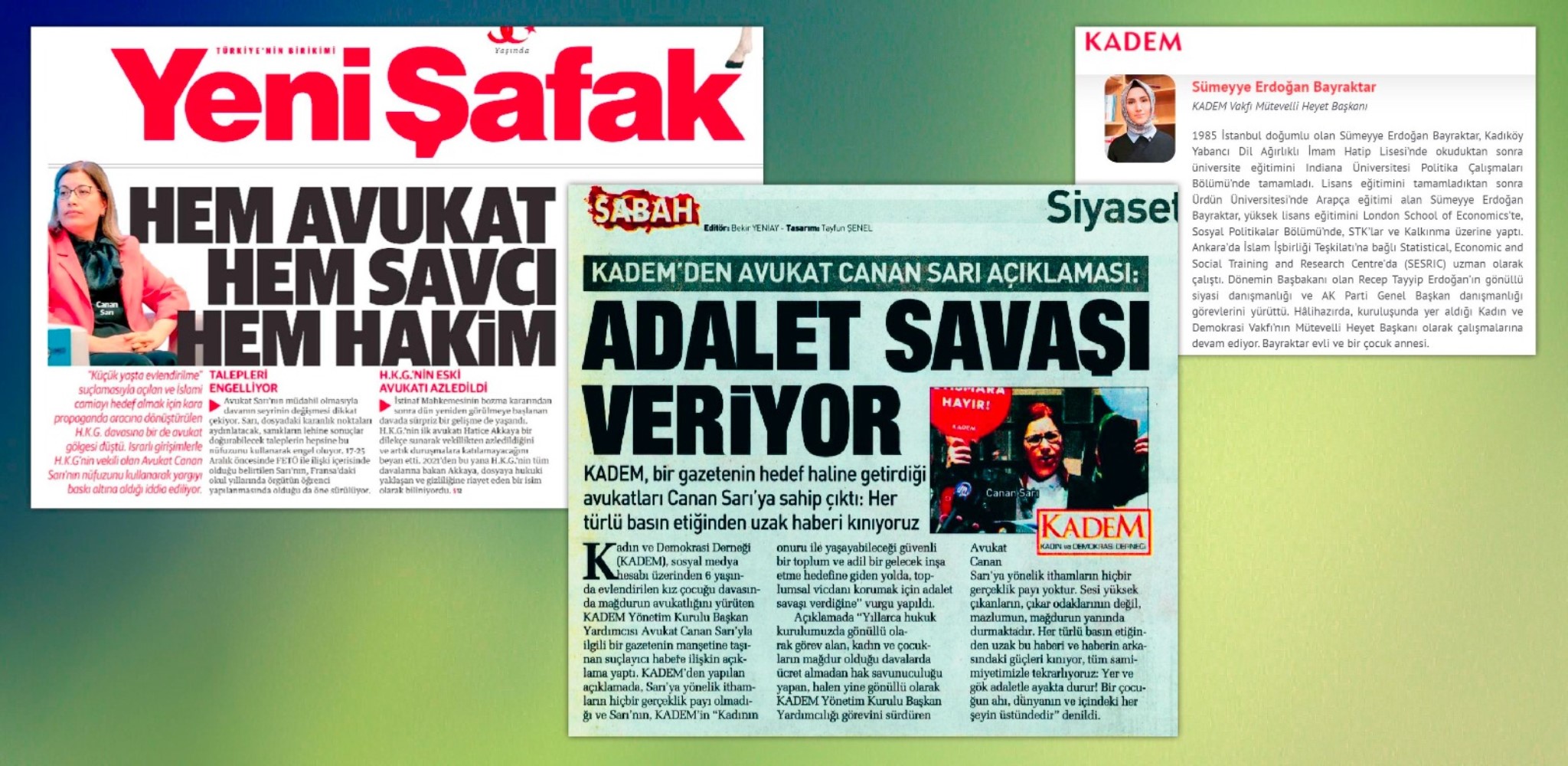
In a headline reading “Both lawyer, prosecutor, and judge,” they accused Canan Sarı, the lawyer for the H.K.G. case and Vice President of the Women’s Labor Evaluation Foundation (KADEM), of being a member of an organization and abusing her influence without relying on any concrete documents or information, stating:
“Sarı uses this influence to block all requests that would shed light on the dark points in the file and lead to results in favor of the defendants. It is also alleged that Sarı, who is stated to have had ties to FETÖ before December 17-25, was part of the organization’s student structure during her school years in France.”
Who is stating this, who is alleging it? These were not in the report. Most importantly, it was unclear why such influence was attributed to Canan Sarı.
Moreover, Yeni Şafak did not publish KADEM’s statement the following day defending Canan Sarı. Interestingly, other pro-government newspapers—Hürriyet, Haber7, Sabah, TRT Haber, Takvim, and Milliyet—used KADEM’s statement, which responded to Yeni Şafak without naming it as “a newspaper’s headline.” They even used headlines like “Statement from KADEM on lawyer Canan Sarı: She is fighting a battle for justice.” Sabah also conducted an interview with Canan Sarı and published it on its website under the headline “Throw mud, let it leave a mark.” Yeni Şafak was not named in this report either.
With this division in the pro-government media, what was meant by “influence” in Yeni Şafak’s report became clear. Because the Chair of the Board of Trustees of KADEM is President Erdoğan’s daughter, Sümeyye Erdoğan Bayraktar. It seems that Yeni Şafak had actually targeted Sümeyye Erdoğan in its report without naming her. Once Sümeyye Erdoğan was the target, other pro-government newspapers felt the need to defend her and her foundation.
The real journalistic problem in this incident is that Yeni Şafak is determined to save the defendants. Without looking at whether they are truly guilty, they argue that “the case is an area of insult to the Islamic community.”
However, they are unaware that by trying to influence the case in this way, they are the ones casting suspicion on the entire Islamic community… And they are once again trampling on journalism…
THE CRIME OF “ACTING LIKE A SPY WITHOUT BEING A SPY”
While protests against the “transparency of foreign influence” bill have been ongoing for weeks in Georgia, the “influence agent” defined in that law has also come to the agenda in Turkey. Yeni Şafak and subsequently Sabah wrote that “influence agency” would be added to the “espionage” crime in the Turkish Penal Code in the new “Judicial Package.” The goal is to impose sanctions on “influence agents who appear to be in favor of Turkey but create public opinion by engaging in propaganda against it!”
This is a dangerous initiative for opposition, critical, and independent journalism. Because until today, the pro-government media—especially Yeni Akit—has already targeted many opposition journalists, writers, and intellectuals as “influence agents.” If such a law is passed, the political power could ensure that any journalist they wish is accused of “influence agency,” a charge with an extremely vague definition. Sabah’s report titled “Influence agents in panic,” which targets journalists criticizing this regulation, is concrete proof of this.
As is known, two years ago, the AKP added to the Turkish Penal Code on the grounds of taking precautions against disinformation, creating the “crime of publicly spreading misleading information.” This regulation, which stipulates prison sentences, has already begun to be used against journalists.
The “influence agency” regulation could also be a new tool of pressure and threat over journalism, just like the “crime of publicly spreading misleading information.” A new concept like “acting like a spy without being a spy,” similar to the monstrosity of “committing a crime on behalf of an organization without being a member of the organization” in the Turkish Penal Code, could be introduced. Every article and every program against the government could be considered “propaganda against Turkey” and declared “influence agency.”
It is necessary to raise our voices now against this regulation, which will also poison the process called “softening” or “normalization.”
JOURNALISTS TRAVELING WITH SIREN-EQUIPPED VEHICLES
It turns out there are pro-government journalists who travel with siren-equipped vehicles and police escorts, and have police carry their bags. The first to write about this was Sabah columnist Melih Altınok. He asked the question, “What is a journalist traveling with a police escort, my friend?” Cem Küçük and Ersoy Dede also supported him.
Ersoy Dede said, “Journalists who shake their fingers at the ‘emergency lane bullies’ all day long do the same thing themselves when they get off the air,” but he did not disclose any names. He said, “Don’t ask me for names. They know who they are.”
Well, what if they know who they are? What matters is that we, the public, learn. If we don’t know who these journalists are who show off with state police and siren-equipped vehicles and use state resources for their personal comfort, we cannot hold them accountable.
If Melih Altınok, Cem Küçük, and Ersoy Dede truly want to prevent those who exploit the blessings of power so tactlessly and abuse journalism, they should not hide their names. Rolling the issue around with such general expressions without naming names looks more like gossip writing.
They are supposedly criticizing, but they are protecting them by not giving names.
AUTOMOTIVE WRITERS HOSTED IN CHINA
Most automotive writers dedicated their pages to the “Auto China 2024” fair in Beijing the previous week. They were describing the new car models introduced at the fair in their articles.
I was curious about the budget with which those writers went to China. As is known, media organizations don’t even send reporters to disasters or events that have “news value” in Anatolian cities, let alone a car fair in China.
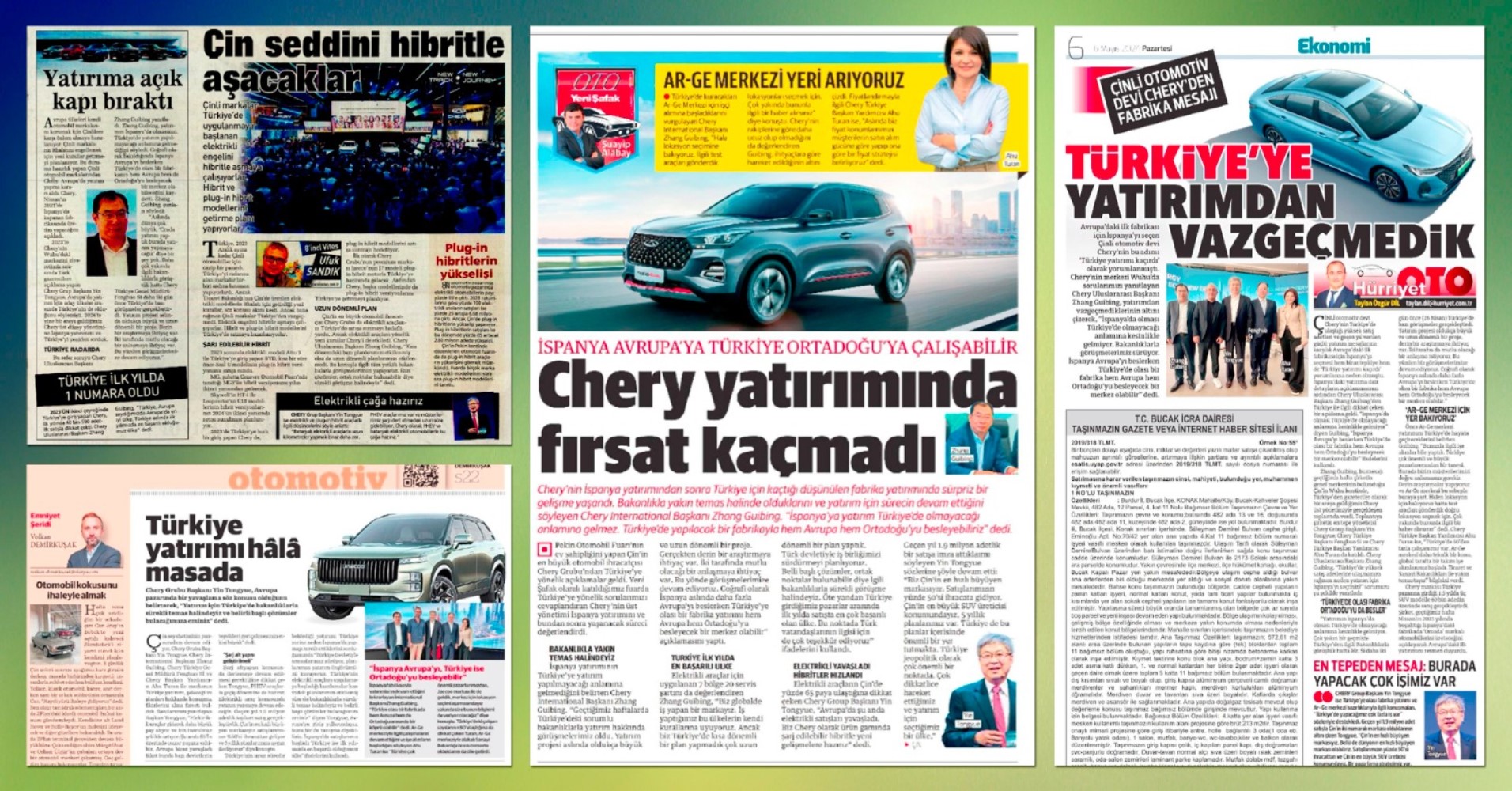
Anyway, it was possible to learn from last week’s articles which companies hosted the automotive writers in China. Statements from Chery Group President Yin Tongyue and International President Zhang Guibing appeared on the same day in Dünya, Hürriyet, Karar, Sabah, and Yeni Şafak. The automotive writers of these five newspapers had visited the company’s headquarters in Wuhu and spoken with the executives!
All five of them put the words of Chery, which is opening a factory in Spain, that it “has not given up on investment in Turkey” at the top of their stories. It is clear that they paid for being hosted in Beijing with this “PR” interview.
Geely had also invited the writers of Auto Show magazine and CNN Türk to Beijing. They also published news about this company. Such publications turn journalism into a corporate promotional activity…
“CRUMB JOURNALISTS” ON SOCIAL MEDIA
Journalist Gökhan Özbek drew my attention to the posts of Oğuz Alper Öktem, the founder of the Martı TAG company, who declared war on taxi drivers in Istanbul. Every post by Öktem is promoted as an advertisement, and some “news accounts” are publishing these advertisements as if they were news.
I checked, and he is very right. On May 1st, Öktem wrote on his X account, “I didn’t get lazy and came to Kenya. There is ride-sharing here too,” and shared footage. It is a post that is a complete advertisement.
But it has been recirculated as if it were news, without any changes, by @pusholder (2.8 million followers), @Darkwebhaber (1.5 million followers), @bosunatiklama (996 thousand followers), @bpthaber (924 thousand followers), @ZAMajans (713 thousand followers), @metropolmedya_ (443 thousand followers), and many accounts with fewer followers.
On May 6th, Öktem shared another video on his X account saying, “Even in the deserts of Egypt, the taxi problem has been solved.” In the same way, this advertisement was published as news by the same accounts without any changes, without adding any new information, and without being checked.
Sharing and publishing an advertisement as news is deceiving people. I don’t know if these accounts publish Öktem’s advertisements for a fee, but that doesn’t change the situation anyway.
Of course, how much of a journalist these sites that share advertisements as news on social media are, and whether they are doing journalism, is a subject open to debate.
But the profile of the Pusholder account includes the description “New generation digital world,” Darkweb Haber says “News portal of the digital age,” and Boşuna Tıklama says “Digital media and news”; the other mentioned accounts also define themselves with similar expressions.
Prof. Dr. Süleyman İrvan defines what these accounts do as “crumb journalism.” They claim to give “news” with a single tweet, a single sentence. However, what they provide is only a headline. Most of them use texts, images, and posts they take from here and there without their own reporters or editorial staff. Journalism is an editorial process. Therefore, I cannot see these posts within the definitions of journalism and news. When that is the case, it is not possible to evaluate them in terms of journalistic principles.
What we should really expect from them is to respect the labor of journalists and not steal their news, and not to present advertisements as news by deceiving their readers and viewers.
In a single sentence:
- Minister of Health Koca said, “Last year, 23 million people did not go to at least one of the appointments they made,” but Sabah wrote on its front page, “Last year, 81 million people did not show up for their appointments.”
- Cumhuriyet, in its report on the appointment of the nephew of Bursa’s CHP Mayor Mustafa Bozbey as “president” of a municipal company, accidentally wrote that he was appointed “as the mayor’s nephew.”
- The information that the festival was held in Datça was missing in BirGün’s report on the “Can Yücel Culture and Arts Festival’s theme ‘Migration’.”
- In Halk TV’s report on the TBMM İliç Mine Accident Investigation Commission, it was said that “the remains of two more workers” were recovered, but it should have been “corpses” or “lifeless bodies,” not “funerals.”
- It was misleading for Yeniçağ to headline its report on Mustafa Denizli signing for an extraordinary meeting of the TFF congress as “Mustafa Denizli said ‘Enough’ and signed.”
- In the reports that “the second astronaut’s flight is on June 9th,” it was stated that this journey would “not create additional costs,” but what the cost was, was not explained.
- CHP Chairman Özel did not say “I am in too,” as was used as the basis for Türkgün’s report “Accounts mixed in CHP”; on the contrary, he said he “would not impose his own candidacy.”
- Musician Kalben was branded as a drug dealer by publishing the search footage from her home, which was served by the police, but after she was released with a travel ban, the reports on some sites were not corrected; no apology was made.
FOR YOUR CRITICISMS, COMPLAINTS, AND SUGGESTIONS: [email protected]
Would you like to get notifications about new developments and save news?
- NotificationsNew developments and breaking news
- SaveNews is stored in the app
Most Read
Video response to Kim Jong-un claims

Murat Ağırel’s police statement has been revealed

The Orionid meteor shower will be visible from Turkey!

Fatoş Seğmen reveals the cause of her daughter's death

Latest status in the race between AKP and YENİ Party revealed

Injury shock at Liverpool: He may miss the Fenerbahçe match

From brotherhood to a distant partnership...

Who authorized the concert held in a parking garage?
Acting mayor of Üsküdar has been determined
Good news from Izmir, may Istanbul be next